String theory (mathematical physics)
Many questions in string theory are well-suited for BootLoops. This page gives an overview and examples are presented in three separate pages: Grassmannian string integrals, flux vacua in the string landscape, and modular graph functions.
Project pages: The Grassmannian string integral · Flux vacua · Modular graph functions
Exact questions in string theory
String theory replaces point particles with vibrating strings, and its promise is a quantum theory of gravity. It began with an exact formula: in 1968 Gabriele Veneziano proposed, for the strong interactions, the scattering amplitude
$$A(s,t)\;=\;\int_0^1 dx\; x^{-\alpha(s)-1}\,(1-x)^{-\alpha(t)-1}\;=\;\frac{\Gamma(-\alpha(s))\,\Gamma(-\alpha(t))}{\Gamma(-\alpha(s)-\alpha(t))}\,,$$where $s$ and $t$ encode the collision energy and scattering angle, $\alpha(s)$ is a linear function of $s$, and $\Gamma$ is Euler’s Gamma function. The integral runs over the position $x$ of one point on a line; it was later understood as the amplitude for four open strings to scatter, and its polesValues of the energy variable at which the amplitude becomes infinite; each one signals an exchanged particle whose mass is set by the pole’s position. give the masses of the string’s excited states. String amplitudes in general are integrals of this kind, over the positions of several points on a line or a sphere and, at the first quantum correctionThe one-loop term: the first correction beyond the classical answer in powers of the string coupling., over the shape of the torus a closed string sweeps out. When these amplitudes are expanded at low energy, the coefficients are particular constants, among them the values $\zeta(n)=\sum_{k\ge1}k^{-n}$ of Riemann’s zeta function and their nested generalizations, the multiple zeta values.
String theory also corrects Einstein’s equations by an infinite series of terms whose coefficients it fixes completely. At the first quantum correction each coefficient comes from integrating special functions called modular graph functions over the shape of the torus. For a long, thin torus these functions reduce to Laurent polynomials (polynomials that allow negative powers). Their coefficients are built from zeta values and multiple zeta values, and only a restricted class of these numbers is conjectured to appear.
The theory’s vacuum states are labeled by integers: the extra dimensions must be curled into a compact space, and fluxes, generalized magnetic fields quantized in whole units, hold its shape fixed. A consistency condition, the tadpole boundFor M-theory on a Calabi–Yau fourfold the flux charge plus the number of space-filling membranes must equal one twenty-fourth of the Euler number of the compact space, so once anti-membranes are excluded the flux charge cannot exceed that number., caps the total flux charge at a budget set by the topology. Questions about the whole set of vacua, the landscape, then become questions about integers: whether any flux within the budget fixes every shape parameter, or how small a vacuum’s charge can be.
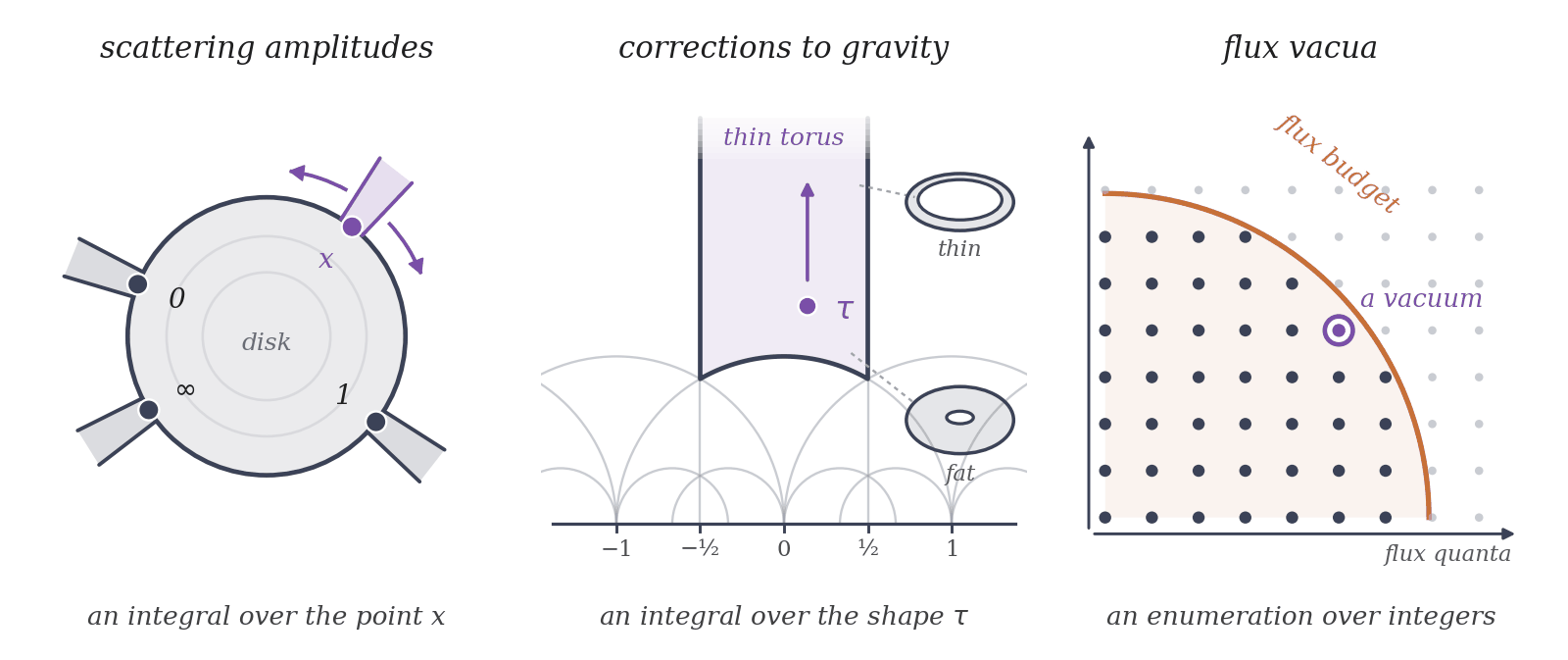
The three kinds of quantity, drawn schematically. Left, a scattering amplitude: open strings attach along the edge of a disk (the strips); three attachment points can be fixed at $0$, $1$ and $\infty$, and the amplitude is an integral over the position $x$ of the fourth (violet), as in Veneziano’s formula above. With more strings there are more points to integrate over. Middle, the first quantum correction to gravity: every shape of a torus corresponds to one point $\tau$ of the shaded strip in the upper half-plane (the region $|\mathrm{Re}\,\tau|\le\tfrac12$, $|\tau|\ge1$; the faint arcs and lines bound copies of it that describe the same shapes). The correction is an integral over that strip, and the thin-torus limit, where modular graph functions reduce to Laurent polynomials, lies far up it. Right, flux vacua: each flux is a point with integer coordinates and the tadpole bound (orange arc) caps its charge. The question is whether any flux within the budget fixes every shape parameter; the violet ring marks one that does. The real lattice of fluxes has many more than two directions and, unlike the drawing, infinitely many points within the budget, which are reduced to finitely many cases and checked one by one in exact arithmetic. (Illustration drawn for this site; not a figure of the papers.)
In each of the three settings the quantity of interest has a definite value (a closed form or a whole number), but much of what was known about such quantities came from numerical searches, from special families of examples, and from conjectures. A floating-point search cannot prove that the smallest flux charge it finds is the true minimum, and a family of modular graph functions that happens to contain only odd zeta values is no test of a conjecture about which other numbers can appear. The three projects on this page use exact methods instead: the enumeration of fluxes is proved complete, floating-point values are replaced by closed forms or by intervals guaranteed to contain the true value, and the conjectures are checked directly on a finite family of functions.
The three projects
The Grassmannian string integral. In 2019 Arkani-Hamed, He and Lam wrote down a family of generalizations of the Veneziano integral; the member called $K(3,6)$ is an integral over six points in the projective plane, and no known string theory produces it. The question is which properties of string amplitudes survive in it. $K(3,6)$ provably still factorizes at every pole as a string amplitude does, even though cluster decompositionThe principle that experiments far apart do not influence each other; in field theory, together with unitarity, it forces the residue at a pole to split into a product of two smaller amplitudes. cannot be formulated for it. Numerically, the Kawai–Lewellen–Tye double copyRelations that express closed-string amplitudes as sums of products of pairs of open-string amplitudes. also holds, and, granted results of Brown and Panzer, the low-energy coefficients are proved to be multiple zeta values to all orders.
Exact methods for flux vacua. The starting question is whether any flux within the budget, 24 units for the compact space K3×K3, can fix every shape parameter; the numerical searches of Bena, Blåbäck, Graña and Lüst had found none. A theorem, under stated hypotheses, says that within the budget no flux supported on a lattice of rank at most threeRoughly, a flux built from at most three independent directions in the lattice of allowed fluxes on each K3 factor; this sublattice is called the support of the flux. can do so, and an explicit flux of higher rank and charge 22, inside the budget, fixes every shape parameter. For the benchmark Kachru–Kallosh–Linde–Trivedi vacuum the defining critical point is proved to exist, and the superpotentialA function $W$ of the shape parameters, determined by the fluxes; the vacua are its critical points, and $W_0$ denotes its value at the vacuum. there is computed with a proven error bound.
Modular graph functions and depth-three zeta values. Zerbini conjectured that the thin-torus coefficients of modular graph functions belong to a restricted class, Brown’s single-valued multiple zeta valuesA subclass defined by Brown via a map sending even zeta values to zero and doubling odd ones; tree-level closed-string amplitudes involve only these., and the coefficients are also expected to map into one another under a symmetry called the cosmic Galois group. The complete families computed previously contain only odd zeta values, for which both properties hold automatically. Here the thin-torus Laurent coefficients of a complete family of forty-nine such functions are computed in closed form, and multiple zeta values of depth three (triple nested sums) appear among them. These depth-three values are provably confined to one coefficient per function, and at each weight there are exactly as many independent ones as the Broadhurst–Kreimer conjecture allows. Under the Galois group the depth-three values map back into the family, and every coefficient in the family is single-valued.
The papers
- Factorization without clustering and the six-point Grassmannian string integral (PDF) — Matthew D. Schwartz. A preliminary version of the paper.
- Exact methods for string flux vacua (PDF) — Matthew D. Schwartz. A preliminary version of the paper.
- Irreducible multiple zeta values of depth three in four-edge modular graph functions (PDF) — Matthew D. Schwartz. A preliminary version of the paper.
Supplementary material
- Supplementary material for the first paper (PDF) — the full account of the numerical computations that its Appendix B summarizes: the kinematic points used, the conventions and values of each numerical check, and the inputs and outputs of the integer-relation searches (Sections S1–S8).
- Supplementary material for the second paper (PDF) — Sections S1–S7: the proofs of the existence and isolation criteria, the enumeration of vacua in ten flux sectors, notes on the KKLT constructions with the numerical data for the benchmark computation, the tests of the implementation, and the lattice, charge-22 and Hulek–Verrill data in full.
Code and data for each project are linked from its own page: the Grassmannian string integral, flux vacua and modular graph functions.
References
| G. Veneziano, Construction of a crossing-symmetric, Regge-behaved amplitude for linearly rising trajectories, Nuovo Cim. A 57 (1968) 190 | the four-point amplitude of 1968 with which string theory began |
| H. Kawai, D. C. Lewellen and S. H. H. Tye, A relation between tree amplitudes of closed and open strings, Nucl. Phys. B 269 (1986) 1 | closed-string amplitudes as sums of products of open-string amplitudes, the double copy |
| F. Cachazo, N. Early, A. Guevara and S. Mizera, Scattering equations: from projective spaces to tropical Grassmannians, JHEP 06 (2019) 039 | generalized the scattering equations and their kinematic invariants from points on a line to points in higher-dimensional projective spaces |
| N. Arkani-Hamed, S. He and T. Lam, Stringy canonical forms, JHEP 02 (2021) 069 | wrote down the Grassmannian string integrals $K(k,n)$, the family containing $K(3,6)$ |
| I. Bena, J. Blåbäck, M. Graña and S. Lüst, The tadpole problem, JHEP 11 (2021) 223 | the numerical searches on K3×K3 that found no fully stabilizing flux within the budget |
| S. Kachru, R. Kallosh, A. Linde and S. P. Trivedi, De Sitter vacua in string theory, Phys. Rev. D 68 (2003) 046005 | the Kachru–Kallosh–Linde–Trivedi (KKLT) scenario to which the benchmark vacuum belongs |
| M. Demirtas, M. Kim, L. McAllister and J. Moritz, Vacua with small flux superpotential, Phys. Rev. Lett. 124 (2020) 211603 | constructed the benchmark vacuum whose $|W_0|$ the second paper computes with a proven error bound |
| K. Hulek and H. Verrill, On modularity of rigid and nonrigid Calabi-Yau varieties associated to the root lattice $A_4$, Nagoya Math. J. 179 (2005) 103 | origin of the fourfold family whose symmetric sector the second paper searches |
| E. D’Hoker, M.B. Green, Ö. Gürdoğan and P. Vanhove, Modular Graph Functions, Commun. Num. Theor. Phys. 11 (2017) 165 | defined and named modular graph functions |
| F. Zerbini, Single-valued multiple zeta values in genus 1 superstring amplitudes, Commun. Num. Theor. Phys. 10 (2016) 703 | conjectured that every Laurent coefficient is a single-valued multiple zeta value |
| F. Brown, Single-valued motivic periods and multiple zeta values, Forum Math. Sigma 2 (2014) e25 | defined single-valued multiple zeta values |
| F. Brown, Feynman amplitudes, coaction principle, and cosmic Galois group, Commun. Num. Theor. Phys. 11 (2017) 453 | the expectation that the constants of a physical theory map into one another under the cosmic Galois group |
| D.J. Broadhurst and D. Kreimer, Association of multiple zeta values with positive knots via Feynman diagrams up to 9 loops, Phys. Lett. B 393 (1997) 403 | the conjectured count of independent multiple zeta values at each weight and depth |