Modular graph functions (string theory)
In string theory the one-loop corrections to Einstein’s equations are integrals over the shape of a torus, with integrands built from modular graph functions, one for each Feynman graph drawn on the torus. On a long, thin torus each function reduces to a finite sum of powers of its length whose coefficients are zeta values and multiple zeta values, and these expansions are computed here exactly, with the BootLoops toolkit, for all forty-nine two-vertex, four-propagator graphs of weights seven through twelve. The irreducible multiple zeta values turn up in only one coefficient of each function, their number at each weight matches the Broadhurst–Kreimer prediction, and every coefficient is single-valued, as Zerbini conjectured.
Gravity's corrections at one loop
String theory is a proposal for quantum gravity, and its concrete predictions are corrections to Einstein's equations: an infinite series of terms with more and more derivatives of the curvature, each multiplied by a number the theory fixes. The terms are organized by powers of $\alpha'$, the square of the string length, and by the number of loops, which for a string counts the handles on the surface it sweeps out in spacetime, its worldsheetThe two-dimensional surface a moving string traces out in spacetime, the analog of the line traced by a moving particle.. At one loop that surface is a torus, and each coefficient is an integral over all shapes of the torus.
The shape of a torus is fixed by one complex number $\tau$: glue together opposite sides of the parallelogram with sides $1$ and $\tau$ in the complex plane. In 2015 D'Hoker, Green, Gürdoğan and Vanhove organized the one-loop four-graviton integrand into what they named modular graph functions, one for each Feynman graph of a scalar field on the torus. The simplest class has two vertices joined by $\ell$ edges, with a positive integer exponent $a_r$ on each edge:
$$C_{a_1,\dots,a_\ell}(\tau) \;=\!\!\sum_{\substack{p_1,\dots,p_\ell\in\Lambda\setminus\{0\}\\ p_1+\cdots+p_\ell=0}} \;\prod_{r=1}^{\ell} \frac{(\operatorname{Im}\tau/\pi)^{a_r}}{|p_r|^{2a_r}}\,, \qquad \Lambda=\mathbb Z\tau+\mathbb Z\,.$$Here $\Lambda$ is the lattice of points $m\tau+n$ with integer $m$ and $n$, the allowed momenta on a torus. Each edge $r$ carries a nonzero momentum $p_r$, momentum is conserved at the two vertices, and $1/|p_r|^2$ is the scalar propagatorThe factor a Feynman graph carries for each edge: the amplitude for a disturbance of the field to travel from one vertex to the other., raised to the power $a_r$. The sum of the exponents, $w=a_1+\cdots+a_\ell$, is called the weight. The function is “modular” because it takes the same value at every $\tau$ that describes the same torus, such as $\tau+1$ and $-1/\tau$. Integrated over torus shapes, a weight-$w$ function contributes to the one-loop term with $2w$ derivatives acting on four powers of the curvature.
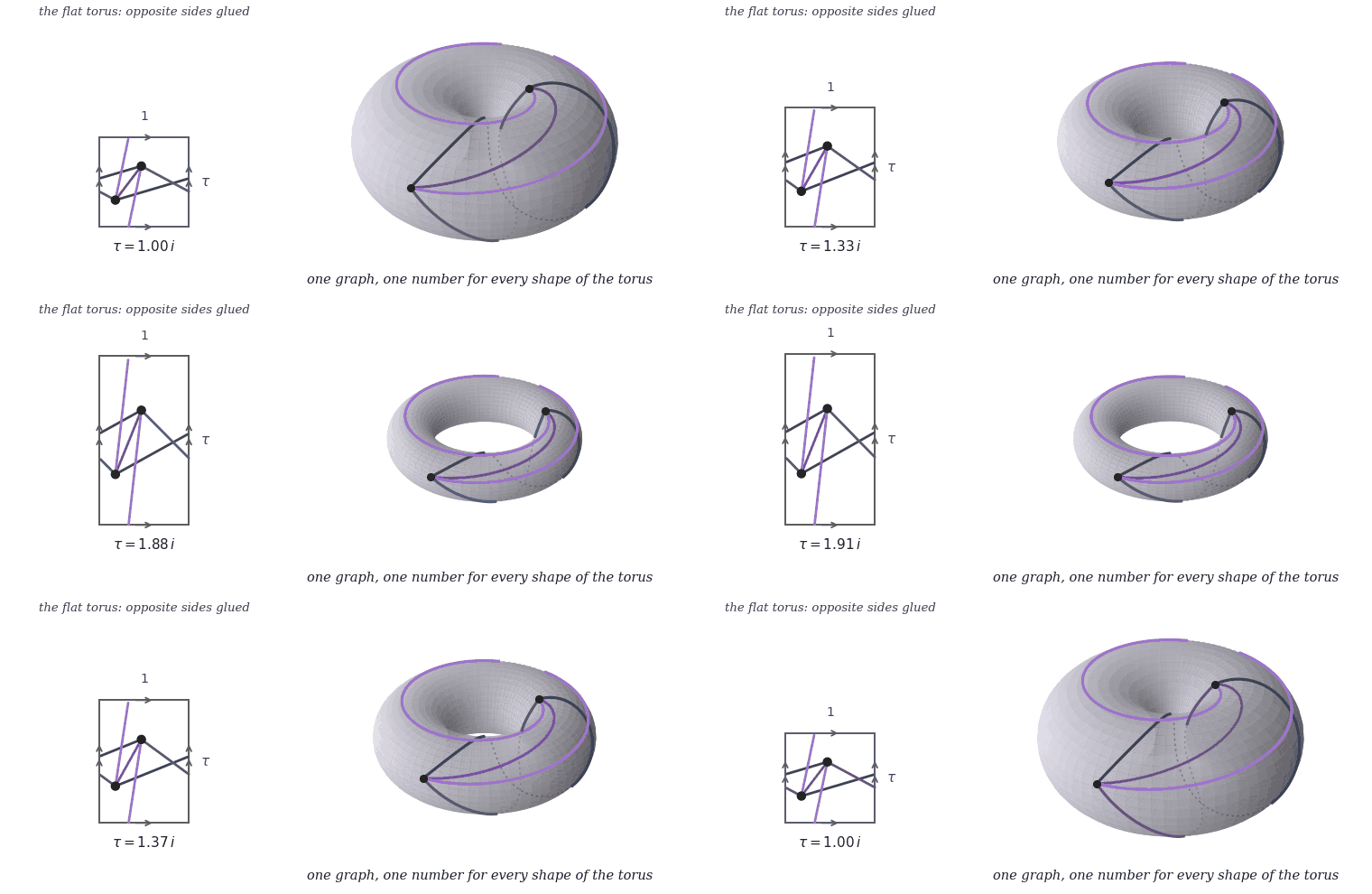
Gluing opposite sides of the cell spanned by $1$ and $\tau$ (left) gives the closed surface on the right, so one complex number fixes the shape. The graph on it has two vertices and four edges, each a propagator winding around the torus in its own way. As $\operatorname{Im}\tau$ grows the torus becomes long and thin, the regime of the next section (animation drawn for this site; the ring in space is schematic).
The thin torus and its numbers
When the imaginary part of $\tau$ is large the torus is long and thin. Up to exponentially small corrections, a weight-$w$ modular graph function then becomes a Laurent polynomial (a polynomial allowing negative powers) in $y=\pi\operatorname{Im}\tau$, with powers from $y^{1-w}$ to $y^{w}$. The coefficients are built from rational numbers, the values $\zeta_3,\zeta_5,\zeta_7,\dots$ of the Riemann zeta function $\zeta_n=\sum_{k\ge1}k^{-n}$ at odd integers and, for complicated enough graphs, multiple zeta values. The shortest member of the four-edge family, the weight-seven function with exponents $(2,2,2,1)$, reads
$$C_{2,2,2,1}(\tau) \;=\; \tfrac{2}{2764125}\,y^{7} + \tfrac{1}{900}\,\zeta_5\,y^{2} + \tfrac{7}{80}\,\zeta_9\,y^{-2} - \tfrac{11}{32}\,\zeta_{11}\,y^{-4} + \tfrac{63}{32}\,\zeta_5\zeta_7\,y^{-5} - \tfrac{825}{512}\,\zeta_{13}\,y^{-6} + O(e^{-2y})\,.$$Every power of $y$ not shown has coefficient zero. As in every member of the family, a pure fraction multiplies the top power, and elsewhere fractions multiply zeta values whose indices, added to the power of $y$, give the weight, here seven. The sum of the zeta indices in a coefficient is called its transcendental weight. A multiple zeta value $\zeta(n_1,\dots,n_r)$ is the nested sum $\sum 1/(k_1^{n_1}\cdots k_r^{n_r})$ over integers $0\lt k_1\lt\cdots\lt k_r$, of weight $n_1+\cdots+n_r$ and depth $r$. Many reduce to polynomials in ordinary zeta values; one that cannot be written using products and values of lower depth is called irreducible, and such values occur from depth two on. Below, a “depth-three constant” means an irreducible one, and the first of those has weight eleven.
Some of these Laurent polynomials were already known in closed formAn explicit finite formula in known constants, with no unevaluated sums, integrals or numerical approximations left in it.. D'Hoker and Green proved that for the “melon” graphs, any number of edges all with exponent one, every coefficient is a polynomial in odd zeta values, and D'Hoker and Duke found the same for every three-edge function. Gerken tabulated the two- and three-vertex functions up to weight six. Zerbini worked out the two-vertex functions with one exponent two and the rest one, up to seven edges, and found irreducible depth-three values at six and seven edges.
Three conjectures about which numbers can appear
Zerbini conjectured that the Laurent coefficients of every modular graph function are single-valued multiple zeta valuesA subalgebra of the multiple zeta values singled out by Brown (2013); the name comes from single-valued versions of the polylogarithm functions, of which these numbers are special values. At depth two they are all polynomials in odd zeta values; the first one that is not is $\zeta_{\mathrm{sv}}(3,5,3)$, at weight 11.. Brown defined these as everything produced by a map on multiple zeta values that sends $\zeta_2=\pi^2/6$, and with it every even zeta value, to zero and doubles the odd zeta values. Every polynomial in odd zeta values is single-valued, and the first single-valued value that is not such a polynomial has depth three and weight eleven. At tree levelThe leading approximation, with no quantum loops; for a closed string the worldsheet is then a sphere., where the worldsheet is a sphere, closed-string amplitudes contain only single-valued multiple zeta values, so Zerbini's conjecture, still unproved, is the natural one-loop statement.
The second conjecture is about a symmetry. Multiple zeta values, suitably formalized, carry the action of a group that Cartier named the cosmic Galois group. Its generators $D_3, D_5, D_7,\dots$ lower the weight by $3,5,7,\dots$. The generator $D_m$ sends $\zeta_m$ to $1$ and every other single zeta value and every power of $\zeta_2$ to $0$, obeys the product rule, and sends a multiple zeta value to a combination of values of lower depth. Brown proposed, and Panzer and Schnetz observed in $\phi^4$ quantum field theory, that the constants a given physical theory produces should be closed under these operations: each $D_m$ sends any one of them to a rational combination of the others.
The third conjecture, made by Broadhurst and Kreimer in 1996, is a formula for the number of irreducible multiple zeta values of each weight and depth. Counting the inequivalent choices of three odd indices gives $1,2,3,5,7,9$ candidates at the odd weights $11$ through $21$; the formula says that only $1,2,2,4,5,6$ of them are independent. The deficit is tied to cusp formsA modular form that vanishes in the thin-torus limit. For the full modular group the first one, the discriminant $\Delta_{12}$, has weight 12.: holomorphic functions of $\tau$ that transform in a fixed way between values of $\tau$ describing the same torus (modular forms) and vanish in the thin-torus limit. Each cusp form, paired with an odd zeta value whose weight makes up the difference, removes one depth-three value from the count, for the first time at weight fifteen.
The melon and three-edge families test none of the three conjectures: polynomials in odd zeta values are automatically single-valued and closed under every $D_m$, and those families contain no depth-three values to count. A 2024 construction by Dorigoni et al. writes modular graph functions as iterated integrals of simpler modular forms with single-valued coefficients. It reaches the four-edge functions below only through weight $w=10$, however, and only under an assumption that its authors note is not yet established in general.
Forty-nine functions in closed form
The computation here covers the two-vertex, four-edge family at every weight from seven through twelve, the range just above Gerken's tables. The functions of weight $w$ correspond to the ways of writing $w$ as a sum of four positive integers, forty-nine in all, with $740$ Laurent coefficients between them.
The method splits the lattice sum into sectors. Write each momentum as $p_r=m_r\tau+n_r$; the integer $m_r$, its component along $\tau$, is called the winding number of edge $r$. Poisson resummationA standard identity that turns a sum of a function over the integers into a sum of its Fourier transform, which often converges much faster. turns each sum over $n_r$ into one that converges rapidly on a thin torus, and the terms are then grouped by which edges have nonzero winding. The sector with no wound edges gives the rational top term, and two wound edges give a single zeta value. Three give Mordell–Tornheim sums, double sums over positive integers $m,n$ with powers of $m$, $n$ and $m+n$ in the denominator, which reduce to multiple zeta values of depth at most two. Four give triple sums of the same kind, which reduce to depth at most three, for any exponents. The resulting multiple zeta values are reduced to a basis, weight by weight, by Gaussian elimination over the rationals using only proved relations. All $740$ coefficients are therefore exact rational combinations of basis values, and none comes from a numerical fit.
The computation runs on the BootLoops toolkit, with the same programs that reduce and identify the zeta-value constants of Feynman integrals. Galois, the toolkit’s package for exact arithmetic with multiple zeta values, carries out reductions of this kind by proved relations, and it also computes Brown’s single-valued map and the operations $D_m$ used in the tests below. Three numerical checks accompany the exact results. The tornheim module of Formglue evaluates the sector sums with three and four wound edges to between $290$ and $700$ digits, in agreement with the exact coefficients to hundreds of digits. Nestor, the toolkit’s high-precision integrator, evaluates thirty-eight of the functions directly as integrals over the torus, with no sector expansion, and reproduces their Laurent polynomials up to the expected exponentially small remainder. PSLQ integer-relation searches on the sector sums, accepted only when two working precisions return the same relation, also recover most of the closed forms independently; the others, at the highest weights, rest on the exact reduction and its numerical check.
A worked example is the weight-eight function $C_{2,2,2,2}$. Its Laurent polynomial has nine nonzero terms: a rational leading coefficient, seven that are fractions times odd zeta values or products of two of them, and the coefficient of $y^{-5}$, which equals $15.818917\ldots$. No rational combination of the three odd-zeta products of its weight, $\zeta_{13}$, $\zeta_3^2\zeta_7$ and $\zeta_3\zeta_5^2$, has been found that reproduces it. In single-valued multiple zeta values it has the closed form
$$c_{-5} \;=\; \frac{13803}{800}\,\zeta_{13} \;+\; \frac{153}{10}\,\zeta_3\zeta_5^{2} \;+\; \frac{51}{400}\,\zeta_{\mathrm{sv}}(5,3,5)\,,$$where $\zeta_{\mathrm{sv}}(5,3,5)$ is one of Brown's irreducible depth-three single-valued values at weight thirteen, an explicit four-term combination of ordinary multiple zeta values. No $\pi$ appears in $c_{-5}$ except inside $\zeta_{\mathrm{sv}}(5,3,5)$ itself, so Zerbini's conjecture holds for $C_{2,2,2,2}$. At weight seven, $C_{3,2,1,1}$ and $C_{4,1,1,1}$ contain the weight-eleven irreducible of Zerbini's examples, while $C_{2,2,2,1}$ above contains none at all: a weight-seven identity of D'Hoker and Kaidi expresses it, up to an additive constant, through three-edge functions and Eisenstein seriesThe basic modular-invariant functions of the torus shape, each a single lattice sum; a graph forming one closed chain of edges gives one., which contain only odd zeta values.
Depth three in one coefficient
Three regularities hold across the forty-nine functions. The first is confinement: in every function, all Laurent coefficients except possibly one are polynomials in odd zeta values, and depth-three constants occur only in the coefficient of $y^{3-w}$, of transcendental weight $2w-3$, called the deep coefficient below. Forty-eight of the functions do have a depth-three constant there; the exception is $C_{2,2,2,1}$ (explained above). For any four positive exponents, computed here or not, depth three provably occurs nowhere else: only the sector with all four edges wound produces triple sums, and counting powers of $y$ puts its whole contribution into $y^{3-w}$. That the other coefficients contain no even zeta values and no depth-two irreducibles is checked function by function from the exact results. Confinement is special to four edges: in five-edge functions computed the same way, depth-three constants spread over several coefficients.
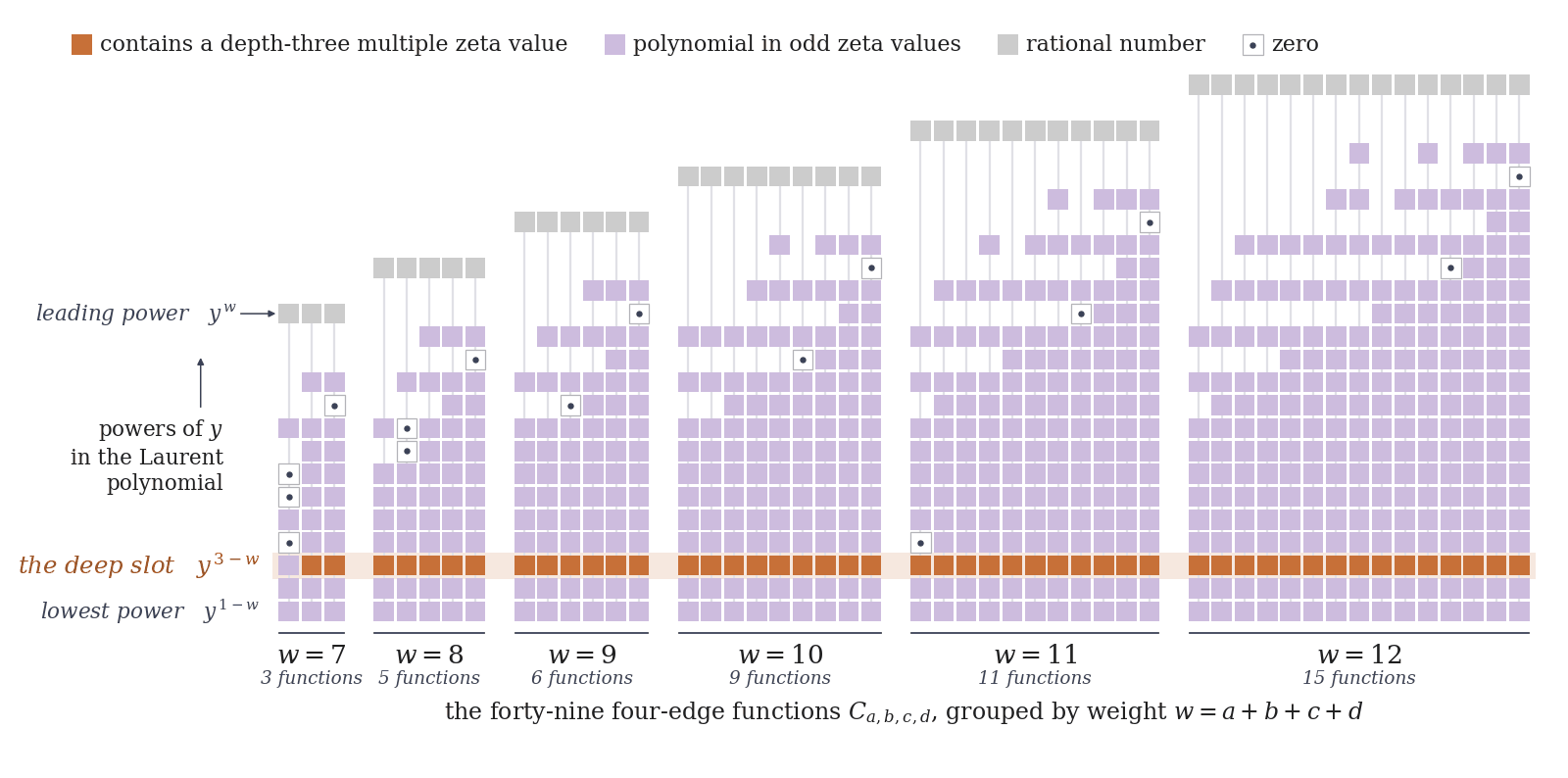
All $740$ Laurent coefficients of the forty-nine functions, one column per function and one square per power of $y$ from $y^{1-w}$ (bottom) to $y^{w}$ (top), grouped by weight: orange squares contain a depth-three constant, lavender ones are polynomials in odd zeta values, gray ones are rational, dotted ones are zero, and empty positions are powers of $y$ that cannot occur for that function. Every depth-three constant in the family sits in the same row, the deep coefficient, that of $y^{3-w}$, and only the first function, $C_{2,2,2,1}$, has none there. (Redrawn from Figure 1 of the paper.)
Modular graph functions also obey differential equations on the space of torus shapes: the Laplacian of that space, applied to one of them, gives a rational multiple of the same function (the eigenvalue) plus products of lower-weight functions (the source). A transport theorem proved here carries confinement through these equations to functions nobody has computed: the Laurent coefficients of the source fix those of the solution, and constants of a given kind in the source produce only constants of the same kind. The exception, called a resonant eigenvalue, is one of the form $k(k-1)$ with integer $k$, for which $y^k$ and $y^{1-k}$ solve the sourceless equation and their coefficients stay undetermined. In Basu's Laplace system for the four-edge family twelve of the forty-six exponent choices at weights eight through twelve are resonant, every $C_{k,1,1,1}$ among them; here every function, resonant or not, is computed directly.
Testing the conjectures
The second regularity is saturation. At each weight, reduce the depth-three parts of the deep coefficients using every known relation among multiple zeta values and count how many remain linearly independent. The answer is $1,2,2,4,5,6$ at transcendental weights $11$ through $21$, the Broadhurst–Kreimer numbers at all six weights.
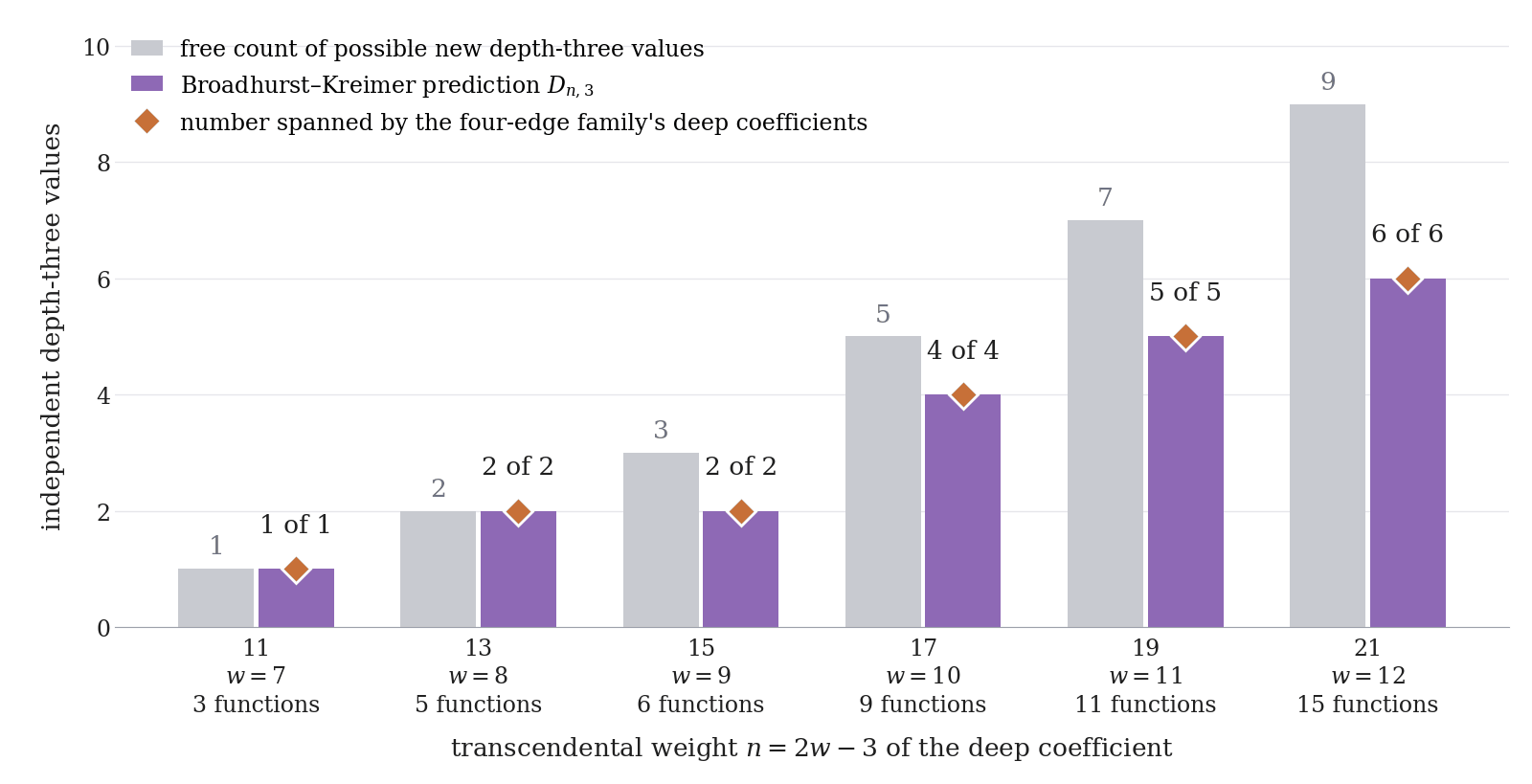
Independent depth-three constants at each odd weight from $11$ to $21$: the free count of possible new values (gray), the Broadhurst–Kreimer prediction after cusp forms remove some (violet), and the number spanned by the four-edge family’s deep coefficients (diamonds). The family reaches the Broadhurst–Kreimer dimension at every weight. (Drawn from Eqs. (14) and (46) of the paper.)
This agreement tests the conjecture without proving it. The known relations already leave at most $1,2,2,4,5,6$ independent candidates at these weights, so full rank is the most the family could show, and the string-theory coefficients reach it at all six weights with no unexpected rational relation among them.
The third regularity is closure under the cosmic Galois group. Applying the $D_m$ requires all eighty-three depth-three single-valued values $\zeta_{\mathrm{sv}}(a,b,c)$ with odd indices at weights $11$ through $21$, written out in ordinary multiple zeta values. Brown had given three of these formulas and Dorigoni et al. those through weight seventeen. Most of the eighty-three were first extracted from $700$-digit numerical values by integer-relation searches, and the rest were derived with Galois’s implementation of Brown’s single-valued map. That algebraic route takes no numerical input, and it reproduces every extracted formula as well.
Each $D_m$ lowers the depth, and a single-valued value of depth two or less is a polynomial in odd zeta values. Every image of a depth-three single-valued value is therefore a rational combination of products of two odd zeta values, for example $D_3\,\zeta_{\mathrm{sv}}(3,3,5)=-10\,\zeta_3\zeta_5$. For the four-edge family more is true: its even-weight coefficients span every such product that can occur, so the image of every deep coefficient under every $D_m$ is a rational combination of the family's own lower-weight coefficients, as closure requires. A span computation on finitely many functions can show consistency with closure but cannot by itself establish it.
The same formulas test Zerbini's conjecture on the twenty-six deep coefficients at $w=11$ and $12$, of transcendental weights nineteen and twenty-one. They lie beyond the reach of the construction of Dorigoni et al., which predicts single-valued coefficients there only under a further unproved assumption, so nothing in print decides them. Each is single-valued, by an exact rational decomposition into $\zeta_{\mathrm{sv}}$ values and products of odd zeta values, so in this family Zerbini's conjecture holds at every coefficient computed, through transcendental weight twenty-one.
The couplings
The physical couplings come from integrating over all torus shapes, with the thin tori beyond a height $\operatorname{Im}\tau=L$ treated separately. Counting powers of $y$ shows which Laurent coefficients reach the cutoff-dependent part. The coefficient of $y^1$ becomes the coefficient of $\ln L$, the growing powers of $L$ cancel against the region beyond the cutoff, and the constant and negative powers drop out as $L$ grows; the remainder is a finite constant $I_C$ that depends on the whole function. At order $\alpha'^8$, where weight-eight functions such as $C_{2,2,2,2}$ enter, the weight-thirteen depth-three constants occur only in the coefficient of $y^{-5}$, so $\zeta_{\mathrm{sv}}(5,3,5)$ drops out of the divergent and logarithmic parts of the coupling. Power counting alone does not decide whether it survives in $I_C$.
Claasen and Doroudiani's representation of these couplings contains two constants that they fixed by assuming uniform transcendentality, the expectation that every term of a coupling carries the same total weight in $\pi$ and zeta values. Recomputed in exact arithmetic from inputs printed in their work, both come out as they gave them, consistent with the exact Laurent polynomials granted that assumption. Uniform transcendentality then requires one cancellation. Each coupling is a sum of products of modular graph functions, integrated one product at a time, and the products already integrated leave in each of the two couplings a term proportional to $\pi\zeta_7\ln(2\pi)$. Since $\ln(2\pi)$ has no consistent transcendental weight, the thirty-nine products whose integrals are not yet known in closed form must cancel these two terms. The condition is necessary and not known to be sufficient, so whether the couplings are uniformly transcendental is undecided.
The computation also corrects three formulas in the earlier literature: the overall sign of an integration formula at even weight, one term of an integrand that carries seven Green functions where every other term carries eight, and a swapped label in a worked example.
The paper
- Irreducible multiple zeta values of depth three in four-edge modular graph functions (PDF) — Matthew D. Schwartz. A preliminary version of the paper.
Supplementary material
- mgf-evaluate.py — stand-alone Python 3 script (mpmath only) that recomputes every coefficient of the weight-eight example $C_{2,2,2,2}$ from its closed form at any requested precision, computing $\zeta_{\mathrm{sv}}(5,3,5)$ at run time, and compares the results with stored 280-digit reference values on every run.
- modulargraphs-ancillary.zip (14 files, 140 KB) — the paper’s ancillary files in one package: all forty-nine Laurent polynomials with their $740$ exact coefficients (plain text, JSON and LaTeX), the $83$ formulas for the single-valued depth-three values $\zeta_{\mathrm{sv}}(a,b,c)$ at weights eleven through twenty-one, the twenty-six single-valuedness certificates at transcendental weights nineteen and twenty-one with the basis data needed to check them, a Python script that verifies every certificate by substitution in exact rational arithmetic, the closed form of $C_{2,2,2,2}$ written out, and a README stating the conventions. Code under the MIT License, data and text under CC BY 4.0.
References
| E. D’Hoker, M.B. Green, Ö. Gürdoğan and P. Vanhove, Modular Graph Functions, Commun. Num. Theor. Phys. 11 (2017) 165 | defined and named modular graph functions in the one-loop four-graviton amplitude |
| F. Zerbini, Single-valued multiple zeta values in genus 1 superstring amplitudes, Commun. Num. Theor. Phys. 10 (2016) 703 | Laurent polynomials of the $C_{2,1,\dots,1}$ functions; the conjecture that every coefficient is single-valued |
| E. D’Hoker and M.B. Green, Absence of irreducible multiple zeta-values in melon modular graph functions, Commun. Num. Theor. Phys. 14 (2020) 315 | proof that the melon functions contain only odd zeta values |
| E. D’Hoker and W. Duke, Fourier series of modular graph functions, J. Number Theory 192 (2018) 1 | the Laurent polynomial of every three-edge function in closed form |
| J.E. Gerken, Basis Decompositions and a Mathematica Package for Modular Graph Forms, J. Phys. A 54 (2021) 195401 | tables of the two- and three-vertex functions through weight six |
| E. D’Hoker and J. Kaidi, Hierarchy of Modular Graph Identities, JHEP 11 (2016) 051 | the weight-seven identities against which $C_{2,2,2,1}$, $C_{3,2,1,1}$ and $C_{4,1,1,1}$ are checked |
| A. Basu, Eigenvalue equation for the modular graph $C_{a,b,c,d}$, JHEP 07 (2019) 126 | the Laplace system for the four-edge family, whose eigenvalues decide resonance |
| F. Brown, Single-valued motivic periods and multiple zeta values, Forum Math. Sigma 2 (2014) e25 | defined single-valued multiple zeta values; the explicit formula for $\zeta_{\mathrm{sv}}(5,3,5)$ |
| P. Cartier, Fonctions polylogarithmes, nombres polyzêtas et groupes pro-unipotents, Séminaire Bourbaki, exposé 885, Astérisque 282 (2002) 137 | introduced the cosmic Galois group acting on multiple zeta values |
| F. Brown, Feynman amplitudes, coaction principle, and cosmic Galois group, Commun. Num. Theor. Phys. 11 (2017) 453 | the proposal that a theory’s constants are closed under the derivations $D_m$ |
| E. Panzer and O. Schnetz, The Galois coaction on $\phi^4$ periods, Commun. Num. Theor. Phys. 11 (2017) 657 | the same closure observed in $\phi^4$ quantum field theory |
| D.J. Broadhurst and D. Kreimer, Association of multiple zeta values with positive knots via Feynman diagrams up to 9 loops, Phys. Lett. B 393 (1997) 403 | the conjectured count of new multiple zeta values by weight and depth |
| D. Dorigoni, M. Doroudiani, J. Drewitt, M. Hidding, A. Kleinschmidt, O. Schlotterer, L. Schneps and B. Verbeek, Non-holomorphic modular forms from zeta generators, JHEP 10 (2024) 053 | single-valued coefficients by another route through $w=10$; depth-three reductions through weight seventeen |
| E. Claasen and M. Doroudiani, From modular graph forms to iterated integrals, JHEP 06 (2025) 204 | the order-$\alpha'^8$ couplings with two constants fixed under a transcendentality assumption |