 AccStack: Agentically Compiled Catalog of Stress and Tone (linguistics)
Which syllable of a word carries the stress, and does pitch distinguish words? ACCSTACK is a catalog of word stress and tone across the world's languages in which every entry quotes its source. The catalog is at accstack.org.
accstack.org — the catalog’s own site: every language’s entry with its quoted source and page, the bibliography, and the data files (in a closed beta for now; the front page says how to request access)
Where the Stress Falls (5½ minutes) — Matthew Schwartz · Kevin Ryan · Matthew Gordon · Joe Pater · Claude. Narrated in a synthetic voice; every word of a language heard in the film is a native speaker’s recording. A dozen languages at once and then four of them one at a time; the people who wrote down the rules of stress and tone, from ancient India and China to the linguists of the last two centuries; the catalogs compiled by hand; and a catalog of just over six thousand languages read from those descriptions by an AI, and the questions such a catalog lets linguists ask. Voices: Wikitongues contributors via Wikimedia Commons (CC BY-SA 4.0 and CC BY 3.0), the FLEURS speech corpus (CC BY 4.0), Dvortygirl (public domain), Yue Tan for the Shtooka project (CC BY-SA 3.0 US) and the UCLA Phonetics Lab Archive (CC BY-NC 2.0) · pages: public-domain scans via the Internet Archive, Google Books and Wikimedia Commons · map: Natural Earth and Glottolog 5.2 (CC BY 4.0) · language list: StressTyp2 · family tree: Glottolog 5.3 (CC BY 4.0). The film is released under CC BY-SA 4.0.
Most books that describe a language, which linguists call grammars, say in a sentence or two which syllable of a word carries the stress and whether the language uses pitch to tell words apart. ACCSTACK collects those sentences for about seven in ten of the world’s spoken languages, each quoted with its source and page beside the codingThe entry’s classification, chosen from a fixed list of categories, as distinct from the quoted words of the source it rests on. it supports; a large language model compiled them under the authors’ written instructions.
Stress and tone
In Finnish, Polish, Hausa and Mandarin alike, part of the meaning lies in how the words are spoken: which syllables the voice leans on, and how its pitch rises and falls over them. A Finnish speaker leans on the first syllable of every word and a Polish speaker on the second from the end; in Hausa and in Mandarin the pitch of a syllable is part of the word itself. Every language has its own rules for stress and pitch, and the rules can be written down and compared.
Finnish A native speaker’s self-introduction.
Polish który trwał trzy stulecia, ‘which lasted three centuries.’
Hausa A native speaker’s self-introduction.
Mandarin 当地主要的啤酒是“一号”啤酒, dāngdì zhǔyào de píjiǔ shì “Yīhào” píjiǔ, ‘the main local beer is “Number One” beer.’
In the strips, rings mark the syllables the voice leans on and the purple line traces its pitch. Voices: Finnish: “WIKITONGUES- Jenni speaking Finnish”, Wikitongues via Wikimedia Commons, CC BY 3.0; Hausa: “Abubakar speaking Hausa”, Wikitongues via Wikimedia Commons, CC BY-SA 4.0; Polish and Mandarin: FLEURS speech corpus (Conneau et al. 2022), CC BY 4.0.
The English noun record and the verb record are spelled alike, but the emphasis falls on the first syllable of the noun and the second of the verb; linguists call that emphasis stress. In Mandarin Chinese the syllable ma said with a level, a rising, a dipping or a falling pitch is four different words, and that use of pitch is tone.
English stress must partly be learned word by word, but many languages place it by rule: Hungarian and Chechen on the first syllable, Swahili on the second from the end. In the catalog’s terms stress is fixed when its position follows from the word’s edges and number of syllables alone, weight-sensitiveSensitive to syllable weight: a “heavy” syllable, typically one with a long vowel or one closed by a consonant, attracts the stress away from where it would otherwise fall. when a heavy syllable, one with a long vowel or a closing consonant, can pull it away from that position, lexical when words of the same shape differ in where it falls, and morphological when it is placed relative to a root, stem or affix rather than the whole word. A rule is written with one symbol $\sigma$ per syllable, in the notation of Gordon’s 2002 survey: an acute accent ($\acute{\sigma}$) for the main stress, a grave accent ($\grave{\sigma}$) for a secondary stressA weaker beat on another syllable of the same word, like the one on the first syllable of English “information.” and a bare $\sigma$ for an unstressed syllable. Penultimate stress, as in Swahili, comes out like this for words of two to five syllables:
$$\acute{\sigma}\sigma,\qquad \sigma\acute{\sigma}\sigma,\qquad \sigma\sigma\acute{\sigma}\sigma,\qquad \sigma\sigma\sigma\acute{\sigma}\sigma$$Badimaya (Pama-Nyungan, Australia) and Karelian (Uralic) put the main stress on the first syllable and a secondary stress on every second syllable after it, never on the last:
$$\acute{\sigma}\sigma,\qquad \acute{\sigma}\sigma\sigma,\qquad \acute{\sigma}\sigma\grave{\sigma}\sigma,\qquad \acute{\sigma}\sigma\grave{\sigma}\sigma\sigma$$Many descriptions of tone languages say nothing about stress, and for those languages the entry records the statement about tone alone. A language described with both tone and a stress rule is classed by the stress rule, with the tone statement quoted beside it, and a pitch accentA system in which each word has at most one syllable marked out by pitch; databases differ on whether to count it as tone or as a class of its own. counts as a class of its own.
Two and a half thousand years of writing it down
People have been writing such rules down for a long time, a few languages at a time. Scholars in India described the accent of Sanskrit words some two and a half thousand years ago, and manuscripts of the Rigveda carry the Vedic accents marked on the text. In fifth-century China the scholar Shen Yue named four tones. In 1595, in Mexico, Antonio del Rincón, a Jesuit of Nahua descent, described the accent of his own language, Nahuatl, in his Arte mexicana. In 1651 another Jesuit, Alexandre de Rhodes, printed a Vietnamese dictionary in Rome with the tones marked by accents, and Vietnamese is written that way today.
Through the 1800s and 1900s missionaries and linguists went to live with the speakers of languages that had never been written down, and wrote books describing them. About half of those books have a sentence about where the stress falls or how the tones work. Lewis Grout’s Zulu grammar of 1893 and Édouard Jacottet’s 1896 grammar, in French, of Louyi, a language of the upper Zambezi, are two such books; in Grout’s the sentence reads “As a general law of the language the accent is laid upon the penultimate syllable.” Counting the languages with a dated description year by year gives about eighty by 1700, eight hundred by 1900, eighteen hundred by 1950 and more than seven thousand today, so most of the world’s languages were first described within living memory. The authors of those descriptions worked in different countries and centuries, and what they wrote is scattered across libraries, journals and the internet.
Catalogs compiled by hand
A few linguists have gathered such statements into one place, which means reading a few hundred of those books, in half a dozen languages, carefully, over years. In 1977 Larry Hyman tallied the position of the main stress in the 444 descriptions then available to him. In 2002 Matthew Gordon surveyed 262 languages with fixed stress. The StressTyp database of Rob Goedemans and Harry van der Hulst coded 510 languages from grammars and typological studies, and the stress chapters of the World Atlas of Language Structures (WALS) map its codings. In 2014 StressTyp was merged with Jeffrey Heinz’s Stress Pattern Database into StressTyp2, which covers 699 languages in its archived version and over 750 online. Whether a language has tone is recorded in other databases drawn from the same literature, among them LAPSyD, chapter 13 of WALS and PHOIBLE.
Hyman’s and Gordon’s surveys and StressTyp2 are the largest compilations, and StressTyp2’s 699 languages are still fewer than one in ten of the world’s. StressTyp2 gives a page and a quotation for some of its entries, and Gordon’s appendix has no column for either. For comparison, Glottolog, the standard open catalog of the world’s languages and of the literature describing them, lists about 7,800 spoken languages, and for 5,468 of them its bibliography holds 54,586 grammars, sketches, phonologies and other works whose titles name sounds, stress or tone. A catalog on that scale is beyond what a linguist or a small group could compile by hand in any reasonable time.
Reading with an AI
An AI can read tens of thousands of books and articles at once and do the same careful thing in every one: find the sentence, copy it out with its page number, write down the rule, and keep every detail, so that a linguist can judge the reading. The result is ACCSTACK, the Agentically Compiled Catalog of Stress and Tone, where “agentically” means that the compiling was done by an AI, the large language model Claude. The readings were made in August and September 2026. The four authors, Matthew Schwartz and the linguists Kevin Ryan, Matthew Gordon and Joe Pater, wrote the coding rules and the procedure for settling disagreements, the model applied them, and every change of classification is the authors’ decision.
Every entry rests on two separate readings of its source. In the first, the model found an accessible copy of a work on the language, located the passage on stress or tone, quoted it verbatim with its page and a translation where needed, and coded it from a closed list of types. One of the written instructions reads: “Never invent a quotation or a page: every quote comes from text you opened; if you could not open a work, say so and leave its quote empty.” For the second reading the model was given the first report and instructed to refute it: the model opened the work again at the cited page, checked the passage word for word, read the surrounding section, and confirmed the language’s identity against neighbors and namesakes. Where the two readings differed, a third reading decided the case field by field, and both earlier readings were kept.
One example is the entry for Seimat, an Austronesian language of Papua New Guinea. Its source is Wozna and Wilson’s Seimat Grammar Essentials (2005), page 7: “Stress normally occurs on the penultimate syllable of a word, except in a small group of trisyllabic words where reduplicationMaking a word by repeating all or part of another; the grammar’s examples are Seimat words for “moon” and a kind of shell. occurs.” The entry’s reading is fixed penultimate stress, with the word as its domain and a listed set of exceptions; its check found the quotation verbatim at the cited page; and its confidence is “fairly confident: one first-hand description, checked against the source,” the second of five levels. When two descriptions of a language disagree, the catalog does not code a compromise between them, and the dissenting source, page and words are shown in the entry.
What the catalog holds
The release of 1 October 2026 (version 1.0) has 6,072 entries, one per language: 5,995 of the 7,803 spoken languages that Glottolog lists, or 77 percent, and 77 entries outside that list (27 artificial languages, 26 pidgins, 15 sign languages, 8 speech registers and one unattested language). In that release the largest class is tone or pitch accent with no statement about word stress (1,906 entries), then fixed stress (1,610), with weight-sensitive (751), lexical (518) and morphologically assigned stress (420) behind them. For 128 languages the source says there is no word stress, and 739 are assigned no type, most often because the sources do not determine one. A statement about tone is recorded in 2,836 entries whatever their stress type, and the 595 entries rated not confident, which lack a confirmed first-hand statement, should be treated as provisional.
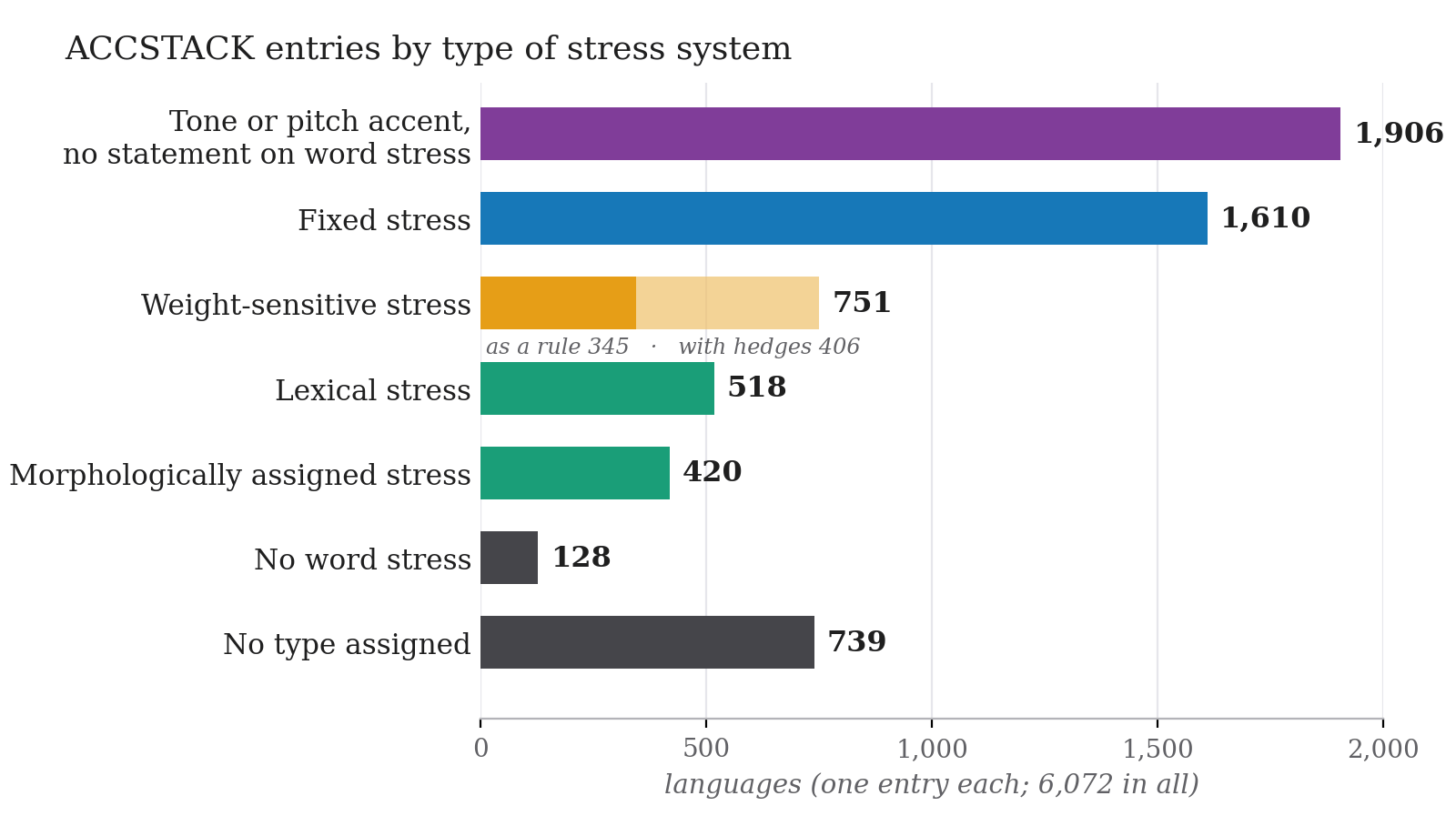
The 6,072 entries of the version 1.0 release by type of stress system. Each bar counts the languages whose entry has that type, with the number at its end. The orange bar is split into weight-sensitive rules that a source states outright (345, darker) and rules it states with hedges (406, lighter). Descriptions that report tone or a pitch accent and say nothing about word stress form the largest class and fixed stress the second, and more than half of all entries have a word-stress type. Of the 739 entries with no type, 307 are languages whose sources do not determine one. (Table 2 of the paper, recounted over the release of 1 October 2026.)
Coverage runs from 69 percent of the languages of PapunesiaGlottolog’s macroarea for island Southeast Asia, New Guinea and the Pacific., through 77 percent of Africa’s, to 88 percent in North America. The languages with an entry belong to 234 of the language families that Glottolog recognizes. A companion bibliography lists 160,654 works on about 8,600 languages, a median of 15 per language, each tagged with what it is known to say about stress or tone and how a copy can be obtained; for each of the 1,808 languages without an entry it says what is lacking.
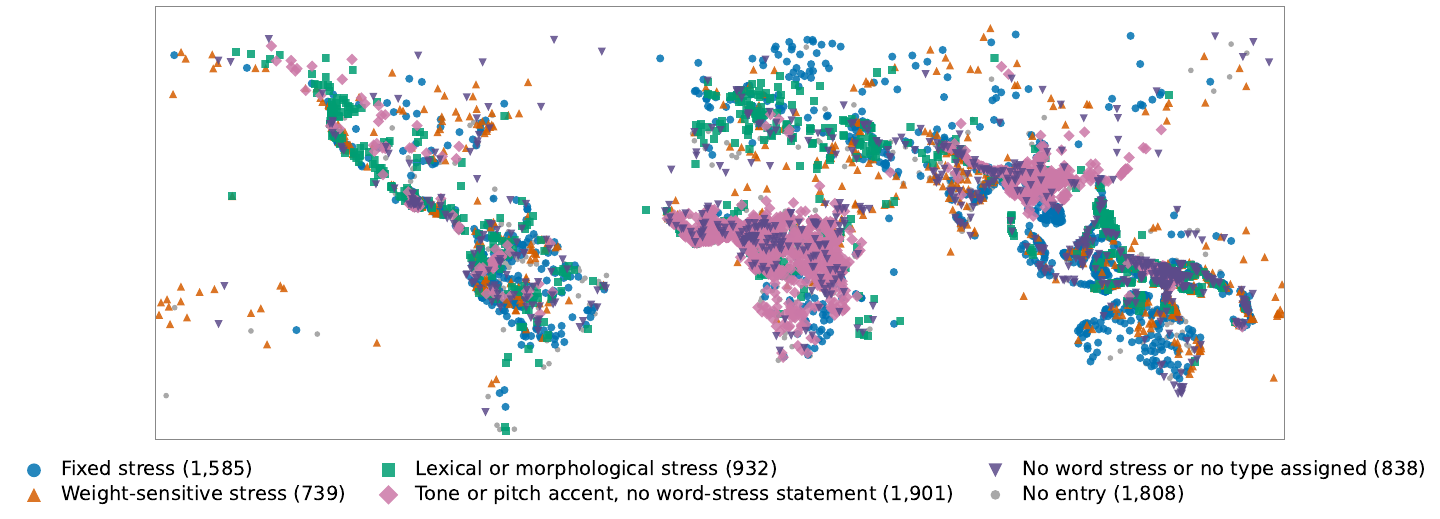
Stress and tone types from the descriptions, on a world map. Each of the 7,803 spoken languages is a mark at its Glottolog coordinates, colored and shaped by the stress type of its catalog entry in the version 1.0 release. Blue circles mark fixed stress (1,585 languages), orange triangles weight-sensitive stress with hedged statements included (739), green squares lexical or morphological stress (932), pink diamonds tone or pitch accent with no word-stress statement (1,901), purple inverted triangles no word stress or no type assigned (838), and small light gray dots the 1,808 languages with no entry. The legend counts languages on Glottolog’s list rather than entries, so the 77 entries outside that list are not on the map. Pink is densest across sub-Saharan Africa and East and Southeast Asia, and blue across Australia. The light gray of missing entries falls mostly in Papunesia and Africa, the two macroareas with the most languages lacking an entry (669 and 504). (Figure 1 of the paper, redrawn over the release of 1 October 2026.)
What a catalog lets you ask
The catalog’s counts bear on three questions that linguists ask about stress and tone. The first is geographical: where tone is found and where stress is. Over the 6,072 entries, tone or a pitch accent is reported for 1,237 of the 1,732 entries in Africa, 455 of 1,469 in Eurasia, 102 of 1,463 in Papunesia, 68 of 612 in North America, 41 of 478 in South America and 1 of 275 in Australia. The counts alone do not say whether that distribution runs in families or has spread between neighboring languages.
The second question is which stress systems occur at all, the subject linguists call typology. Sorting the catalog’s fixed-stress entries by the syllable that carries the main stress in words of four to seven syllables gives 354 languages that always stress the first syllable, Czech, Finnish and Hungarian among them; 31 that stress the second, such as Basque and Lakota; one that stresses the third and none the fourth; and, counting from the other end of the word, 418 that stress the last syllable, 571 the second from the end, 25 the third from the end and one the fourth from the end. What pattern lies behind those eight numbers is one question; what makes a syllable heavy enough to pull the stress toward it is another. In the catalog, 740 languages have an entry that names a weight criterion: a long vowel for 276, a long vowel or a closing consonant for 219, a closing consonant for 91, a full rather than a reduced vowel for 93, and something else for 61.
The third question is historical. Czech and Slovak stress the first syllable, Polish the second from the end, and Russian places the stress word by word, yet about a thousand years ago these Slavic languages were one language. How often a stress rule changes in that way, which rules stay put for centuries, and which ones cross between neighboring languages that are not related at all are open questions, and the catalog’s six thousand sourced entries are the material for studying them.
Using the catalog
The catalog is at accstack.org. The site shows every entry with all its fields and, for 4,404 languages, links to recordings; it keeps each release with its data files and the full reading instructions; and it takes proposed corrections. The site is in a closed beta and asks visitors to sign in; its front page gives an address for requesting access. The authors expect the catalog to change as more descriptions become openly available and as its users correct it.
Funding for AccStack was provided by Anthropic. AccStack is not an Anthropic project. AccStack is owned and maintained by Matthew Schwartz, Kevin Ryan, Matthew Gordon and Joe Pater.
The paper
- AccStack: An agentically compiled catalog of word stress and tone, with sources (PDF) — Matthew D. Schwartz, Kevin M. Ryan, Matthew K. Gordon, Joe Pater, and Larry M. Hyman. A preliminary version of the paper.
Supplementary material
- accstack.org — the catalog and its companion bibliography, version 1.0, release of 1 October 2026, for download. The catalog comes as one data file with one entry per language and every field the paper describes; the bibliography as an index with a row per language, a file for each language, and a summary of the counts. The site shows every entry with all its fields, links recordings for 4,404 languages, keeps each release with its data files and the full reading instructions, and takes proposed corrections.
- Where the Stress Falls (film, 5½ minutes, on YouTube) — the film at the head of this page, by Matthew Schwartz, Kevin Ryan, Matthew Gordon, Joe Pater and Claude, released under CC BY-SA 4.0; the recordings, scans and data in it keep their own licenses, listed on its end card.
References
| L. M. Hyman, On the nature of linguistic stress, in Studies in Stress and Accent, Southern California Occasional Papers in Linguistics 4 (1977) 37 | tallied the dominant position of main stress in the 444 descriptions then available |
| M. Gordon, A factorial typology of quantity-insensitive stress, Nat. Lang. Linguist. Theory 20 (2002) 491, doi:10.1023/A:1015810531699 | the 262-language fixed-stress survey whose codings, references, and accent notation the catalog takes over |
| R. Goedemans and H. van der Hulst, StressTyp: a database for word accentual patterns in the world’s languages, in The Use of Databases in Cross-Linguistic Studies, Mouton de Gruyter (2009) 235 | the 510-language stress database whose codings the WALS stress chapters map |
| R. Goedemans and H. van der Hulst, Fixed stress locations, in The World Atlas of Language Structures Online, chapter 14 (2013) | the WALS map of fixed-stress positions, one of the stress codings the catalog is compared with |
| J. Heinz, On the role of locality in learning stress patterns, Phonology 26 (2009) 303 | cited for Heinz’s Stress Pattern Database, later merged with StressTyp into StressTyp2 |
| R. Goedemans, J. Heinz and H. van der Hulst, StressTyp2, st2.ullet.net (2014), version 1 archive of April 2015 | the 699-language stress database whose fixed-stress codings and references the catalog reuses |
| H. Hammarström, R. Forkel, M. Haspelmath and S. Bank, Glottolog 5.2, Max Planck Institute for Evolutionary Anthropology (2025), glottolog.org | the catalog of languages and descriptive sources that defines the 7,803-language list and supplies the map coordinates |
| I. Maddieson, Tone, in The World Atlas of Language Structures Online, chapter 13 (2013) | the WALS tone chapter, which classes 527 languages as toneless, simple, or complex; one of the tone codings compared |
| I. Maddieson, S. Flavier, E. Marsico, C. Coupé and F. Pellegrino, LAPSyD: Lyon-Albuquerque Phonological Systems Database, Proc. Interspeech (2013) 3022 | a 764-language database with stress and tone categories, compared with the catalog on both |
| I. Maddieson and K. Benedict, Global linguistic data (version 1.1.2), Zenodo (2024), doi:10.5281/zenodo.11205300 | tone and stress categories for 1,003 languages, compared with the catalog on both |
| S. Moran and D. McCloy, PHOIBLE 2.0, Max Planck Institute for the Science of Human History (2019), doi:10.5281/zenodo.2626687 | 3,020 phoneme inventories for 2,186 languages, with tones where the source describes them; lowest in tone agreement among the seven databases charted above |
| K. Maslinsky, V. Vydrin and D. Gerasimov, ThoT Database, thot.huma-num.fr (2025) | ThoTDB, which marks each Glottolog language as tonal, toneless, or unknown; one of the tone codings compared |
| B. Wozna and T. Wilson, Seimat grammar essentials, Data Papers on Papua New Guinea Languages 48, SIL (2005) | the grammar quoted in the sample entry: penultimate stress in Seimat, page 7 |
| A. del Rincón, Arte mexicana, Pedro Balli, Mexico (1595), scan at the Internet Archive | the 1595 Nahuatl grammar, with its description of the accent |
| A. de Rhodes, Dictionarium Annamiticum Lusitanum et Latinum, Sacra Congregatio de Propaganda Fide, Rome (1651) | the 1651 Vietnamese dictionary, with the tones marked by accents |
| L. Grout, The Isizulu: a revised edition of a grammar of the Zulu language, Kegan Paul, Trench, Trübner, London (1893) | the 1893 Zulu grammar whose accent rule, page 35, is quoted above |