Black-hole scattering (gravitational waves)
When two black holes fly past each other, one part of their predicted deflection, at fifth order in Newton's constant, blows up when they pass at about 94 percent of the speed of light, a speed at which nothing special happens. The blow-up comes from a singular point, a node, of a K3 surface whose periods appear in the integrals. The point lies on the path of integration of a cut of these integrals, which makes the blow-up a Landau singularity of the second type, the kind studied for Feynman integrals in collider physics, and no real classical process produces it.
Two black holes orbiting each other and radiating gravitational waves. In the scattering problem the two fly past each other once. The K3 and Calabi–Yau periods found there are continued to the energies of bound orbits like this one.
One part of the deflection, the contribution of the potential region, diverges at a relative Lorentz factor $\gamma=3$. At that value a singular point of the K3 surface, called a node, lies on the contour over which the maximal cut of a K3 sector of four-loop integrals is integrated. This makes $\gamma=3$ a Landau singularity of the cut. The contour is pinched there at infinite loop momentum, and the singularity corresponds to no real classical process. Driesse et al. required the divergence to cancel without introducing new poles in the dimensional regulator, and these conditions fix the two boundary integrals of the memory region up to one constant. With the retarded routing of Driesse et al. the leading coefficients of these boundary integrals are derived in closed form, which confirms $c_M=1$ analytically. With Feynman propagators the $\epsilon^{-4}$ pole does not cancel, and its coefficient, $1/(6144\,\pi^6)$, and the next two poles are derived. The K3 and Calabi–Yau periods of these integrals are also continued to the energies of bound orbits.
Black-hole scattering in powers of G
Modeling the gravitational waves from merging black holes, at the accuracy next-generation detectors will need, requires precise calculations of the two-body problem of general relativity. The post-Minkowskian (PM) expansion treats two black holes flying past each other as point masses and expands the result in powers of Newton’s constant $G$, with the dependence on velocity kept exact. Its results connect to bound orbits and enter effective-one-bodyA model that maps the motion of two bodies onto the motion of one body in an effective curved spacetime, used to build waveform templates for detectors. waveform models. Each order in $G$ adds a loop, so fifth order (5PM) means four-loop integrals over the momenta of exchanged gravitons. Each integrand is a product of propagatorsThe factor each exchanged particle contributes to a Feynman integral. It has a pole, an infinity, where that particle could travel freely.: quadratic ones for the gravitons and linear ones for the two black-hole paths (worldlines). A second expansion runs alongside, in the ratio of the two masses, whose orders are called self-force (SF) orders; “5PM-2SF” means fifth order in $G$ at second order in the mass ratio.
The integrals are reduced to master integrals and solved through differential equations, as in collider physics. The answers are special functions tied to geometry. Through third order they are polylogarithms. At fourth order products of complete elliptic integrals appear, the periodsThe integral of a surface’s natural volume form over a closed cycle, the way $2\pi i$ is the integral of $dz/z$ around the origin. As the surface deforms with the velocity, its periods become new functions of the velocity. of a K3 surface. At fifth order the four-loop integrals involve two K3 surfaces and two Calabi–Yau threefolds, and no other geometry occurs. In the conservative 5PM-2SF result one K3 period remains while the threefolds drop out.
A divergence at 94 percent of light speed
At 5PM-2SF one part of the result, the contribution of the potential region in which gravitons are exchanged almost instantaneously, diverges at relative Lorentz factorThe relativistic measure of speed: equal to 1 at relative rest and growing without bound as the relative velocity approaches that of light. $\gamma=3$, a speed of $\sqrt8/3$ times that of light, about 94 percent. The divergence enters through the integrals of a K3 sector. It is not physical, because nothing is special at that speed, so it must cancel. Similar unphysical divergences appear in scattering amplitudes, such as gauge-dependent poles of individual diagrams, and they too must cancel.
The integrals depend on one variable, the relative Lorentz factor $\gamma=(1+x^2)/2x$, where $x=\gamma-\sqrt{\gamma^2-1}$ runs over $0\lt x\lt1$ for scattering. The periods of the K3 surface obey a linear differential equation, the Picard–Fuchs equation. With $z=x^2$ and $\theta=z\,d/dz$, its operator is the Apéry operator
$$L_A \;=\; \theta^3-z(2\theta+1)(17\theta^2+17\theta+5)+z^2(\theta+1)^3\,.$$One solution is a power series whose coefficients are the Apéry numbers,
$$\varpi_0(z)=\sum_{n\ge0}A_n z^n\,,\qquad A_n=\sum_{k=0}^{n}\binom{n}{k}^{2}\binom{n+k}{k}^{2}=1,\ 5,\ 73,\ 1445,\ \dots\,,$$and the surface is the K3 that Beukers and Peters attached to these numbers. The operator is singular where $z^2-34z+1$ vanishes. The smaller root is
$$z_+ \;=\; 17-12\sqrt2 \;=\; x^2\big|_{\gamma=3}\,,$$inside the scattering region. At $\gamma=3$ the K3 surface acquires a node, an ordinary double point. The differential equation says where a period can be singular, but not whether the integral over the physical contour is singular there or what kind of singularity it has.
The node on the integration contour
The singularity can be located from the maximal cutReplace every propagator of a Feynman integral by a delta function putting that particle on its mass shell. What is left is a low-dimensional contour integral of an algebraic function. It solves the homogeneous part of the integral’s differential equation and sets the normalization of the basis in which the full answer is expanded.. Putting every propagator of the K3 sector on shell leaves a contour integral of $1/\sqrt{Q_6}$ over two variables $t_1,t_2$, with $Q_6$ a polynomial published by Brammer et al. Since $(1+x^2)\pm2x=(1\pm x)^2$, it factors,
$$Q_6=P_+P_-\,,\qquad P_\pm=x(1+t_1)(t_1+t_2^2)-(1\pm x)^2\,t_1t_2=x\,t_1t_2\,(w-2\gamma\mp2)\,,\qquad w=\frac{(1+t_1)(t_1+t_2^2)}{t_1t_2}\,,$$and the cut integral over the unit torus $T^2$, $|t_1|=|t_2|=1$, is the period itself:
$$\varpi(z)\;=\;\frac{1}{(2\pi i)^2}\oint_{T^2}\frac{dt_1\,dt_2}{\sqrt{Q_6}}\;=\;\sum_{n\ge0}A_n z^n\,.$$The identity follows, without integration-by-parts reduction, from a Griffiths–Dwork reduction of the integrand at symbolic $x$, which shows that the Apéry operator annihilates the cut integral. The same integral generates the return numbers of a random walk on the simple cubic lattice.
On the torus $w$ is real with $|w|\le4$, and $w=4$ only at the point $t_1=t_2=1$. The curve $P_\pm=0$ is where $w=2\gamma\pm2$, so the curve misses the torus for $\gamma\gt3$, touches it at $\gamma=3$, and crosses it for $1\lt\gamma\lt3$. At $\gamma=3$ the node sits at $t_1=t_2=1$, on the curve $P_-=0$ and on the integration torus, and the torus integral is pinched there. Eliminating $t_1$ and $t_2$ gives the singular points in $x$,
$$\mathrm{disc}_t\,Q_6 \;\propto\; x\,(x^2-1)\,(x^4-34x^2+1)\,,$$whose only root in the scattering region is $x=3-2\sqrt2$, which is $\gamma=3$. In the language of Landau’s analysis of where a Feynman integral can be singular, $\gamma=3$ is a Landau singularity of the maximal cut. It is of the second type: following the cut back to loop momenta, the whole integration torus lies at infinite loop momentum, and so does the pinch at the node. By Coleman and Norton’s criterion a singularity at physical momenta comes from a real classical process among on-shell particles. Here the ten on-shell conditions of the sector have no real solution, because a real massless momentum orthogonal to a timelike velocity vanishes, so the singularity corresponds to no real classical process. Solving the Landau equations in Feynman parameters on the subtopologies (the integrals with some propagators removed) and the faces of the Newton polytope that could be analyzed gives no singular points beyond those where $x$ or $1\pm x$ vanishes, and nothing that singles out $\gamma=3$. These searches are not exhaustive.
What the cancellation fixes
Only one other region can cancel the divergence: the memory region, named for the memory effect, the permanent displacement a burst of gravitational radiation leaves in freely falling test masses. In this region two of the four gravitons, the memory gravitons, are radiative. Their propagators can be retarded, advanced, or Feynman, a choice of how each pole is skirted (the $i0$ routingRetarded: the field acts only after its source does, cause before effect. Advanced: the time reverse. Feynman: the time-ordered choice of quantum field theory.), and the result depends on this choice even in dimensional regularizationThe standard bookkeeping of loop integrals: compute in $4-2\epsilon$ dimensions, where intermediate infinities appear as poles in $\epsilon$ that must cancel in the final answer..
At zero relative velocity the memory region reduces to two boundary integrals, $I_1^{(M)}$ and $I_2^{(M)}$. Driesse et al. require that the memory region cancel the divergence at $\gamma=3$ and introduce no new pole in $\epsilon$. These two conditions fix the leading poles up to one constant $c_M$,
$$I_1^{(M)} = \frac{1}{15\,(8\pi)^4\,\epsilon} + \mathcal{O}(\epsilon^0)\,,\qquad I_2^{(M)} = -\frac{5\,c_M}{6\,(8\pi)^4\,\epsilon^2} + \mathcal{O}(\epsilon^{-1})\,.$$The cancellation then holds for any $c_M$. The constant enters the conservative scattering angle at fifth post-Newtonian order, and fixing it requires a choice of routing. Driesse et al. route both memory gravitons as retarded propagators directed toward the three-graviton vertex, averaged with the time-reversed routing, and obtain $c_M=1$. They generally evaluate such integrals numerically and reconstruct analytic values from the numerical data.
With the same routing the integrals are evaluated in closed form. A Fourier transform to the time along the worldline turns each two-frequency integral into a one-dimensional one, whose integrand obeys a differential equation that is solved order by order in $\epsilon$, and every resulting term is an Euler Beta integral or one of its derivatives. The Laurent coefficients of $I_1^{(M)}$ and of an auxiliary integral $I_3^{(M)}$ come out in closed form through order $\epsilon$; for example,
$$I_1^{(M)} = \frac{1}{15\,(8\pi)^4}\Big[\frac{1}{\epsilon}+4\lambda+\frac{232}{15}+\epsilon\Big(8\lambda^2+\frac{928}{15}\,\lambda+\frac{50944}{225}-7\pi^2\Big)\Big]+\mathcal{O}(\epsilon^2)\,,\qquad \lambda=\ln 2\pi-\gamma_E\,.$$An integration-by-parts identity gives $I_2^{(M)}$ from these two, and the $\epsilon^{-4}$ and $\epsilon^{-3}$ poles cancel identically. The result is $c_M=1$ exactly, which confirms the value of Driesse et al. analytically. With Feynman propagators on the two memory gravitons, the $\epsilon^{-4}$ pole of $I_2^{(M)}$ does not cancel. Its coefficient is $1/(6144\,\pi^6)$ exactly, and the three leading poles are
$$I_{2,F}^{(M)} = \frac{1}{6144\,\pi^6}\Big[\frac{1}{\epsilon^{4}}+\frac{4\lambda+2i\pi}{\epsilon^{3}}+\frac{8\lambda^2+8i\pi\lambda-\tfrac{23}{12}\,\pi^2}{\epsilon^{2}}\Big]+\mathcal{O}(\epsilon^{-1})\,,$$so with Feynman propagators the leading poles do not take the form that defines $c_M$.
Which way the gravitons point
How the 5PM-2SF result splits into a conservative and a dissipative part depends on the $i0$ choice for the radiative memory gravitons. The conservative part carries over to bound orbits and effective-one-body models, so the split matters, and different choices give different conservative results. The full observable should not depend on the choice, but no rule for it has yet been derived from first principles. Porto and Riva, working at fifth post-Newtonian order, reproduce the result of the retarded routing where the two computations overlap, but advocate a local-in-time version of the Feynman choice, under which the memory-like contribution has the opposite sign.
The singularity at $\gamma=3$ does not fix the $i0$ choice either. The divergence arises in potential-region integrals, which do not depend on the graviton $i0$ choice, while $c_M$ is fixed at zero velocity by the routing of the memory gravitons and contains no K3 period. And with cut worldline propagators, the four-dimensional scalar integral of the K3 sector in impact-parameter space is regular at $\gamma=3$ for either routing of its radiative gravitons. The complete observable would need this integral in $d=4-2\epsilon$ and the reduction of the full integrand.
Maximal cuts and boundary limits
The location of the node and the memory-region coefficients come from maximal cuts and boundary limits, without an integration-by-parts reductionThe standard algorithm that uses linear relations among the integrals of a family to express all of them through a small basis of master integrals. of the full four-loop integrand. The same maximal-cut construction, applied to each of the four geometries, fixes the constant relating the cut to the period of its Picard–Fuchs operator, and it gives a closed formula, proved for all $n$, for the series coefficients $1,\,112,\,47376,\dots$ of the period of the threefold at second order in the mass ratio.
Maximal cuts and boundary limits are also used to begin a study of the dissipative sector, the part with radiation reaction. There are four integral families at 5PM-2SF, and both routings of the uncut worldline propagators are kept. A first-stage reduction, at a fixed depth and not yet a converged basis, gives master-integral counts. The smallest family, labeled PX2, has $37$ master integrals on its four leading top sectorsThe largest sets of propagators of a family. Every other sector, with some of these propagators removed, sits inside one of them., of which $12$ are even and $25$ odd under reversal of the worldline velocities. The auxiliary-mass flow gives some propagators a large auxiliary mass and evolves it down to zero. The flow is linear in its starting data, $M=A\,b$, so every direction $v$ with $v^TA=0$ points to a candidate relation $v^TM=0$ among the master integrals $M$. The implication holds if the enumerated boundary integrals are complete, which is not proved. On three top sectors of PX2 there are ten such relations, and all ten are exact reduction identities of the family. Twelve master integrals are evaluated at one velocity, $\gamma=5/4$, with Feynman graviton propagators. All values are derived in closed form except the finite parts of three of them and one order-$\epsilon$ term, which were identified by an integer-relation search. The values are built from $\pi$, $\ln2$ and Euler’s constant, with $\ln3$ and $\mathrm{Li}_2(\tfrac14)$ in those four terms. The computed values satisfy all seven of the ten relations that involve only them; one of these is
$$I_0+\tfrac{16}{3}\,I_2-6\,I_3\;=\;0\,,$$which holds order by order in $\epsilon$. None of these $37$ master integrals contains a K3 or Calabi–Yau period; such periods can enter only through $36$ further top sectors.
The periods for bound orbits
A scattering event is a flyby, with $\gamma\gt1$. The binaries that detectors observe are bound, which in these variables means $\gamma=\cos\varphi$ between $0$ and $1$ and $x=e^{-i\varphi}$ on the unit circle. As solutions of their Picard–Fuchs equations, the K3 and Calabi–Yau periods extend to that arc. Each geometry has its own variable $z$, in which the bound orbits trace their own curve, and a period can fail to be analytic only at the singular points of its operator. The fourth-order K3’s arc meets a singular point at the threshold $\gamma\to1$, and each threefold’s bound domain has a singular point at an endpoint. The Apéry arc has none, threshold included: of its two singular points, $z_+$ lies inside the unit circle and the other outside. The point $\gamma=3$ enters the bound-orbit periods only through the monodromy around $z_+$, the constant matrix that multiplies the periods when they are continued once around that point.
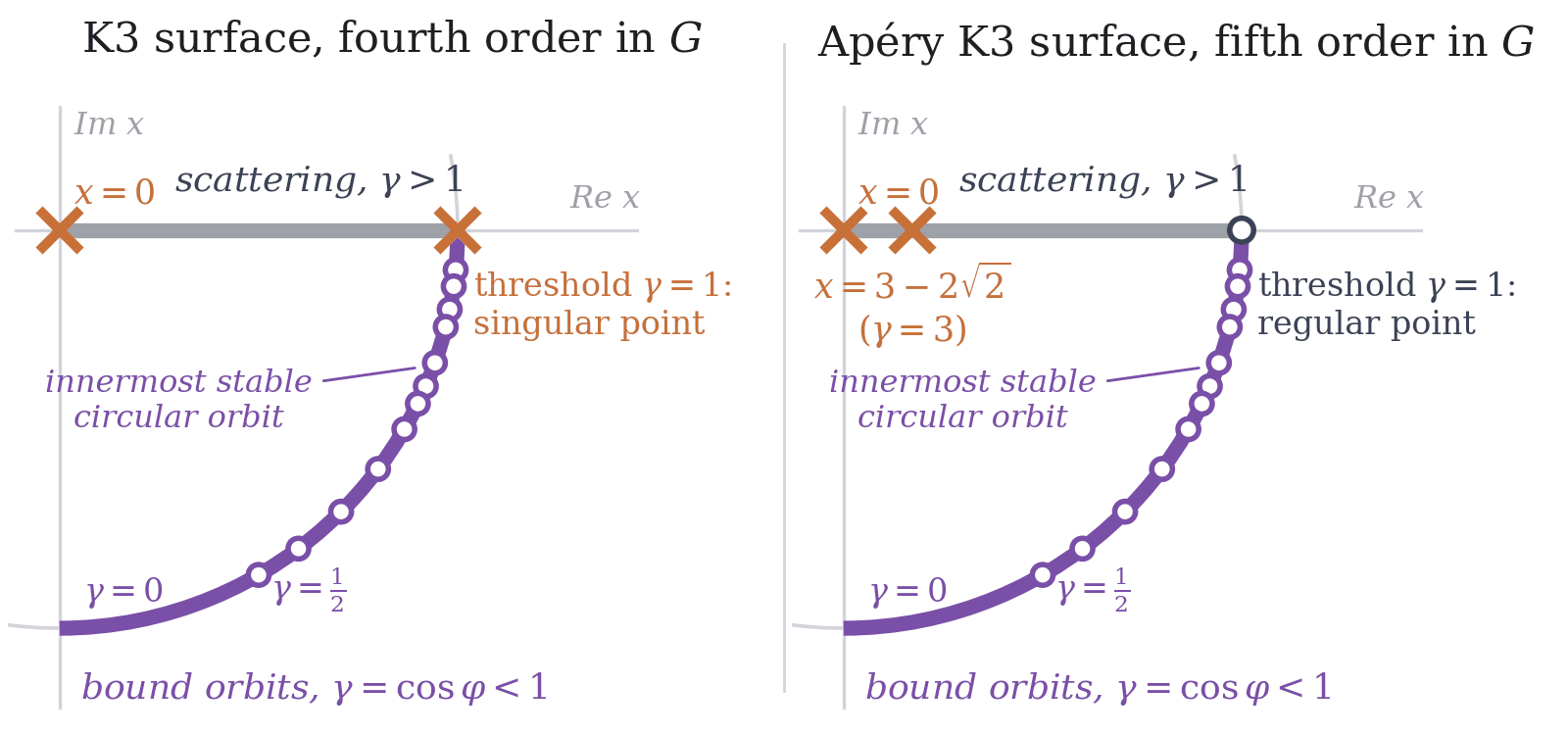
Where the periods can go singular: the K3 surface of fourth order (left) and the Apéry K3 surface of fifth order (right), each drawn in the complex plane of the velocity variable $x$ (adapted from two of the four panels of Figure 1 of the paper, redrawn in the variable $x$; the paper writes $\theta$ for the angle called $\varphi$ here). Scattering, $\gamma\gt1$, is the gray segment $0\lt x\lt1$. Bound orbits, $\gamma=\cos\varphi\lt1$, lie on the violet arc $x=e^{-i\varphi}$ of the unit circle, from the threshold $\gamma=1$ at $x=1$ around to $\gamma=0$; the open dots are the twelve bound energies at which the periods are evaluated, one of them the energy of the innermost stable circular orbit. Orange crosses are singular points of each surface’s Picard–Fuchs operator; the one at $x=0$ is the point of maximal unipotent monodromy, where the series solutions are expanded. The fourth-order periods are singular exactly at the threshold end of the arc. The Apéry operator’s singular point sits instead at $x=3-2\sqrt2$, the image of $\gamma=3$, inside the scattering segment, and its bound arc is free of singular points, threshold included.
The full Frobenius bases of the four operators are evaluated at twelve bound energies down to $\gamma=1/2$, including $\gamma=\sqrt{8/9}$, the energy of the innermost stable circular orbit of a Schwarzschild black hole. Each value is obtained by integrating the Picard–Fuchs equation in ball arithmeticNumerics in which every quantity is carried as a midpoint plus an error radius. along two paths that can be deformed into each other. Paths that wind differently around the singular points give bases related by a monodromy matrix: for the Apéry K3 the loop around $z_+$ gives the reflection matrix, and for the threefold at first order in the mass ratio an extra winding about $z=0$ gives the inverse monodromy there. To our knowledge the full bases of the Apéry K3 surface (K3′ in the paper) and of the threefold at first order in the mass ratio had not been evaluated at bound kinematics before.
A bound-orbit observable needs, beyond the continued periods, a map from scattering data to bound dynamics. The boundary-to-bound dictionary provides one for local-in-time contributions, but nonlocal-in-time tail terms can be mapped only at large eccentricity. For dissipative observables without tail logarithms, as at fourth order, it may be possible to map the fluxes directly to bound orbits, and their coefficient functions need only be evaluated at $\gamma\lt1$, where the continued periods are available.
The paper
- Landau singularity of the K3 maximal cut in black-hole scattering at fifth post-Minkowskian order (arXiv:2610.36128) — Matthew D. Schwartz.
Ancillary files
- memoryeffect-ancillary.zip (53 files, 1.3 MB) — the machine-readable data behind the paper’s tables. It holds the integral families and reduction setup, the master-integral lists, the response matrices and their null vectors, the boundary master integrals of PX2 with closed forms, the four Picard–Fuchs operators with their Frobenius matrices on the bound arc, and the data and closed forms for $c_M$. Scripts for the two proofs that the cut period generates the Apéry numbers and a script that checks the package are included, with a README mapping each file to its section or table.
References
| M. Driesse, G. U. Jakobsen, G. Mogull, C. Nega, J. Plefka, B. Sauer and J. Usovitsch, Conservative Black Hole Scattering at Fifth Post-Minkowskian and Second Self-Force Order, Phys. Rev. Lett. 137 (2026) 081402 | the conservative 5PM-2SF dynamics; the divergence at $\gamma=3$, the memory region, the conditions fixing its boundary integrals up to $c_M$, and the retarded routing |
| R. A. Porto and M. M. Riva, Black hole dynamics at fifth post-Newtonian order, JHEP 09 (2026) 075 | reproduce the retarded routing where the computations overlap; advocate a local-in-time version of the Feynman choice |
| D. Brammer, H. Frellesvig, R. Morales and M. Wilhelm, Classification of Feynman integral geometries for black-hole scattering at 5PM order, JHEP 10 (2025) 212 | no geometries beyond two K3 surfaces and two Calabi–Yau threefolds; source of the polynomial $Q_6$ |
| A. Klemm, C. Nega, B. Sauer and J. Plefka, Calabi-Yau periods for black hole scattering in classical general relativity, Phys. Rev. D 109 (2024) 124046 | the Picard–Fuchs operators of the 5PM geometries, including the Apéry operator of the K3 sector |
| F. Beukers and C. A. M. Peters, A family of K3 surfaces and $\zeta(3)$, J. Reine Angew. Math. 351 (1984) 42 | the K3 surface attached to Apéry’s numbers |
| L. D. Landau, On analytic properties of vertex parts in quantum field theory, Nucl. Phys. 13 (1959) 181 | the equations locating the singularities of a Feynman integral |
| D. B. Fairlie, P. V. Landshoff, J. Nuttall and J. C. Polkinghorne, Singularities of the Second Type, J. Math. Phys. 3 (1962) 594 | singularities from pinches at infinite loop momentum |
| S. Coleman and R. E. Norton, Singularities in the physical region, Nuovo Cim. 38 (1965) 438 | physical-region singularities as real classical processes |
| X. Liu, Y.-Q. Ma and C.-Y. Wang, A Systematic and Efficient Method to Compute Multi-loop Master Integrals, Phys. Lett. B 779 (2018) 353 | the auxiliary-mass flow |
| G. Kälin and R. A. Porto, From Boundary Data to Bound States, JHEP 01 (2020) 072 | the boundary-to-bound dictionary between scattering data and bound orbits |
| G. U. Jakobsen, G. Mogull, J. Plefka and B. Sauer, Dissipative scattering of spinning black holes at fourth post-Minkowskian order, Phys. Rev. Lett. 131 (2023) 241402 | noted that fluxes without tail logarithms may map directly to bound orbits |