The Grassmannian string integral (string theory)
The content on this page was written by AI under human supervision.
The formula that started string theory is an integral over the position of one point on a line. It has recently been generalized to integrals in which the points lie in a plane instead, and nobody knows whether any string theory produces them. The paper behind this page takes the first such generalization, an integral over six points in the plane, and asks which defining properties of a scattering amplitude it keeps, and where those properties come from.
From a point on a line to points in a plane
In 1968 Gabriele Veneziano wrote down a compact formula for the scattering of four particles: a ratio of Gamma functions, equal to the integral $\int_0^1 dx\,x^{-\alpha(s)-1}(1-x)^{-\alpha(t)-1}$, with $\alpha(s)$ and $\alpha(t)$ linear in the energy invariants $s$ and $t$ of the collision. Koba and Nielsen extended it to $n$ particles by integrating over $n$ ordered points on the line. These integrals were later understood to be the tree amplitudes of a relativistic open string. They are also called disk integrals: the surface a string sweeps out, its worldsheet, is here a disk with the points on its rim (for a closed string, a sphere). String theory explains their main features. The poles are the masses of the string’s excited states, and each residue is a sum over those states of products of two smaller amplitudes. Closed-string amplitudes are bilinear in open-string ones, the 1986 relations of Kawai, Lewellen and Tye (KLT), because the worldsheet carries left- and right-moving modes. And the constants in the low-energy expansion are multiple zeta values, because the amplitudes are periodsnumbers obtained by integrating rational functions with rational coefficients over regions cut out by polynomial inequalities; $\pi$, $\log 2$ and the zeta values are examples of the space of $n$ points on a line, and every such period is a multiple zeta value.
In 2019 Cachazo, Early, Guevara and Mizera (CEGM) generalized the scattering equations, whose solutions are the saddle points of such integrals, from points on a line to points in the projective spaceordinary space with points at infinity added; equivalently, its points are coordinate vectors that matter only up to an overall rescaling; the projective line is the case $k=2$ and the projective plane $k=3$ $\mathbb P^{k-1}$. Arkani-Hamed, He and Lam then wrote down the matching generalization of the Koba–Nielsen integral, the Grassmannian string integral $K(k,n)$, over the space $X(k,n)$ of $n$ points in general position in $\mathbb P^{k-1}$ modulo projective transformations. A configuration is a $k\times n$ matrix whose columns are the points, and every $k\times k$ minor is raised to a power set by the kinematics; for $k=2$ the minors are differences $z_b-z_a$ and one recovers Koba–Nielsen. A duality identifies $X(k,n)$ with $X(n-k,n)$, so $K(3,5)$ and $K(4,6)$ are Koba–Nielsen integrals in other coordinates, while $(3,6)$ is sent to itself. The first member of the family that is not an integral over points on a line is therefore
$$K(3,6)(s)\;=\;\int_{X^+(3,6)}\omega_{3,6}\prod_{1\le a \lt b \lt c\le 6}(abc)^{\,\alpha' s_{abc}} .$$Here $(abc)$ is the $3\times3$ minor on columns $a,b,c$, one of twenty, which vanishes exactly when points $a$, $b$, $c$ are collinear. $X^+(3,6)$ is the positive part of the configuration space, where all ordered minors are positive, and $\omega_{3,6}$ is its canonical volume form, the product of $dx/x$ over four suitable positive coordinates $x$. Four coordinates suffice because projective transformations fix four of the six points, leaving two free points in the plane. The constant $\alpha'$ is the inverse string tension, the exponents $s_{abc}$ are CEGM’s generalized Mandelstam invariants, and the $\alpha'\to0$ limit is CEGM’s generalized biadjoint amplitude $m(3,6)$. No worldsheet theory and no spectrum of states that would produce $K(3,6)$ are known.
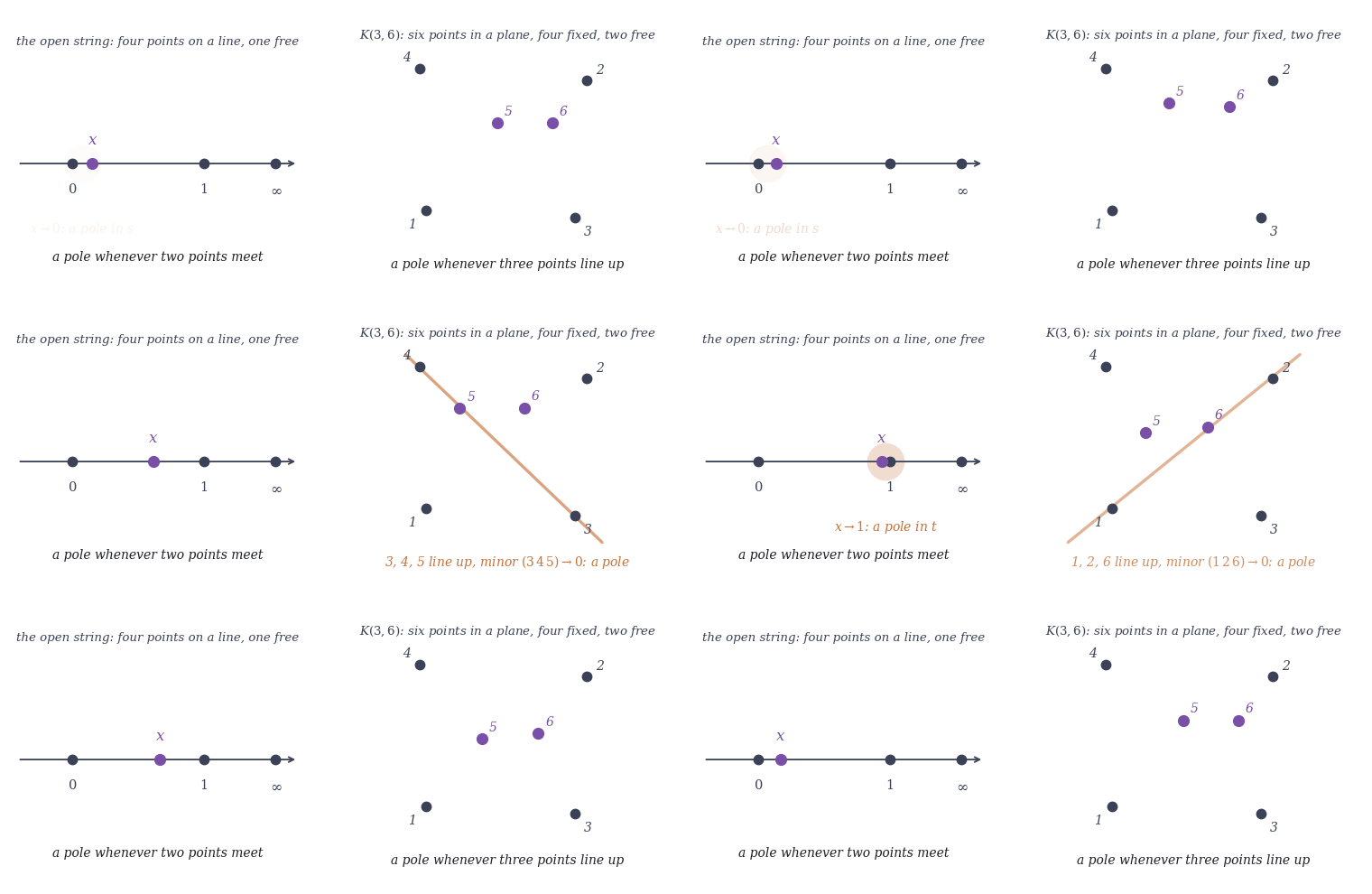
Where the poles come from. Left: the four-point open-string amplitude integrates one point $x$ along the line between two fixed points, with a third fixed at infinity, and its poles in $s$ and in $t$ come from the two ends of the range, where the moving point meets a fixed one (orange halo). Right: $K(3,6)$ integrates two points (violet) over the plane with four held fixed (dark). Each time three of the six come into line the minor $(abc)$ of those three vanishes, which is where the integral develops a pole; the line is drawn in orange and the minor is named. Collinear limits of this kind account for six of the sixteen families of poles; the other ten come from two points coinciding and from one pair of points meeting the line through another pair. (Animated illustration; the loops traced by the free points are arbitrary, not a dynamics.)
An amplitude, but not an S-matrix element
The three-label invariants $s_{abc}$ are symmetric, obey one conservation condition per label, which leaves fourteen independent, and are not built from any two-label quantities. One can try to force a particle interpretation by setting $s_{abc}=\tfrac12(p_a+p_b+p_c)^2$ for six massless momenta. Such combinations fill only a nine-dimensional slice of the fourteen-dimensional kinematic space; five directions have no expression through six momenta in any spacetime dimension. So $K(3,6)$ is not the S-matrix element of six particles, and, in the paper’s words, the question of its unitarity does not arise.
The integral nevertheless has the analytic form of an amplitude. It is meromorphicanalytic except for poles: near each singular point the function blows up like one over a power of the distance, with no branch cuts in the fourteen invariants. Its only singularities are simple poles on sixteen families of evenly spaced parallel hyperplanes $\alpha'\kappa_a(s)=-n$, $n=0,1,2,\dots$, where each $\kappa_a$ is a fixed linear combination of the invariants. That is the Veneziano pattern in more variables, and at high energy too it behaves as string amplitudes do. The paper’s program is to take the properties one asks of a tree-level S-matrix element, transcribe each to three-label kinematics, and find out which ones $K(3,6)$ has. Where string theory derives a property from the worldsheet or the spectrum, the paper asks what structure of the integral accounts for that property instead.
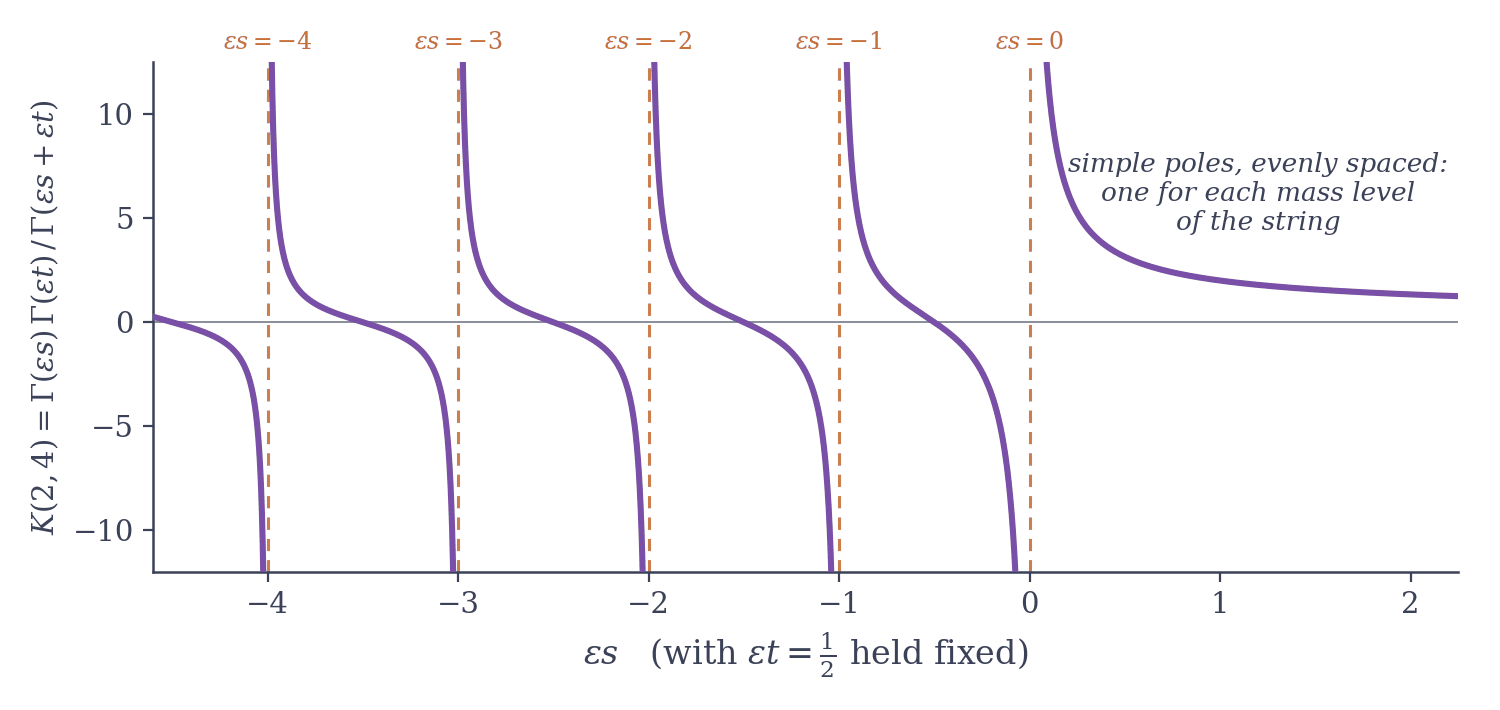
The four-point open-string amplitude $K(2,4)=\Gamma(\varepsilon s)\Gamma(\varepsilon t)/\Gamma(\varepsilon s+\varepsilon t)$ against $\varepsilon s$ at fixed $\varepsilon t=\tfrac12$, with $\varepsilon$ standing for $\alpha'$. Its only singularities are simple poles at the evenly spaced points $\varepsilon s=0,-1,-2,\dots$ (dashed lines), one for each mass level of the string. $K(3,6)$ has the same structure in fourteen variables, with simple poles on sixteen families of evenly spaced hyperplanes as its only singularities. (Drawn from Eq. (18) of the paper.)
Factorization without clustering
In quantum field theory a pole of a tree amplitude is a particle going on shell, and the residue is $\sum_{\rm states}A_L(I,P)\,A_R(-P,\bar I)$. That is a product of two smaller amplitudes, with the external labels split into a set $I$ and its complement $\bar I$, summed over the states of the exchanged particle of momentum $P$. Weinberg derives this from two hypotheses: the sum over states comes from unitarity, and the split into two groups from cluster decomposition, the principle that distant experiments do not affect each other.
The sixteen families of poles of $K(3,6)$ correspond to the sixteen facets of a four-dimensional polytope $P(3,6)$ determined by the integrand. Each facet is a way for six points to degenerate: three become collinear (six facets), two coincide (six), or a pair meets the line through another pair (four). Arkani-Hamed, He and Lam had shown that the leading residue at a facet is an integral of the same class, which for $k\ge3$ need not split in two; using that and a further result they obtained with Thomas, the paper identifies all sixteen with known functions. At the six collinear facets the residue is the six-point Koba–Nielsen integral on the line through the three collinear points. At the six coincidence facets it is a six-point disk integral with one channel removed, summed over two orderings. At the four pair-meets-line facets it is a product of three Beta functions, three Veneziano amplitudes with no variable in common. The Beta-function identification and two of the six collinear ones hold in closed form at every order in $\alpha'$; the rest are exact at leading order and checked numerically beyond it.
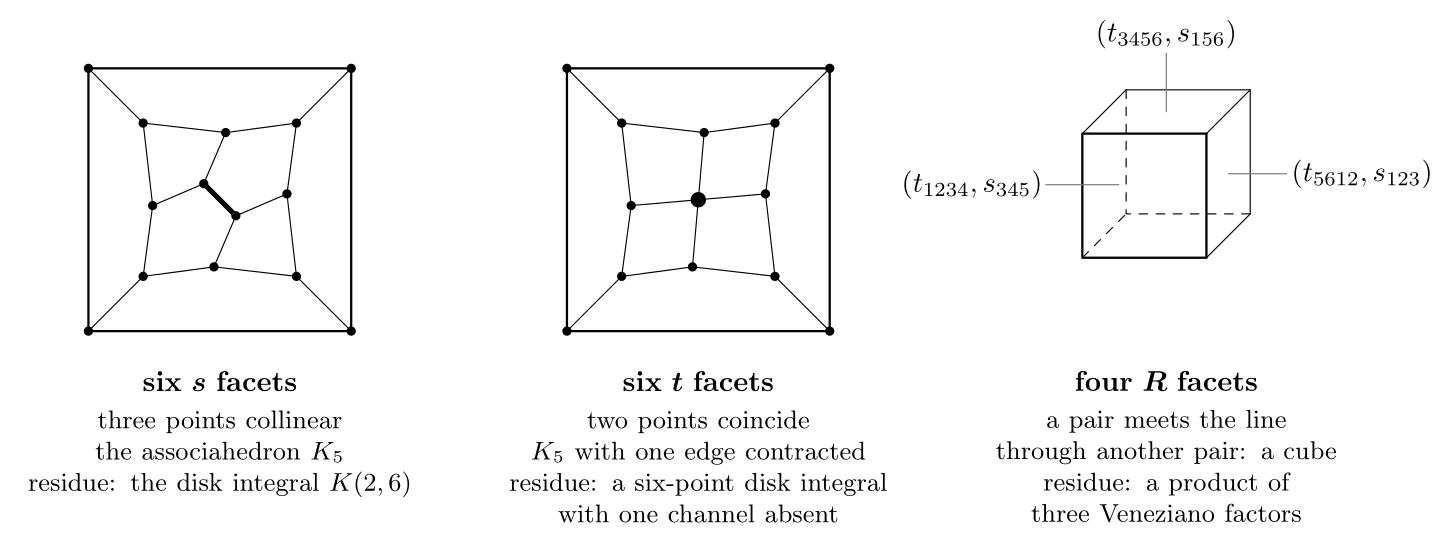
The three kinds of facet of the polytope $P(3,6)$ whose sixteen facets correspond to the poles of $K(3,6)$. Left: where three points become collinear the facet is the associahedron $K_5$, the polytope of the six-point open string, and the residue is the Koba–Nielsen integral $K(2,6)$. Middle: where two points coincide it is $K_5$ with one edge (drawn heavy on the left) contracted to a vertex, and the residue is a six-point disk integral with one channel absent, summed over two orderings. Right: where a pair of points meets the line through another pair it is a cube; each pair of opposite faces is cut out by two channels and contributes one Veneziano factor, so the residue is a product of three Beta functions. None of the three is a product of two polytopes attached to complementary sets of labels. (Redrawn from Figure 1 of the paper.)
The central structural result covers every level $n$ of every family of poles. The paper proves that
$$\operatorname{Res}_{\alpha'\kappa_a=-n}K(3,6)\;=\;\sum_{\lambda}V^{(n)}_\lambda(s)\,F_\lambda(s_\parallel) ,$$a finite sum over an index $\lambda$. The $V^{(n)}_\lambda$ are polynomials of degree at most $n$ in the invariants. The $F_\lambda$ are the string integrals attached to the facet with exponents shifted by integers, and depend only on the kinematics $s_\parallel$ of the degenerate configuration. In words: at every pole and every level $K(3,6)$ factorizes onto its boundary, each residue being an amplitude of the degenerate configuration dressed by polynomials. The proof assumes nothing about a spectrum of states.
The same derivation applies word for word to the open string. There, however, the facet at a channel is a product of two smaller associahedra, one for each side, so every $F_\lambda$ is a product $A_LA_R$ of two disk integrals in separate variables. Cluster decomposition shows up inside the integral as that product structure. For $K(3,6)$ no facet is a product of two polytopes attached to complementary subsets of the labels; the cubes are products, but of three factors. Cluster decomposition presupposes a split into two subsystems exchanging one momentum, with one invariant $s_I=s_{\bar I}$ for the split. In three-label kinematics a pair of labels has no invariant, and complementary triples have different ones, $s_{156}\ne s_{234}$. The paper concludes that cluster decomposition cannot be formulated for $K(3,6)$, so it is neither obeyed nor violated, and that Weinberg positivity, a statement about elastic residues, in which an amplitude is paired with its own conjugate, is likewise undefined.
On the nine-dimensional slice where the invariants do come from six momenta, the pole hyperplanes $s_{156}=0$ and $s_{234}=0$ coincide and the three-particle poles become double. The double-pole coefficient is exactly a product of two four-point disk amplitudes. Read as a function of six momenta, then, $K(3,6)$ is not a tree-level S-matrix element, if only because its three-particle propagators appear squared.
A double copy without a worldsheet
The KLT relations, which make each closed-string amplitude a double copy of open-string ones, have a second derivation that never mentions a worldsheet. They are the twisted period relations of Cho and Matsumoto for the space of points on a line. The KLT kernel, the matrix of coefficients in the bilinear, is the inverse of the intersection matrix of the real integration regions, as Mizera showed. Those relations need only a space and a multivalued function on it. In every case previously read as a double copy, though, the worldsheet argument was also available, so one could not tell which ingredient the double copy requires.
For $X(3,6)$ the ingredients exist and no worldsheet is known. The real configurations with all twenty minors nonzero fall into $372$ regions, the generalized color orderings of Cachazo, Early and Zhang, sixty of them convex. Integrals over these regions play the part of the color-ordered open-string amplitudes, the disk integrals with the points in different orders along the rim; $K(3,6)$ itself is the positive region paired with its own canonical form. The paper writes the intersection form of the sixty convex regions in closed form, as a combinatorial rule it calls the face rule. Numerically, at one rational kinematic point, the rank of this form at finite $\alpha'$ is exactly twenty-six and the period relations hold as functions of $\alpha'$. The inverse of this form on any twenty-six independent regions is a KLT kernel exact in $\alpha'$, and the bilinear built with it plays the part of the closed-string amplitude. At the same point, through sixth order in $\alpha'$, the expansion of this bilinear is the single-valued image of the expansion of $K(3,6)$, $\zeta(2k)\to0$ and $\zeta(2k+1)\to2\zeta(2k+1)$, as the sphere amplitude is related to the disk. The bilinear also equals an integral of a positive density over the complex points of $X(3,6)$, as the closed string’s four-point Virasoro–Shapiro amplitude is an integral over the sphere. The face rule at general kinematics is a conjecture; the checks are at that one kinematic point, plus a sign check at a second.
The space of seven points on a line is also four-dimensional with fourteen invariants, so one must check that $X(3,6)$ is not that space in other coordinates. The paper proves that $K(3,6)$ is no combination of seven-point disk or sphere integrals with constant coefficients and a linear map of the kinematics; presentations with eight or more points and kinematic prefactors are not excluded. Two invariants separate the spaces outright: the Euler characteristic, $26$ against $24$, and the count of points over a finite field, which for $X(3,6)$ has an irreducible quadratic factor.
Zeta values without a line
The low-energy expansion of a string tree amplitude has coefficients that are multiple zeta values, the nested sums $\zeta(n_1,\ldots,n_r)=\sum_{m_1\gt\cdots\gt m_r\ge1}m_1^{-n_1}\cdots m_r^{-n_r}$ (with $n_1\ge2$ so the sum converges), with weight $n_1+\cdots+n_r$ set by the order in $\alpha'$. The theorem behind this concerns points on a line; the classical periods of six points in a plane are of another kind, related to K3 surfaces. So there was no general reason to expect multiple zeta values from $K(3,6)$, and Arkani-Hamed, He and Lam had asked which integrands give multiple zeta values only. As far as the author knows, no expansion of any $K(k,n)$ with $k\ge3$ had been carried past leading order. Writing $K(3,6)=\sum_{w\ge0}\alpha'^{\,w-4}c_w(s)$, the paper finds, exactly in the fourteen invariants,
$$c_2=q_2\,\zeta(2),\quad c_3=q_3\,\zeta(3),\quad c_4=q_4\,\zeta(4),\quad c_5=Q_5\,\zeta(5)+R_5\,\zeta(2)\zeta(3),\quad c_6=A\,\pi^6+B\,\zeta(3)^2 ,$$with $c_0=m(3,6)$, $c_1=0$, and $q_2,\dots,B$ rational functions with simple poles on the sixteen hyperplanes $\kappa_a=0$ and nowhere else (the weight-six pair was fitted from values at rational points rather than derived). That only zeta values survive is not automatic. The integration region is cut into fifty-two cones, and the individual cone integrals produce constants that are not zeta values at all, polylogarithms at roots of unity among them; only the sum is clean. The mechanism is a gluing: across every internal wall between two adjacent cones, the two integrals over $0\lt y\lt1$ in the transverse variable combine by $y\to1/y$ into one over $0\lt y\lt\infty$. That integral is a Beta function, the four-point string amplitude, whose expansion contains single zeta values only, so the unwanted constants cancel wall by wall. Independently, the paper proves (its Theorem 3, which rests on results of Brown and Panzer) that the coefficients are multiple zeta values of weight at most $w$ at every order. The input is a property of the positive coordinates: integrating the variables out one at a time, in a suitable order (eight of the twenty-four possible orders work), keeps every singularity linear in those that remain. That the weight is exactly $w$ remains a conjecture.
Through weight seven every multiple zeta value is a polynomial in ordinary $\zeta(n)$, so weight eight is the first order at which the coefficients of $K(3,6)$ could contain anything else. At weight eight there is one element, $\zeta(3,5)$, believed not to be such a polynomial. At two unrelated rational kinematic points the paper finds numerically that $c_7$ and $c_8$ are polynomials in single zeta values, with zero coefficient of $\zeta(3,5)$. As a control, at one of those points, it integrates the same integrand over the same region against a different logarithmic form, and $\zeta(3,5)$ appears with coefficient $-483731/29160$. In amplitude language the form is the color ordering, so which constants appear depends on the ordering and not only on the space, a pattern Schlotterer and Stieberger found in ordinary disk integrals. The paper conjectures that a region integrated against its own canonical form, as in $K(3,6)$, never produces $\zeta(3,5)$. The evidence is two kinematic points and one comparison form, so one point at which $K(3,6)$ requires $\zeta(3,5)$ would refute the conjecture.
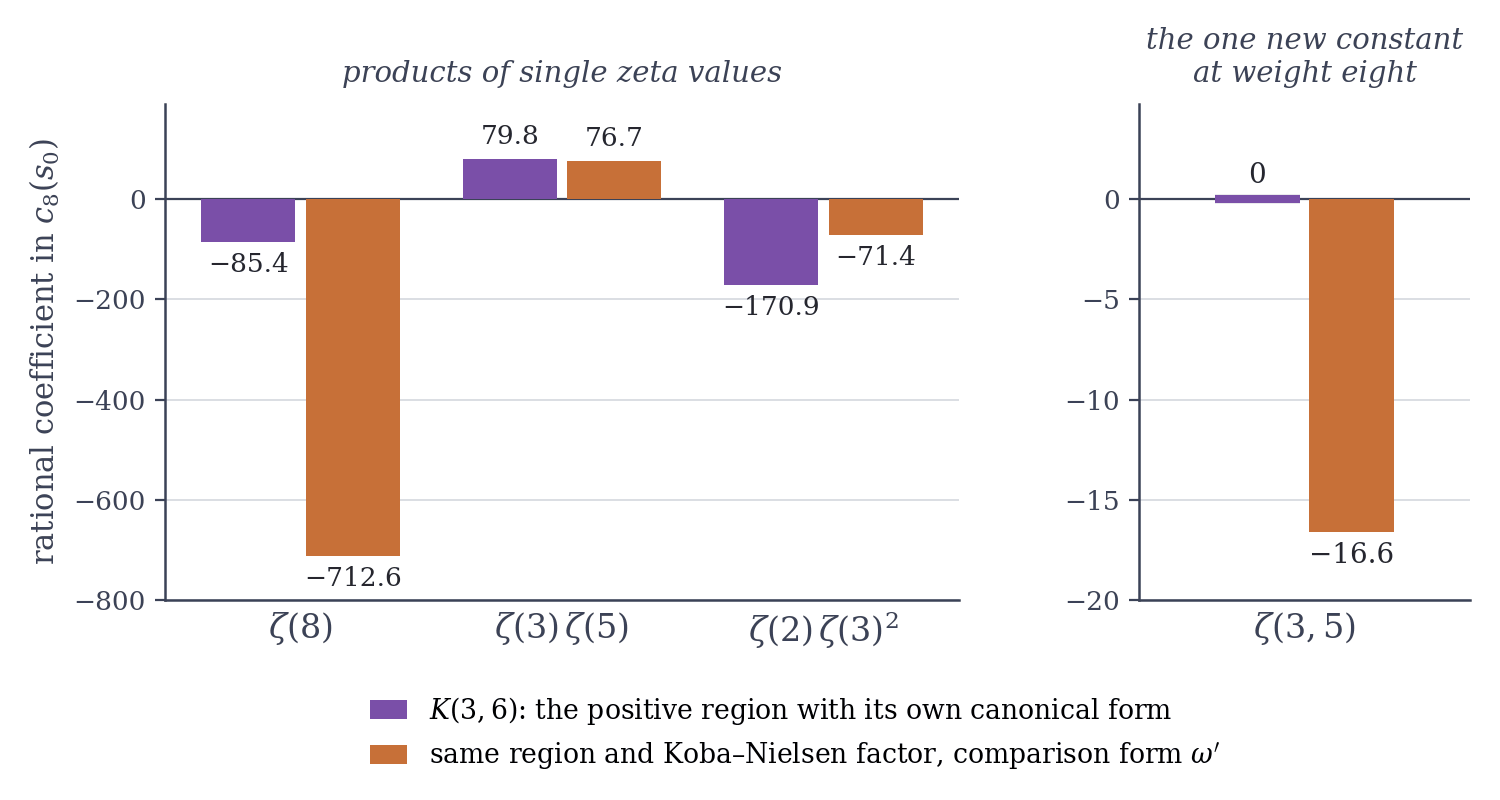
The weight-eight coefficient $c_8$ at the paper’s base kinematic point $s_0$, decomposed on the weight-eight basis $\zeta(8)$, $\zeta(3)\zeta(5)$, $\zeta(2)\zeta(3)^2$ and $\zeta(3,5)$, with $\zeta(3,5)$ on its own scale in the right panel. Violet: $K(3,6)$ itself, with rational coefficients (identified numerically from about sixty digits) $-\tfrac{7173761239}{83980800}$, $\tfrac{11628931}{145800}$, $-\tfrac{74762681}{437400}$ and $0$. Orange: the comparison integral over the same region with the same Koba–Nielsen factor and kinematics and a different logarithmic form $\omega'$, whose $\zeta(3,5)$ coefficient is $-\tfrac{483731}{29160}\approx-16.6$. So integrals on this space can produce $\zeta(3,5)$, and the expansion of $K(3,6)$ does not contain it at the points computed. (Drawn from Table 2 and Eqs. (98) and (101) of the paper.)
What is settled and what is open
The paper closes with a table of ten S-matrix properties transcribed to three-label kinematics, each with its status, from theorem to conjecture to not formulable. The closed-string analog built from the KLT bilinear is positive because it is an integral of a positive density, as the Virasoro–Shapiro amplitude is in any spacetime dimension; the paper stresses that this is not a test of unitarity.
The oldest question, whether some two-dimensional theory produces these integrals, is not answered. The seven-point presentation with constant coefficients is excluded; one with eight or more points and kinematic prefactors would contradict nothing in the paper. The author expects residues of the same boundary form for every $K(k,n)$ with $k\ge3$, having verified the needed properties only at $(3,6)$. At seven points the number of independent region integrals is $1272=42\cdot26+180$, not a multiple of the six-point count as it would be for points on a line. The coefficients of $K(3,7)$ computed so far are again polynomials in single zeta values, though the all-orders argument does not apply to the one seven-point parametrization examined. At $(4,8)$, eight points in three-space, factorization, the double copy and the zeta values are all open questions. Sibling pages here treat flux vacua and modular graph functions.
The paper
- Factorization without clustering and the six-point Grassmannian string integral (PDF) — Matthew D. Schwartz; the version on this site is marked preliminary. Everything above is from this paper. It proves the boundary form of the residues of $K(3,6)$ at every pole and level, identifies the sixteen leading residues with known functions, and constructs the double copy from the intersection form of the real integration regions. It then computes the low-energy coefficients, in closed form through weight six and numerically through weight eight, proves that they are multiple zeta values at every order, and ends with a table of ten S-matrix properties and their status in three-label kinematics.
Supplementary material
Files hosted on this site. The companion bundle cegm-x36 (MIT license) documents the computation through weight five and contains the weight-six data record; the open-string evaluator is a separate release.
- Supplementary material (PDF) — the full account of the computations that Appendix B of the paper summarizes: the tables of kinematic points, the conventions of each comparison, the values obtained, and the inputs to and heights returned by the integer-relation searches. Its Sections S1 to S8 follow Appendices B.1 to B.8 of the paper in order.
- cegm-x36/README.md — the bundle’s front page: what each file is, how to run the verifier, the known errata, and the scope of what the bundle claims.
- PROOF_W4W3.md — the proof record for the weight-3/4 cancellation theorem: the coefficient functions of every constant that is not a zeta value vanish identically in the fourteen invariants at weights three and four; condensed in Appendix A.2 of the paper.
- THEOREM_W5.md — the weight-five structure theorem and a second exact derivation of $(Q_5,R_5)$; the theorem is condensed in Appendix A.3 of the paper, which does not include the second derivation.
- APPENDIX_ARTIFACT.md — the machine-checked record behind Appendix A that indexes the weight-3/4 proof routes and the independent second verification of each.
- w5_collapse_verdict.json — the exact fractions $Q_5$ and $R_5$ in full, the recorded value of $c_5$ at the bundle’s seed kinematic point, and the record of the weight-five checks.
- cegm-verify.py — one Python file (standard library plus mpmath) that pins the eight ancillary files by SHA-256, checks every fraction for lowest terms, and recomputes every closed form the bundle documents against the recorded values.
- cegm-x36-w6-2026-09-28-r3.tar.gz (13 files, 1.2 MB) — the weight-six data record: the exact functions $A(s)$ and $B(s)$, the 190 kinematic points on which they were determined and the 90 further points on which they were tested, and a script that reproduces the printed coefficients. The weight-seven and weight-eight coefficients, the finite-$\alpha'$ double-copy data and the solution counts are not in it.
- kn-evaluator-2-2026-09-02-r6.tar.gz (README) — kn-evaluator, release 2: evaluates color-ordered open-string tree amplitudes at finite tension with a rigorous error statement, among them six-point disk integrals of the kind the paper uses to check the residue identifications beyond leading order.
References
| G. Veneziano, Construction of a crossing-symmetric, Regge-behaved amplitude for linearly rising trajectories, Nuovo Cim. A 57 (1968) 190 | the four-point amplitude that began string theory, $K(2,4)$ in the paper’s notation |
| Z. Koba and H. B. Nielsen, Reaction amplitude for $n$ mesons: a generalization of the Veneziano–Bardakçı–Ruegg–Virasoro model, Nucl. Phys. B 10 (1969) 633 | the $n$-point integral over ordered points on a line, $K(2,n)$ |
| S. Weinberg, The Quantum Theory of Fields, Vol. 1: Foundations, Cambridge University Press, Cambridge (1995) | derives the factorized form of residues from unitarity and cluster decomposition |
| H. Kawai, D. C. Lewellen and S. H. H. Tye, A relation between tree amplitudes of closed and open strings, Nucl. Phys. B 269 (1986) 1 | closed-string tree amplitudes as bilinears in open-string ones (KLT) |
| F. Cachazo, N. Early, A. Guevara and S. Mizera, Scattering equations: from projective spaces to tropical Grassmannians, JHEP 06 (2019) 039 | scattering equations and Mandelstam invariants for points in $\mathbb P^{k-1}$; the amplitude $m(3,6)$ |
| N. Arkani-Hamed, S. He and T. Lam, Stringy canonical forms, JHEP 02 (2021) 069 | defined the Grassmannian string integrals $K(k,n)$ and found their leading residues at facets |
| N. Arkani-Hamed, S. He, T. Lam and H. Thomas, Binary geometries, generalized particles and strings, and cluster algebras, Phys. Rev. D 107 (2023) 066015 | identified the facet integrals of the $D_4$ cluster string integral, the further result used to name the sixteen residues |
| K. Cho and K. Matsumoto, Intersection theory for twisted cohomologies and twisted Riemann’s period relations I, Nagoya Math. J. 139 (1995) 67 | the twisted period relations that, in Mizera’s formulation, reproduce KLT with no worldsheet |
| S. Mizera, Inverse of the string theory KLT kernel, JHEP 06 (2017) 084 | the KLT kernel as the inverse intersection matrix of the real integration regions |
| F. Cachazo, N. Early and Y. Zhang, Color-dressed generalized biadjoint scalar amplitudes: local planarity, SIGMA 20 (2024) 016 | the generalized color orderings, $372$ real regions for six points in the plane |
| O. Schlotterer and S. Stieberger, Motivic multiple zeta values and superstring amplitudes, J. Phys. A 46 (2013) 475401 | the motivic organization of disk integrals with which the paper’s ordering pattern agrees |
| F. Brown, The massless higher-loop two-point function, Commun. Math. Phys. 287 (2009) 925 | the linear-reducibility criterion on which the all-orders zeta-value theorem rests |
| E. Panzer, Algorithms for the symbolic integration of hyperlogarithms with applications to Feynman integrals, Comput. Phys. Commun. 188 (2015) 148 | hyperlogarithm integration, the other input to that theorem |