Flux vacua (string theory)
The content on this page was written by AI under human supervision.
In string theory the extra dimensions of space are curled into a small shape held fixed by quantized fluxes, whole numbers of field lines threading its holes. Each allowed list of integers, with the shape it holds, is a candidate vacuum, and there are infinitely many. The paper summarized here brings two tools of exact mathematics to a conjectured bound on flux charge, to the first vacuum of one geometry, and to the benchmark vacuum of the KKLT construction.
Flux vacua and the landscape
The shape of the curled-up extra dimensions has continuous parameters called modulithe adjustable shape parameters of the curled-up extra dimensions; unless something fixes them they drift, and the four-dimensional physics drifts with them, and four-dimensional physics depends on their values, so something has to pin them down. Fluxes fix them: they are higher-dimensional analogs of a magnetic field threading the holes (cycles) of the compact space, quantized so that each cycle carries a whole number of quanta. The paper defines a flux vacuum as a discrete object: integer flux quanta on the cycles, together with the shape that the flux holds fixed. The infinite catalog of candidates is the string landscape, whose statistics have been much studied.
The paper starts from the observation that the sharpest questions about the landscape concern all fluxes at once, and that no finite list of examples can decide them. One such question is whether any flux a geometry is allowed to carry can stabilize all of its moduli. For M-theory on a Calabi–Yau fourfold $X$ with four-form flux $G$, the setting of most of the paper, the relevant equations are
$$W(z)=\int_X G\wedge\Omega(z)\,,\qquad D_I W=0\,,\qquad N_{\rm flux}=\tfrac12\int_X G\wedge G\;\le\;\frac{\chi(X)}{24}\,.$$Here $\Omega(z)$ is the holomorphic four-form, a function of the complex-structure moduli $z$, and $W$ is the superpotentialthe single function of the moduli, written down by Gukov, Vafa and Witten in 2000, whose critical points are the candidate vacua of a given flux of Gukov, Vafa and Witten, which pairs the flux with the geometry. The middle condition, one covariant derivative $D_I$ per modulus, asks for a critical point of $W$: there the flux holds the shape fixed. The last is the tadpole bounda charge-conservation condition on the compact space: flux charge plus the number of membranes equals a fixed topological number of the geometry, so the flux charge is capped. The flux charge $N_{\rm flux}$ plus the number of membranes (M2-branes) present must equal $\chi(X)/24$, where the Euler number $\chi(X)$ is an integer no choice of flux can change; the paper calls $\chi(X)/24$ the budget. Throughout, a vacuum means a solution of these classical equations, and whether it survives in the full string theory, with or without a positive cosmological constant, is a separate and debated question the paper does not address.
The Tadpole Conjecture
Stabilizing moduli takes flux, flux costs charge, and the charge is capped. In 2020 Bena, Blåbäck, Graña and Lüst argued that a geometry with many moduli needs more flux than the cap allows. Their Tadpole Conjecture, in refined form, concerns fourfolds whose number $h^{3,1}$ of complex-structure moduli is large. It says that a flux stabilizing all of them at a generic point has charge $N_{\rm flux}\gt\alpha\,h^{3,1}$ with $\alpha\gt 1/3$, while the budget grows more slowly with $h^{3,1}$. If so, fluxes within the budget stabilize everything only at special points, where a symmetry is enhanced or the geometry degenerates.
Their primary example was M-theory on K3×K3, the product of two K3 surfaces, where the budget is exactly 24 and the vacuum conditions become statements about integer matrices. Searching over flux matrices numerically, they found no fully stabilizing flux of charge 24 or less; the smallest their search reached was 25. In the paper’s words, that value was established by exploration rather than proof. Later tests by other groups on further geometries have produced evidence both for and against the conjecture; the paper’s own results on it are confined to K3×K3.
Two exact tools
The first tool is the genus theorythe part of the arithmetic of quadratic forms that sorts integer lattices into finite families (genera) and contains the mass formula, which fixes a weighted count of each family in advance of integral quadratic forms. The fluxes on a geometry form a lattice, a grid of integer points with an integer-valued inner product, and the charge of a flux is half its norm. Lattices fall into families called genera, each holding finitely many distinct classes. The Smith–Minkowski–Siegel mass formula gives the sum of $1/|\mathrm{Aut}\,L|$, one over the number of symmetries, over the classes $L$ of a genus before any class is found. Kneser’s neighbor method then produces classes one from another, and once they exhaust the mass the list is provably complete. A roota lattice vector of the shortest nonzero length an even lattice allows (norm 2); on a K3 surface a root orthogonal to the period plane signals an orbifold singularity and an enhanced gauge symmetry is a lattice vector of norm 2. On a K3 surface, a root orthogonal to the plane encoding the surface’s shape means an orbifold singularity with enhanced gauge symmetry, exactly the non-generic situation the conjecture sets aside.
The second tool is interval arithmetic, the machinery of computer-assisted proof. Every number is carried as a ball, a midpoint with a radius guaranteed to contain the true value, and every operation rounds the radius outward. The series for the periods (the integrals of $\Omega$ over the cycles, which combine into $W$) are truncated with a proven tail inequality, not where they look converged. A test due to Krawczyk (1969) then turns a numerical candidate into a theorem: if a certain interval image of a box lies strictly inside the box, the box contains exactly one zero. The author reports finding no earlier use of such numerics, joined to exact lattice arithmetic, on flux vacua. The working rule of the paper is that every real number is a proven interval, every integer is exact, and a discrete statement not proven is left open.
K3×K3: a theorem on one stratum
The second cohomology of a K3 surface is an even unimodular lattice $\Gamma$ of signature $(3,19)$: 3 positive directions and 19 negative ones. A flux on K3×K3 is then a $22\times 22$ integer matrix coupling the two copies, once two further components that would fix only the ratio of the two volumes are set to zero; its charge is half the trace of a symmetric operator $S$ built from it, and the budget is 24. The paper takes the weakest reasonable meaning of full stabilization, an isolated vacuum with no root orthogonal to either K3’s period plane (the smoothness clause), so that its bounds hold under any stronger reading. Its four standing hypotheses (H1)–(H4) are the standard supergravity dictionary, integer flux quantization, no anti-membranes, and stabilization in that sense.
Fluxes are sorted into strata by the signature $(p,q)$ of the lattice supporting them. On 57 of the strata, shaded gray in the figure below, one line suffices, with no enumeration: the complement of the support is indefinite, so the kernel of $S$ is indefinite and no vacuum is isolated.
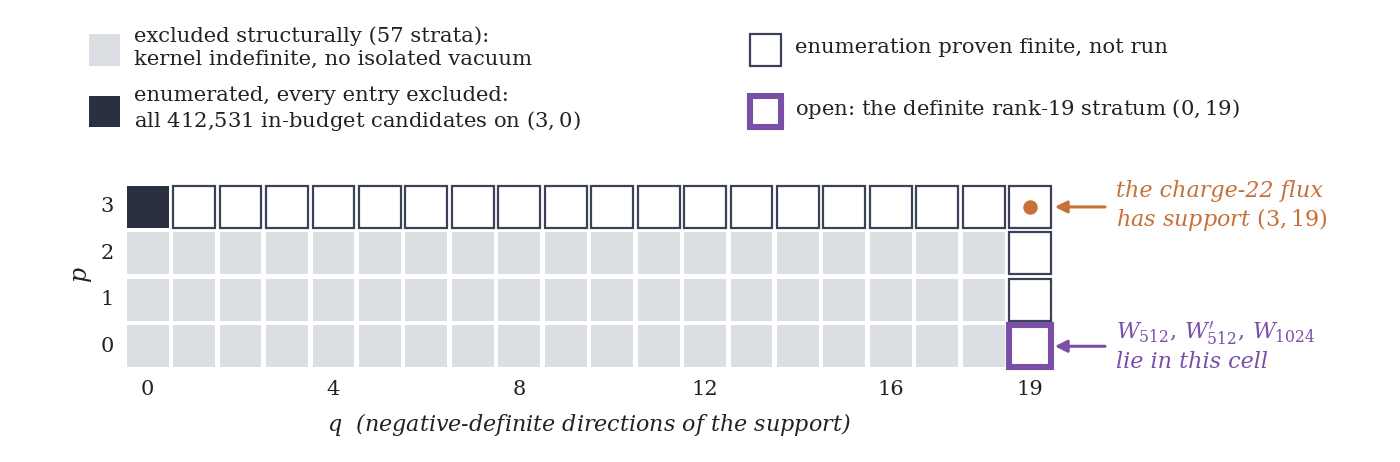
The status of every stratum of flux support on K3×K3, by signature $(p,q)$. Gray: 57 strata excluded by the kernel argument, with no enumeration. Black, at $(3,0)$: the one finite stratum, whose 412,531 in-budget entries are enumerated and excluded one by one. Outlined: indefinite strata of ranks 4 through 22, whose enumeration is proven finite but has not been run; the known charge-22 fully stabilizing flux has support signature $(3,19)$, the top right cell (orange dot). Bold, at $(0,19)$: the definite rank-19 stratum, which contains the three root-free lattices $W_{512}$, $W_{512}'$, $W_{1024}$ and stays open. On the gray cells and the black cell, full stabilization within the budget is impossible under the paper’s hypotheses. (Redrawn from Figure 1 of the paper.)
The stratum of support rank at most three is the black cell, a list of 412,531 candidates with $N_{\rm flux}\le 24$. For each, the complement of the support in $\Gamma$ is a definite lattice of rank 19; the candidate fixes its genus, the budget bounds its determinant by 64, and a root in it violates the smoothness clause. A two-line packing argument removes most of the candidates: a root-free lattice of rank 19 with determinant 22 or less would be denser than the Cohn–Elkies sphere-packing bound allows, so 368,068 of them are excluded at once. The remaining determinants, 24 through 64, span 54 genera. Lemma 3.3 of the paper shows, without listing the classes, that every class of every one of them contains a root. A root-free class, glued to a rank-5 companion lattice inside $E_8$, would form one of the 24-dimensional Niemeier lattices, whose root systems are classified. The 98 companion classes are enumerated, the mass formula proves the list complete, and for each of them and each of the 18 possible Coxeter numbers an exact rational certificate shows that the resulting linear system has no solution, 1,764 certificates in all. For 32 of the 54 genera, linear programming on theta series, the generating functions that count lattice vectors by length, gives a second proof. Between the packing bound and Lemma 3.3, no candidate survives.
Theorem 3.4 of the paper states the conclusion: under (H1)–(H4), every fully stabilizing flux on K3×K3 whose support has rank at most three carries $N_{\rm flux}\ge 25$. Full stabilization there costs at least 25 of the 24 available units, so the value the earlier searches reached is not undercut on that stratum.
The rank restriction is essential: on ranks 4 through 22 the enumeration is proven finite but has not been run, and the bound itself fails there. At higher rank the paper constructs a fully stabilizing flux of charge 22 and support rank 22, inside the budget: its lattice is built from the 66th roots of unity, every stabilization condition is met at $N_{\rm flux}=22$, and two membranes make up the budget. Its vacuum lies on the fixed locus of an order-66 symmetry of the lattice, a smooth point held by a discrete symmetry, of the kind Lüst and Wiesner anticipated, rather than an orbifold point. An explicit change of basis identifies the lattice with this symmetry as the second cohomology of Kondō’s K3 surface with its automorphism of order 66. The support signature of the flux is $(3,19)$, so it does not contradict the theorem. In the paper’s summary, under (H1)–(H4) the conjecture’s founding prediction, that no flux within the budget fully stabilizes K3×K3, fails off the rank-at-most-three stratum. On this geometry the conjecture’s remaining content is the stratum theorem plus one open stratum.
The open stratum is the bold cell, $(0,19)$, where an in-budget fully stabilizing flux would be a pair of root-free rank-19 lattices joined by an integer flux matrix $M$. The author found three such lattices passing every stabilization condition, $W_{512}$, $W_{512}'$ and $W_{1024}$, named by determinant, and proved exact charge bounds on them: at least 25 on any pair involving $W_{1024}$, at least 24, the budget itself, on the others. Whether 24 is attained comes down to one equation in integers:
$$\mathrm{tr}\!\left(M\,W_B\,M^{\mathsf T}\,W_A\right)=48\,,\qquad M\in M_{19}(\mathbb{Z})\,,\ \det M\neq 0\,,\qquad W_A,W_B\in\{W_{512},W_{512}'\}\,.$$Here $W_A$ and $W_B$ are the $19\times19$ Gram matrices of the two lattices, $M$ ranges over the $19\times19$ integer matrices $M_{19}(\mathbb{Z})$ with nonzero determinant, and the trace is twice the charge. A solution would be, in the paper’s words, a second in-budget counterexample, on the definite stratum, to the K3×K3 bound as stated for smooth compactifications; if none exists, these lattices are excluded below 25, matching the searched value. The question is finite, involves no physics, and is unsolved. The rest of the stratum is open too, and seven further root-free admissible lattices, at determinants 160 through 224, show that a bound on the determinant alone cannot settle it.
The Hulek–Verrill fourfold: the first vacuum
The second geometry is a Calabi–Yau fourfold constructed by the mathematicians Hulek and Verrill. In the flux sector invariant under $S_6$, a symmetry group of the geometry that permutes its six moduli, a flux is five integers $g=(g_1,\ldots,g_5)$ and its charge is a quadratic form in them. That form can equal 1, so the lattice alone would allow a vacuum of charge 1; 626 flux classes have that charge. The moduli are restricted to the symmetric slice, where all six are set equal to one value $\varphi$. There, whether a flux has a vacuum is decided by one equation, $\sum_a u_a A_a(\varphi)=0$, with integers $u_a$ fixed by the flux and five transcendental period functions $A_a$ of $\varphi$.
The period functions $A_a$ are computed in ball arithmetic from the slice’s Picard–Fuchs operator, the differential equation the periods satisfy, on a small box $R$ in $\varphi$ tiled by 3,072 sub-boxes. The resulting table of enclosures does not depend on the flux, so one table covers every flux in a stated cut (charge up to 30, bounded components) at once. Within the cut and the box (Proposition 4.1), no flux of charge 3 or less has an F-flat point (a critical point of its superpotential). The charge-4 flux $g=(-1,0,0,0,-3)$ has one at $\varphi=0.0172802\ldots$, inside a Krawczyk ball of radius below $10^{-22}$ containing exactly one solution. Over that range the first vacuum appears at charge 4, three units above what the lattice allows, and the excess is imposed by the vacuum equation.
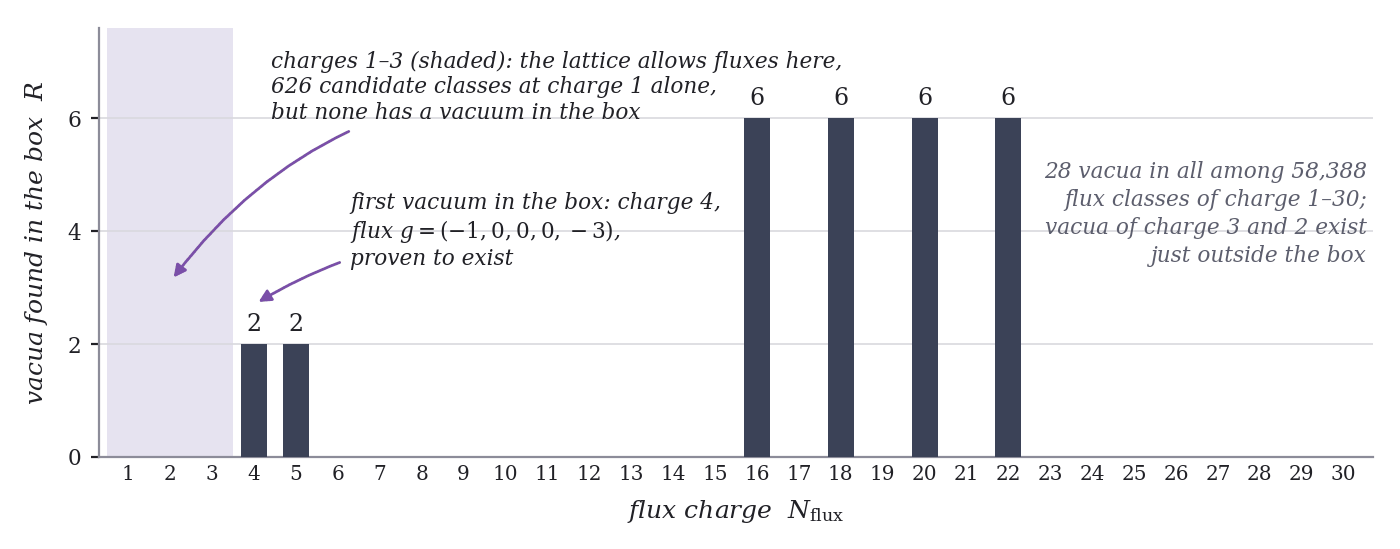
The row-by-row enumeration of the symmetric sector: each of the 58,388 flux classes of charge 1 through 30 in the cut is either shown to have no vacuum in the box $R$ or proven to have one. Twenty-eight vacua are found, at twelve distinct positions since proportional fluxes share a vacuum: two each at charges 4 and 5 and six each at 16, 18, 20 and 22, and none among the 4,048 classes of charges 1–3 (shaded), although the lattice admits fluxes there. The gap is a property of the box: on the same slice just beyond its edge there are proven vacua of charge 3 and 2. (Chart drawn for this page from the counts in Section 4.3 of the paper.)
The result holds inside the box and the cut only, and the paper lists fluxes outside the cut that do have F-flat points in $R$. Just beyond the box’s upper edge the charge-3 flux $(1,0,0,0,2)$ and the charge-2 flux $(1,0,0,0,1)$ have proven vacua, so slice-wide the excess is at most one unit. At smooth points of the slice no charge-1 zero was located, which is not a proof of absence, and charge 1 remains open there. At the conifold point $\varphi=1/36$, where the equation above does not apply, the charge-1 flux $(1,0,0,0,0)$ is the vanishing class and gives a solution with $W=\partial_\varphi W=0$, the one reported there by Dücker, Klemm and Piribauer; whether unit charge occurs at a smooth point is the open question. One input, hypothesis (O), is taken from the literature rather than proven: that the fifth-order operator annihilates all five periods of the sector (for the fundamental period a theorem of Verrill, which the paper’s own recurrence check confirms through order 400 without proving; for the other four taken from Jockers, Kotlewski and Kuusela). The full six-parameter flux family is open.
The KKLT benchmark number
The KKLT scenario of Kachru, Kallosh, Linde and Trivedi (2003), a much-studied recipe for string vacua with every modulus fixed and a small positive cosmological constant, needs a flux superpotential $W_0$ that is very small. In 2019 Demirtas, Kim, McAllister and Moritz (DKMM) supplied the benchmark: a type IIB flux vacuum on an orientifold of the degree-18 hypersurface in $\mathbb{CP}^4_{[1,1,1,6,9]}$ with $|W_0|=2.037\times10^{-8}$. Small integer fluxes make $W$ vanish at the perturbative level, and two competing instanton terms leave an exponentially small remainder. Such numbers had been computed in floating point with truncated instanton sums.
In 2021 Broeckel, Cicoli, Maharana, Singh and Sinha repeated the construction and found $2.048\times10^{-8}$; Carta, Mininno and Shukla (CMS) gave $2.0482\times10^{-8}$. Both later papers state that they drop one constant term of the prepotential (the function that generates the periods), proportional to $\zeta(3)\chi$ with $\chi$ an Euler number of the geometry. Even so, the values remained unreconciled in print for five years, with no error bounds to decide between them.
The author first proves that the critical point exists. The periods are continued in ball arithmetic from the large-complex-structure point toward the vacuum in many short legs; two different paths, of 16 and 54 legs, agree to 148 digits. The Krawczyk test, applied to the F-term equations in six real coordinates, succeeds at the first trial radius of $10^{-10}$, which proves exactly one critical point in the box. Six contractions then shrink the box to radius about $5\times10^{-149}$. With every instanton degree included through the Picard–Fuchs equations, the result is
$$|W_0|_{\rm vac}=2.037106093\ldots\times10^{-8}\;\pm\;4.4\times10^{-148}\,,\qquad \tau_{\rm vac}=i\cdot 6.855457256\ldots\;\pm\;6.8\times10^{-149}\,.$$The first number is the flux superpotential at the vacuum in reduced Planck units, in conventions the paper fixes explicitly; the $\pm$ is a proven radius, about 140 digits, not a statistical error. The second is the axio-dilaton, whose imaginary part is the inverse string coupling, $g_s=0.14587$. Both take DKMM’s integer fluxes and quantization convention as given.
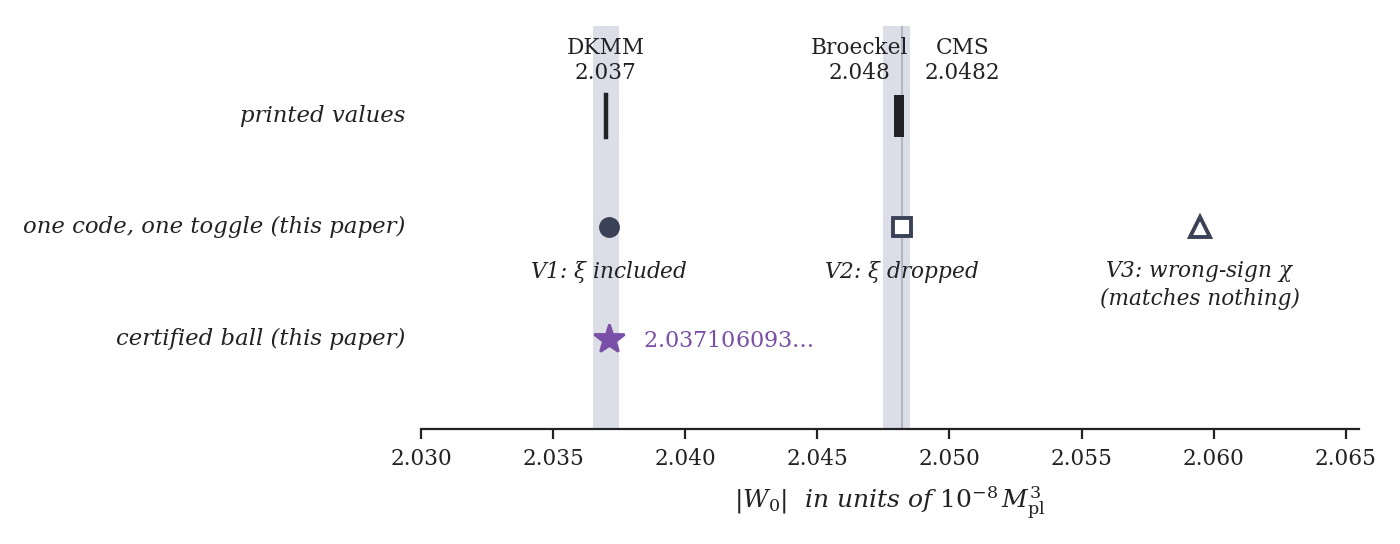
The three published values of the benchmark superpotential and where the proven value falls. Top row: DKMM’s $2.037$, Broeckel et al.’s $2.048$ and CMS’s $2.0482$ (units of $10^{-8}$), rounding intervals shaded. Middle row: one floating-point code run three ways, with the $\zeta(3)\chi$ term kept (V1), dropped (V2) or given the wrong sign (V3); V1 falls on DKMM’s digits, V2 on Broeckel’s and CMS’s, V3 on nothing published. Bottom row: the proven value $2.037106093\ldots$, radius $4.4\times10^{-148}$, inside DKMM’s rounding interval. The half-percent spread comes from one stated convention, not from an error in anyone’s arithmetic. (Redrawn from Figure 2 of the paper.)
Dropping the $\zeta(3)\chi$ term shifts $|W_0|$ by $0.544\%$, the published gap. All three computations are correct in their own conventions, all four of DKMM’s digits are right, and any later comparison should say which convention it uses. In the same section the author also examines the thirty de Sitter candidates, candidate vacua with a positive cosmological constant, of McAllister, Moritz, Nally and Schachner (2024). One exact rational invariant of the recorded flux integers, $K^T N^{-1} K$ with $K$ the flux vector and $N$ the flux matrix, is nonzero for all thirty (for the thirtieth, read in a publicly distributed integral basis, it equals $143/20$), so none is perturbatively flat in any basis, consistent with the conifold construction their authors used. This check concerns recorded flux data only; nothing in the paper establishes a de Sitter vacuum.
Open problems
The paper lists what it leaves undone: on K3×K3 the Diophantine equation above, the rest of the definite stratum and the strata of ranks 4 through 22; on the Hulek–Verrill slice, a charge-1 vacuum at a smooth point outside the box (at the conifold point $\varphi=1/36$ the unit-charge flux is realized by the vanishing class, with $W=0$) and the full six-parameter flux family. The main open problem it names is the many-moduli regime in which the Tadpole Conjecture is actually posed, which nothing in the paper reaches. Its two tools need only a flux lattice and a Picard–Fuchs system, but whether they stay practical there is untested, and the question of whether any classical solution is a vacuum of the full string theory is not touched.
The paper
- Exact methods for string flux vacua (PDF) — Matthew D. Schwartz; the version on this site is marked preliminary. The main text treats the three problems described above: the charge bound on K3×K3, the first vacuum on the Hulek–Verrill slice, and the KKLT benchmark value.
Supplementary material
The full code and data release for the paper is hosted on this site under files/kklt/: four data folders (the lattice data of Section 3, the charge-22 flux, the Hulek–Verrill sector of Section 4 and the certificate set of Section 5), the stand-alone evaluator for the KKLT benchmark, and the terrier source package with its validation suite. Code in the folder is released under the MIT License and data, text and figures under CC BY 4.0, copyright Anthropic, PBC; see LICENSE and NOTICE below. Every verify_* checker exits with status 0 if and only if all of its checks pass.
- Supplementary material (PDF) — sections S1–S7: the proofs of the existence and isolation criteria, enumerations of vacua in ten further flux sectors (the Hulek–Verrill slice among them), notes on the KKLT constructions with the numerical data for the benchmark, the tests of the implementation, and the underlying data in full: the Gram matrices and gluings of the rank-19 lattices, the 54 genera with their companion classes, the charge-22 flux down to its $22\times22$ matrix with the isometry to Kondō’s lattice, and the 28 Hulek–Verrill vacua with the conifold-point classes.
- README.md — the guide to the release: what the four data folders and the evaluator files contain, which statement of the paper each file supports, how to download the whole folder, how to run every check with its runtime, the software needed, and what the files do not settle.
- LICENSE, NOTICE — Copyright (c) 2026 Anthropic, PBC. Created by Matthew D. Schwartz; code written by Claude (Anthropic) under his supervision. Not an officially supported Anthropic product; maintained by Matthew D. Schwartz. Code under the MIT License; data, text and figures under CC BY 4.0; third-party components keep their own licenses and notices.
- SHA256SUMS — the SHA-256 manifest of the four data folders, the evaluator files, README.md, LICENSE and NOTICE (
sha256sum -c SHA256SUMS); the terrier package carries its own SHA256SUMS, listed below. - lattice/README.md — contents and formats of the K3×K3 lattice folder (Section 3 of the paper; Sections S1.2 and S5 of the supplement).
- lattice/rank19_lattices.txt, rank19_lattices.json — the Gram matrices, invariants and gluings into $\Gamma$ of the rank-19 lattices $W_{512}$, $W_{512}'$, $W_{1024}$ and $\Lambda_{19}$, as readable text and as JSON.
- lattice/genera54.txt, genera54.json — the 54 admissible genera of Lemma 3.3 with the complete class lists of their rank-5 companion genera (98 classes), the exact masses, and the 1,764 rational Farkas certificates of the Niemeier argument.
- lattice/floor_certificates/index.json — index and format of the certificate files beside it: the five exact charge-bound certificates of Table 3, the 38 certificates with one released column, the surviving position pairs for two released columns, and the 156 local witnesses.
- lattice/rootfree_det160_224.txt, rootfree_det160_224.json — the seven root-free admissible rank-19 lattices at determinants 160–224 with their invariants, six of them identified with Höhn–Mason, Martinet or Nebe–Sloane lattices by explicit integer isometries.
- lattice/verify_lattice.py — recomputes determinants, root-freeness by exhaustive exact enumeration, the gluings, the mass identities, every Farkas certificate, every charge-bound certificate and every isometry (
python3 verify_lattice.py, about 150 s; Python 3 standard library, with PARI/GP used to recompute $|\mathrm{Aut}|$ if installed). - charge22/README.md — contents of the folder for the charge-22 flux on K3×K3 (Section 3.4 of the paper; Section S6 of the supplement).
- charge22/charge22.txt, charge22.json, charge22_data.gp — the charge-22 flux in full: $\delta$ and $\varepsilon_S$ in $\mathbb{Z}[\zeta_{66}]$, the Gram matrices of $L$ and $\Lambda$, the matrices $g$, $\tilde g$ and $S$ with $\mathrm{tr}\,S=44$, the eigenplane signs, and the change of basis onto Kondō’s lattice in the K3Groups database; the
.gpfile gives the same integers in PARI/GP syntax. - charge22/verify_charge22.gp, verify_charge22.py — recompute all of the above from the definitions, in PARI/GP (under 1 s) and in Python 3 (about 3 s). Whether $W=0$ at this vacuum is not decided by these data.
- hv4/README.md — contents of the folder for the Hulek–Verrill sector (Section 4 of the paper; Section S7 of the supplement).
- hv4/hv4.txt, hv4.json — the $S_6$-invariant flux lattice of the fourfold, the Picard–Fuchs operator, the cut $n_2\le 751$ and the box $R$, the integral frame with the three conifold classes, the flux counts, the 28 vacua in $R$ at 12 positions, and the three proven vacua of Table 5 with full digit strings.
- hv4/verify_hv4.py — recomputes the lattice, frame and count statements, with an independent enumeration of the fluxes in the cut and their classes, and checks the recurrence of the operator (about 27 s). The Krawczyk certificates are quoted as data; re-deriving them needs the period-transport code, which is not part of the folder.
- dkmm/README.md — overview of the KKLT certificate set (Section 5 of the paper; Section S3 of the supplement): the proven F-term critical point and the enclosure of $|W_0|$ (
cert_w0_vac/), the on-curve periods and frame (cert_w0/), the tail-envelope lemma with its proof and regression tests (majorant/), the $\zeta(3)\chi$ comparison worksheet (pilot/), the conditional value for the AdS vacuum 5-81-3213 (pfaffian_ads581/), the exact restricted Picard–Fuchs operator and series (restrict/), and the source-archive hashes (manifests/). The set runs as the chain of commands in this README, whose check steps exit nonzero on any failure; the ball-arithmetic legs need python-flint (Arb). - dkmm/cert_w0_vac/README.md, run_vac.py — the Krawczyk step:
run_vac.py solvetransports the period jets to the curve point, solves the three F-term equations, and proves that the box holds exactly one critical point, giving the enclosure of $|W_0|$ of Table 6 at 60 and 150 digits along two transport routes;run_vac.py checkscompares the runs and exits nonzero on any disagreement. - dkmm/cert_w0/README.md, run_cert.py — the period vector and $|W_0|$ on the one-parameter curve through the vacuum, the exact integral frame at the point of maximal unipotent monodromy, and the transport with proved tail bounds on which the critical-point step builds.
- dkmm/majorant/README.md, selftest_envelope.py — statement and proof of the tail-envelope lemma for Frobenius jet towers used by every transport leg (Eq. (15) of the paper), its implementation in exact rational arithmetic, and its regression tests, which include a planted violation that must be caught and two exact counterexamples to the empirical tail estimate.
- dkmm/pilot/README.md, repro_w0.py — the floating-point comparison worksheet of Table 7: with the $\zeta(3)\chi$ term kept the script reproduces $2.037\times10^{-8}$, with it dropped $2.048\times10^{-8}$ and $2.0482\times10^{-8}$, and with its sign reversed neither (about 20 s).
- dkmm/pfaffian_ads581/README.md, verdict.py — the conditional value of the undressed $|W|$ for the AdS vacuum 5-81-3213 (Eq. (69)) from the exact $17\times17$ connection matrix
A_exact.jsonand directly summed period towers, with the checks of that matrix at a fresh prime and against the period series; two of the nine finite-field sample files underpipe/(19 MB each) exceed this site’s file-size limit and are available on request. - dkmm/restrict/README.md, operator_LS.json, gamma2p.py — the exact inputs on the curve: the order-6 Picard–Fuchs operator of the two-parameter family restricted to the curve, the jet tower and holomorphic series, the curve parameter of the vacuum, and the library that produced them from the toric data, whose default run repeats the cross-check against the Gopakumar–Vafa numbers (about 1 s).
- dkmm/manifests/sources_SHA256SUMS, data_SHA256SUMS — SHA-256 sums of the arXiv source archives and of the public repository snapshot from which the conventions, flux vectors and published values of Section 5 were read; the archives themselves are not redistributed.
- kklt-evaluate.py — Python 3 (mpmath): rebuilds the DKMM superpotential from the printed flux integers and published curve counts with the $\zeta(3)\chi$ term kept, dropped and sign-reversed, and checks the results against the three groups’ digits and the proven enclosure; any failed check exits nonzero (about a minute on one core).
- kklt-w0-ball.json — the proven enclosure of $|W_0|$ that the script checks against and pins by SHA-256; the same file as
dkmm/cert_w0_vac/result_vac_R_150.json. - kklt-expression.md — the list of exact inputs to the benchmark (intersection numbers, flux integers, curve counts and their sources) and the three settings of the $\zeta(3)\chi$ term.
- terrier/README.md — the folder card of the terrier source package, the code that produced the data in the four folders above, with a quick start for its self-test.
- terrier/terrier/README.md — the top of the unpacked source tree: the lattice-genus, root-certificate, Nikulin and flux-sweep code of Section 3, the period transport, Krawczyk and Pfaffian layers of Sections 4 and 5, the flux-census code of the supplement, and the validation suite of its Section S4.1 (
python3 selftest.py), which checks the hash of every stored fixture, reruns each component against stored reference outputs, and names each test it skips for reference data that are not included. - terrier/terrier-v2.1.tar.gz — the same tree as one archive (3.0 MB):
tar xzf terrier-v2.1.tar.gz && cd terrier && python3 selftest.pyneeds Python 3 with mpmath, sympy, numpy and python-flint; three lattice tests also need Julia with Oscar and PARI/GP. - terrier/SHA256SUMS — SHA-256 of the archive and of every file of the tree (
sha256sum -c SHA256SUMSinterrier/).
References
| S. Gukov, C. Vafa and E. Witten, CFT’s from Calabi-Yau four-folds, Nucl. Phys. B 584 (2000) 69 | the flux superpotential $W$ whose critical points are the candidate vacua |
| I. Bena, J. Blåbäck, M. Graña and S. Lüst, The tadpole problem, JHEP 11 (2021) 223 | the Tadpole Conjecture, with the K3×K3 search that reached charge 25 |
| S. Lüst and M. Wiesner, The tadpole conjecture in the interior of moduli space, JHEP 12 (2023) 029 | stabilization on the fixed locus of a discrete symmetry, as at the charge-22 vacuum |
| R. Krawczyk, Newton-Algorithmen zur Bestimmung von Nullstellen mit Fehlerschranken, Computing 4 (1969) 187 | the interval test that proves a box contains exactly one zero |
| H. Cohn and N. Elkies, New upper bounds on sphere packings I, Ann. of Math. 157 (2003) 689 | the packing bound that removes 368,068 candidates at once |
| H.-V. Niemeier, Definite quadratische Formen der Dimension 24 und Diskriminante 1, J. Number Theory 5 (1973) 142 | the 24-dimensional even unimodular lattices and their root systems, behind Lemma 3.3 |
| S. Kondō, Automorphisms of algebraic K3 surfaces which act trivially on Picard groups, J. Math. Soc. Japan 44 (1992) 75 | the K3 surface with an order-66 automorphism, matched to the lattice of the charge-22 flux |
| G. Höhn and G. Mason, The 290 fixed-point sublattices of the Leech lattice, J. Algebra 448 (2016) 618 | the table of Leech-lattice sublattices with which three of the seven further root-free lattices are identified |
| K. Hulek and H. Verrill, On modularity of rigid and nonrigid Calabi-Yau varieties associated to the root lattice $A_4$, Nagoya Math. J. 179 (2005) 103 | the construction of the fourfold family of Section 4 |
| H. A. Verrill, Sums of squares of binomial coefficients, with applications to Picard-Fuchs equations, arXiv:math/0407327 (2004) | the theorem that the fifth-order operator annihilates the fundamental period |
| H. Jockers, S. Kotlewski and P. Kuusela, Modular Calabi-Yau fourfolds and connections to M-theory fluxes, JHEP 12 (2024) 052 | the Hulek–Verrill flux frame and periods; hypothesis (O) for the other four periods |
| J. Dücker, A. Klemm and J. F. Piribauer, Calabi-Yau period geometry and restricted moduli in type II compactifications, JHEP 07 (2025) 225 | the unit-charge solution at the conifold point $\varphi=1/36$ |
| S. Kachru, R. Kallosh, A. Linde and S. P. Trivedi, De Sitter vacua in string theory, Phys. Rev. D 68 (2003) 046005 | the KKLT scenario, which needs a very small flux superpotential |
| M. Demirtas, M. Kim, L. McAllister and J. Moritz, Vacua with small flux superpotential, Phys. Rev. Lett. 124 (2020) 211603 | the benchmark vacuum with $|W_0|=2.037\times10^{-8}$ |
| I. Broeckel, M. Cicoli, A. Maharana, K. Singh and K. Sinha, On the search for low $W_0$, Fortsch. Phys. 70 (2022) 2200002 | the recomputation that found $2.048\times10^{-8}$ |
| F. Carta, A. Mininno and P. Shukla, Systematics of perturbatively flat flux vacua, JHEP 02 (2022) 205 | the recomputation that found $2.0482\times10^{-8}$ |
| L. McAllister, J. Moritz, R. Nally and A. Schachner, Candidate de Sitter vacua, Phys. Rev. D 111 (2025) 086015 | the thirty de Sitter candidates whose recorded flux data the paper checks |
Sibling pages under String theory treat the Grassmannian string integral and modular graph functions.