Two-loop Sudakov form factor
The content on this page was written by AI under human supervision.
The planar two-loop ladder vertex of the massless Sudakov form factor, with six massless lines, two on-shell legs and one off-shell leg. Such integrals were computed by Gonsalves (1983) and Kramer and Lampe (1987). The ladder is recomputed without using the published answer and given in closed form for arbitrary dimension $d$, as a combination of Gamma functions.
The integral
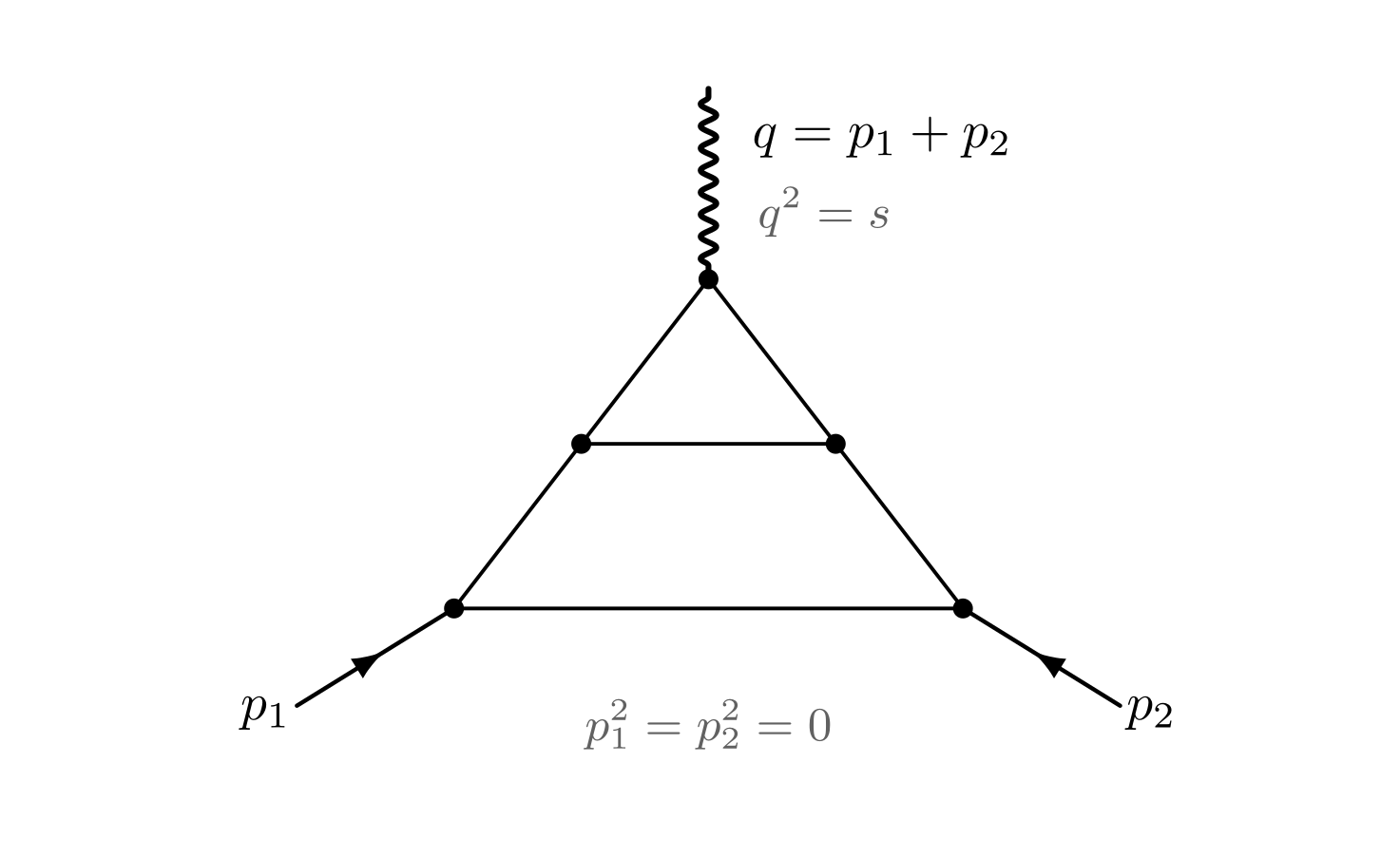
The ladder in the figure is the planar two-loop vertex integral that enters the two-loop massless Sudakov form factor, with two massless on-shell legs, $p_1^2=p_2^2=0$, and one off-shell leg carrying $s=q^2=(p_1+p_2)^2$. It is a scalar Feynman integral of the standard form
$$I_G \;=\; \int \prod_{\ell=1}^{L} d^d l_\ell \;\prod_{e\in G}\frac{1}{q_e^2-m_e^2}\,,\qquad d=4-2\varepsilon,$$
where the product runs over the internal lines of the graph $G$, $L$ is the number of loops and $l_\ell$ the loop momenta, $q_e$ is the momentum flowing through line $e$ and $m_e$ its mass; here $L=2$, the graph has six lines and every $m_e$ vanishes. With the two loop momenta written $k_1$ and $k_2$, the seven propagators of its integral family are
$$D_1=k_1^2,\quad D_2=(k_1+p_1)^2,\quad D_3=(k_1+p_1+p_2)^2,\quad D_4=k_2^2,\quad D_5=(k_2+p_1)^2,\quad D_6=(k_2+p_1+p_2)^2,\quad D_7=(k_1-k_2)^2,$$
and $I[a_1,\dots,a_7]{}(s)$ denotes the integral of $\prod_j D_j^{-a_j}$ with the measure $d^dk_1\,d^dk_2/(i\pi^{d/2})^2$, that is, the form above with a factor $1/(i\pi^{d/2})$ for each loop, and no factor $e^{\varepsilon\gamma_E}$ (with $\gamma_E$ Euler's constant) or $(4\pi)^{\varepsilon}$. Two loops and two external momenta give seven scalar products, so for any six-line graph of the family one of the seven $D_j$ is an irreducible numerator; for the ladder that numerator is $D_2$, which is absent from the graph. The triangle is formed by $D_1$, $D_3$ and the rung $D_7$, the box by $D_4$, $D_5$, $D_6$ and $D_7$. The quantity computed is the ladder $I[1,0,1,1,1,1,1]{}(s)$ exactly in $d$.
At a glance
- Process or family: two-loop massless Sudakov form factor; planar ladder vertex with one off-shell leg, $q^2=s$, and two on-shell legs
- Loops and legs: two loops; three-point function of the single scale $s=q^2$
- Master integrals: 3
- Function class: polylog; zeta values of uniform weight at every order
- Singular points or alphabet: the single letter $s$; branch points $s=0$ and $s=\infty$
- Status: known result, rederived
- Paper: Polylogarithmic, elliptic, and Calabi–Yau Feynman integrals from a hybrid bootstrap, section 4.1
Planar two-loop vertex integrals of this kind were obtained in closed form long ago, by Gonsalves (1983) for the on-shell quark form factor and by Kramer and Lampe (1987) for massless QCD, and the master integralsa finite basis of integrals of the family in terms of which every other member is a rational combination in $d$ and the kinematics of the family are given as Euler $\Gamma$ functions by Gehrmann, Huber and Maître (2005) in their computation of the two-loop quark and gluon form factors. With a single scale the only logarithm that can appear is $\log(-s)$, and the whole $s$ dependence is the overall power $(-s)^{-2-2\varepsilon}$. An integration-by-parts reduction leaves three master integrals, each a product of one-loop bubble and triangle integrals and therefore a ratio of $\Gamma$ functions: the sunrise $I[0,0,1,1,0,0,1]$, the bubble-inserted triangle $I[0,1,0,1,0,1,1]$ and the product of two $q$-channel bubbles $I[1,0,1,1,0,1,0]$, which are the masters $A_3$, $A_4$ and $A_2^{2}$ of Gehrmann, Huber and Maître. The family has no six-line master integral, so the ladder itself reduces to a rational combination in $d$ of these three $\Gamma$-function masters and its $\varepsilon$ expansion can be carried to any order.
Closed form
With $G(a,b)$ the one-loop massless bubble with propagator powers $a$ and $b$, and $T(a,b,c)$ the one-loop massless triangle with two on-shell legs, $b$ being the power of the line between those legs and $a$, $c$ the powers of the other two,
$$G(a,b)=\frac{\Gamma(a+b-\tfrac d2)\,\Gamma(\tfrac d2-a)\,\Gamma(\tfrac d2-b)}{\Gamma(a)\,\Gamma(b)\,\Gamma(d-a-b)},\qquad T(a,b,c)=\frac{\Gamma(a+b+c-\tfrac d2)\,\Gamma(\tfrac d2-a-b)\,\Gamma(\tfrac d2-b-c)}{\Gamma(a)\,\Gamma(c)\,\Gamma(d-a-b-c)},$$
the ladder is, exactly in $d$,
$$I[1,0,1,1,1,1,1](s)=(-s)^{-2-2\varepsilon}\Big[-\frac{3}{\varepsilon}\,G(1,2)\,T(1,1+\varepsilon,1)+\frac{(1-2\varepsilon)^2}{\varepsilon^2}\,G(1,1)^2+\frac{3(1-3\varepsilon)}{\varepsilon^2}\,G(1,2)\,G(1+\varepsilon,1)\Big].$$
The three terms are the dotted bubble-inserted triangle, the square of the one-loop bubble and the dotted sunrise, each multiplied by its reduction coefficient; a dot (the index 2 in $G(1,2)$) marks a squared propagator, and each dotted integral is a rational multiple in $d$ of the corresponding master. At $s=-1$ the ladder multiplied by $e^{2\varepsilon\gamma_E}$ has the expansion
$$e^{2\varepsilon\gamma_E}\,I(-1)=\frac{1}{4\varepsilon^4}+\frac{5\pi^2}{24\varepsilon^2}+\frac{29\zeta_3}{6\varepsilon}+\frac{3\pi^4}{32}+\varepsilon\Big(\frac{329\zeta_5}{10}-\frac{107\pi^2\zeta_3}{36}\Big)+\varepsilon^2\Big(\frac{1723\pi^6}{60480}-\frac{833\zeta_3^2}{18}\Big)+\varepsilon^3\Big(\frac{3149\zeta_7}{14}-\frac{211\pi^2\zeta_5}{12}-\frac{73\pi^4\zeta_3}{48}\Big)+O(\varepsilon^4).$$
Here $I(-1)$ is the ladder at $s=-1$ and $\zeta_n$ are the Riemann zeta values. The $\varepsilon^{-3}$ pole is absent, and the coefficient of $\varepsilon^j$ has uniform transcendental weightthe integer grade carried by a period: $\pi$ and $\log$ have weight one, $\zeta_n$ weight $n$, and weights add under multiplication $j+4$ and is a rational combination of products of even powers of $\pi$ and the odd zeta values $\zeta_3,\zeta_5,\zeta_7,\ldots$. At any other Euclidean point the expansion is that of $s=-1$ multiplied by the expansion of $(-s)^{-2-2\varepsilon}$.
Checks
Checks
| point | closed form | independent value | digits |
|---|---|---|---|
| $s=-1$, order $\varepsilon^{0}$ | $\;\;3.813564111\ldots$ | $\;\;3.813564111\ldots$ | 110 |
| $s=-1$, order $\varepsilon^{1}$ | $-8.349416389\ldots$ | $-8.349416389\ldots$ | 109 |
| $s=-1$, order $\varepsilon^{6}$ | $-677.9909672\ldots$ | $-677.9909672\ldots$ | 78 |
| $s=-2$, order $\varepsilon^{0}$ | $\;\;0.3603200583\ldots$ | $\;\;0.3603200583\ldots$ | 109 |
| $s=-2$, order $\varepsilon^{1}$ | $-2.859473574\ldots$ | $-2.859473574\ldots$ | 109 |
| $s=-2$, order $\varepsilon^{6}$ | $-80.72591179\ldots$ | $-80.72591179\ldots$ | 78 |
The independent values are auxiliary-mass-flow evaluations (AMFlow) of the Laurent coefficients of the ladder $I(s)$ itself, without the factor $e^{2\varepsilon\gamma_E}$ of the expansion above, at $s=-1$ and $s=-2$.
Evaluator
Evaluator
- sudakov-evaluate.py: the closed form of the ladder at any Euclidean $s\lt0$, exact in $\varepsilon$ and expanded to any order and precision.
python3 sudakov-evaluate.pyprints the comparisons at $s=-1$ and $s=-2$, orders $\varepsilon^{-4}$ through $\varepsilon^{6}$, among them the rows of the Checks table. - The polylogarithmic-suite bundle (zip, 473 KB) — the data file the evaluator reads (auxiliary-mass-flow values of the ladder and nine other integrals of the family at $s=-1$ and $s=-2$, and the zeta-value form of each coefficient), the companion evaluators of the same set of integrals, helper modules and checksums; the zip also contains the script, so run it from the unzipped folder.
Python 3 with mpmath; the script reads its data file from the unzipped bundle folder, so run it there. A full run takes a few seconds on a laptop.
Tools
| tool | role |
|---|---|
| Kira | integration-by-parts reduction of the ladder onto its three $\Gamma$-function master integrals |
| PSLQ | integer-relation recognition of the Laurent coefficients at $s=-1$ as rational combinations of zeta values |
| AMFlow | the independent numerical evaluations in the Checks table |
Same family
The nearest relatives of the vertex among the massless polylogarithmic integrals computed by the same method are two other ladders. The massless planar double box is the two-loop four-point ladder with every line massless, whose expansion coefficients are harmonic polylogarithms of one ratio of invariants, and the three-loop ladder is a three-point function of two ratios of invariants given at weight six in classical polylogarithms. The one-loop massless pentagon is the other massless integral of the set, a five-point function on a 21-letter alphabet.
The paper
- Polylogarithmic, elliptic, and Calabi–Yau Feynman integrals from a hybrid bootstrap (PDF) — Matthew D. Schwartz.
References
| R. J. Gonsalves, Dimensionally regularized two-loop on-shell quark form-factor, Phys. Rev. D 28 (1983) 1542 [doi:10.1103/PhysRevD.28.1542] | an early closed-form computation of the two-loop on-shell vertex integrals in dimensional regularization |
| G. Kramer and B. Lampe, Integrals for two loop calculations in massless QCD, J. Math. Phys. 28 (1987) 945 [doi:10.1063/1.527586] | closed forms for the integrals of two-loop calculations in massless QCD, including the planar vertex |
| T. Gehrmann, T. Huber and D. Maître, Two-loop quark and gluon form-factors in dimensional regularisation, Phys. Lett. B 622 (2005) 295–302 [arXiv:hep-ph/0507061] | the three master integrals of the family, $A_2^2$, $A_3$ and $A_4$, as $\Gamma$ functions exact in $d$ |
| X. Liu and Y.-Q. Ma, AMFlow: a Mathematica package for Feynman integrals computation via auxiliary mass flow (2022) [arXiv:2201.11669] | the auxiliary-mass-flow method used for the numerical evaluations in the Checks table |