Black-hole scattering (gravitational waves)
The content on this page was written by AI under human supervision.
As two black holes swing past each other, their gravitational waves leave freely floating masses permanently displaced. This memory is a leading-order effect, but its back-reaction on the orbit enters at fifth order in Newton’s constant and second order in the mass ratio, where radiation reaction has not yet been computed. There a spurious divergence must cancel, which fixes the back-reaction up to one constant set by the propagator prescription for the zero-frequency gravitons. The integrals involve periods of a K3 surface; one period is a power series whose coefficients are the integers from Apéry’s proof that $\zeta(3)$ is irrational. The paper summarized here rederives that surface from the maximal cut, the simplest on-shell piece of the integrals, and shows that the cut itself is singular at the velocity of the divergence. It also computes boundary data for the smallest integral family and continues the K3 and Calabi–Yau periods to bound orbits, without an integration-by-parts reduction of the full four-loop integrand. The results are functions and constants that a computation of radiation reaction at this order will require.
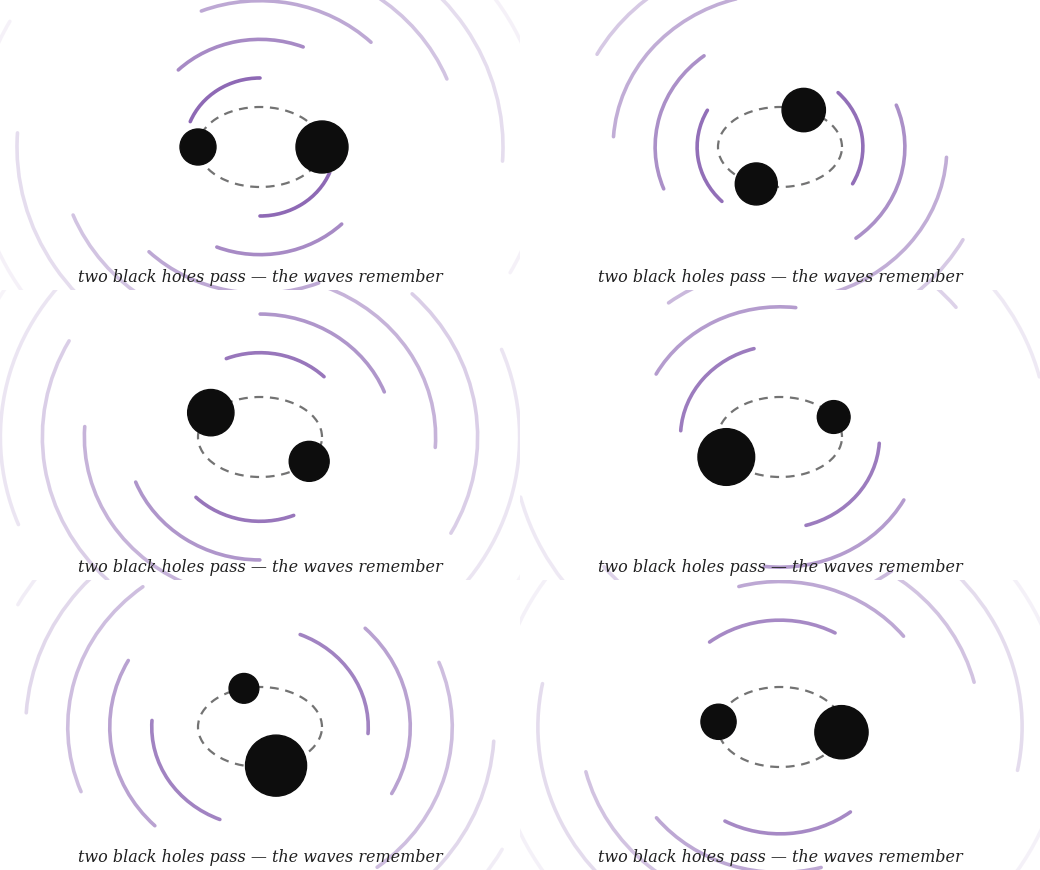
Two black holes on a bound orbit, radiating. The paper computes the scattering (unbound) problem and continues its functions to orbits like this one.
Gravitational-wave memory
Put two free masses a distance $L$ apart, across the path of a gravitational-wave burst with strain $h(t)$. Their separation is $L\,[1+h(t)/2]$, so it oscillates while the wave passes. Afterward the strain does not return to zero. The paper defines the memory as the difference of two readings of this two-mass detector,
$$\Delta h \;=\; h(t_2) - h(t_1)\,,$$with $t_1$ any time before the burst arrives and $t_2$ any time after it has passed. Once the energy flux dies away, $\Delta h$ stops depending on $t_2$: the masses end at rest relative to each other, at a new separation, and an interferometer that holds lock through the burst reads the offset from then on. The gravitational field itself has changed permanently.
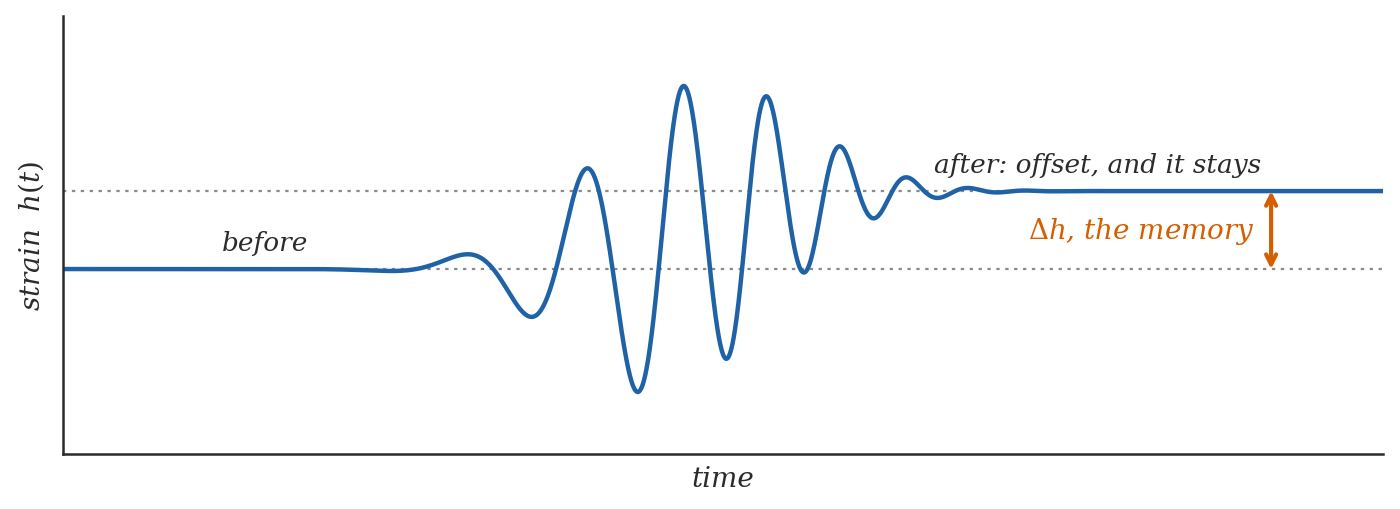
The memory as a detector would record it (a schematic drawn for this page, not a figure of the paper; it illustrates Eq. (1) of the paper). The blue curve is the strain: flat before the burst, oscillating during it, and afterward flat again at a level permanently offset from where it began. The orange interval $\Delta h$ between the two flat stretches is the gravitational-wave memory.
Zel’dovich and Polnarev found the effect in 1974 for stars flying past one another on unbound orbits, and Braginsky and Thorne named such signals “bursts with memory.” Christodoulou then found a second, nonlinear contribution with no electromagnetic counterpart: photons carry no charge, so light does not source light, but gravitational waves carry energy, energy gravitates, and the waves’ own energy flux generates a further permanent offset. In frequency space the step becomes a $1/\omega$ rise at low frequency that, for a binary merger, reaches into the band of ground-based detectors. Searches through the merger catalogs, most recently GWTC-5.0, find no decisive evidence yet; next-generation ground detectors and the space mission LISA should see the memory of single events.
Black-hole scattering in powers of G
Predicting the memory from a black-hole encounter means solving the two-body problem of general relativity. The post-Minkowskian (PM) expansion treats two black holes flying past each other as point masses and expands each observable, such as the deflection angle or the net momentum kick (the impulse), in powers of Newton’s constant $G$ with the velocity dependence kept exact. Order $L+1$ in $G$ comes from $L$-loop Feynman-type integrals over exchanged graviton momenta, so fifth order (5PM) means four-loop integrals. Each integrand is a product of propagators, one factor for every graviton line and every black-hole line (worldline) of the corresponding diagram. A second expansion runs alongside, in the ratio of the two masses, whose orders are called self-force (SF) orders; “5PM-2SF” means fifth order in $G$ at second order in the mass ratio.
The conservative dynamics, the motion with energy loss set aside, is known through 5PM-2SF, completed by Driesse and collaborators with 731 master integralsA finite basis of integrals to which every integral of a family reduces by linear (integration-by-parts) relations; solving the masters solves the family.. The integration-by-parts reduction of a full four-loop integrand to such a basis is a major bottleneck of the post-Minkowskian program; the results described below were obtained without it. On the dissipative side the radiated energy and radiation-reacted impulse are known at fifth order in $G$ only to first order in the mass ratio. Radiation first acts back on the orbit at third order in $G$; the memory’s own back-reaction first appears at 5PM-2SF, where, to the author’s knowledge, no dissipative results have been published.
The four-loop integrals are evaluated as a sum of contributions from regions of the graviton momenta. In the potential region gravitons are exchanged almost instantaneously; in the tail region emitted radiation scatters off the pair’s own gravitational field and acts back on the orbit later. At 5PM-2SF a new one appears, the memory region, in which two of the four gravitons are genuine radiation while the net frequency delivered to the black holes is zero. That zero-frequency field is the $\Delta h$ above, re-entering the dynamics of the orbit that produced it. The zero-frequency limit can be taken with retarded, advanced, or Feynman propagators on the two memory gravitons, an “$i0^+$ prescription” fixing how each pole is skirted, and the impulse depends on the choice even in dimensional regularizationThe standard bookkeeping of loop integrals: compute in $4-2\epsilon$ dimensions, where intermediate infinities appear as poles in $\epsilon$ that must cancel in the final answer..
At zero relative velocity, the static limit, the memory region’s contribution reduces to two integrals. Driesse et al. showed that requiring the $\epsilon$ poles to cancel between regions, along with a spurious divergence at relative Lorentz factor $\gamma=3$, fixes both up to one constant, $c_M$. They fixed it by a routing rule, retarded propagators directed toward the three-graviton vertex and averaged with the time-reversed assignment, which they call the $\gamma$-3 prescription after the divergence it cancels; under that rule $c_M=1$. The rule is adopted rather than derived and has been debated since; Porto and Riva, working at fifth post-Newtonian order, argue instead for the Feynman prescription. Taking the retarded routing as input and evaluating the two integrals anew, the paper summarized here also finds $c_M=1$, in agreement with Driesse et al. and with what Porto and Riva’s fifth-post-Newtonian calculation gives when the same retarded routing is used.
A K3 surface in the integrals
Going to higher orders in $G$ also changes the kind of function the answer is made of. Through third order every observable is a polylogarithm. At fourth order complete elliptic integrals appear, and they are periods of a K3 surface, the two-complex-dimensional cousin of an elliptic curve; a periodThe integral of an algebraic variety’s natural volume form over a closed cycle, the way $2\pi i$ is the integral of $dz/z$ around the origin. As the variety deforms with the kinematics, its periods become transcendental functions of the velocity. is to such a surface what $2\pi$ is to a circle. The surface deforms with the relative velocity of the black holes, so its periods are new transcendental functions of that velocity, obeying a linear differential equation called the Picard–Fuchs equation. At fifth order Frellesvig, Morales, and Wilhelm found the first Calabi–Yau threefold, the three-complex-dimensional member of the same family (elliptic curve, K3 surface, threefold), in a post-Minkowskian integral. Klemm, Nega, Sauer, and Plefka showed that its periods govern the dissipative integrals at first self-force order, and at second order they found another K3 surface, whose Picard–Fuchs operator is the Apéry operator written out below, and another threefold. Brammer, Frellesvig, Morales, and Wilhelm then showed that exactly these four geometries occur through fifth order. In Driesse et al.’s conservative 5PM-2SF result the Apéry K3 period stays in the function space while the threefold integrals drop out; Bern and collaborators argue, by contrast, that neither Calabi–Yau nor complete elliptic integrals contribute to conservative observables at this order.
The integrals depend on a single variable, the relative Lorentz factor $\gamma=(1+x^2)/2x$, where $x=\gamma-\sqrt{\gamma^2-1}$ runs over $0\lt x\lt1$ for scattering. With $z=x^2$ and $\theta=z\,d/dz$, the Apéry operator that annihilates the periods of the 5PM-2SF K3 surface reads
$$L_A \;=\; \theta^3-z(2\theta+1)(17\theta^2+17\theta+5)+z^2(\theta+1)^3\,.$$Near $z=0$, the high-energy end, one solution is a plain power series $\varpi_0=\sum_nA_nz^n$ whose coefficients are the Apéry numbers $1,\ 5,\ 73,\ 1445,\dots$, the integers behind Apéry’s proof that $\zeta(3)=\sum_{n\ge1}1/n^3$ cannot be written as a fraction; the surface is the K3 that Beukers and Peters attached to that sequence. The operator is singular where its leading coefficient $z^2-34z+1$ vanishes, and the smaller root, $z_+=17-12\sqrt2$, is $x^2$ at $\gamma=3$, a relative speed of $\sqrt8/3$ times that of light, inside the physical scattering region. At that velocity the potential region of Driesse et al. has its spurious divergence.
The maximal cut and Apéry's numbers
The paper begins by obtaining the K3 surface and its operator with no reduction machinery, from the maximal cutReplace every propagator of a Feynman integral by a delta function putting that particle on its mass shell. This leaves a low-dimensional contour integral of an algebraic function; it solves the homogeneous part of the integral’s differential equation and sets the normalization of the basis in which the full answer is expanded, without evaluating the integral itself.: putting every propagator on shell leaves a contour integral of $1/\sqrt{Q}$ over a few leftover variables, with $Q$ a polynomial whose zero set is the geometry. For the planar K3 sector two variables $t_1,t_2$ survive, and $Q$ is a degree-six polynomial, $Q_6$, published by Brammer et al. The author observes that $Q_6$ is a difference of squares: since $(1+x^2)\pm2x=(1\pm x)^2$, it factors as $Q_6=P_+P_-$ with $P_\pm=x(1+t_1)(t_1+t_2^2)-(1\pm x)^2t_1t_2$, a factorization Duhr and collaborators had reached in other variables. Both factors have the form $P_\pm=x\,t_1t_2\,(w-2\gamma\mp2)$ with $w=(1+t_1)(t_1+t_2^2)/t_1t_2$, so $1/\sqrt{Q_6}$ can be expanded in powers of $w$. A change of angles on the unit torus shows that the constant term of $w^n$ is $\binom{n}{n/2}^2$ for even $n$ and zero for odd $n$, and the double contour integral collapses to
$$\varpi(z)\;=\;\frac{1}{(2\pi i)^2}\oint_{T^2}\frac{dt_1\,dt_2}{\sqrt{Q_6}}\;=\;\sum_{n\ge0}A_n z^n\,,\qquad A_n=\sum_{k=0}^{n}\binom{n}{k}^{2}\binom{n+k}{k}^{2}=1,\ 5,\ 73,\ 1445,\ \dots\,.$$Here $T^2$ is the torus $|t_1|=|t_2|=1$, and the series on the right is the solution $\varpi_0$ met above. The last equality is verified as an identity of power series through order $z^{50}$. To all orders it follows from Apéry’s recurrence once the surface is identified with the Beukers–Peters K3; the paper does not prove it directly from the integral. Either way the operator $L_A$, which Klemm et al. had established from integration-by-parts relations and differential equations on nine master integrals, follows from the cut alone, as Duhr and collaborators had shown. For each of the four geometries the same construction fixes the constant of proportionality between the maximal cut and the corresponding period. The paper also reduces this sector on the cut, keeping only the integrals that are even under reversal of all worldline frequencies, and finds eleven masters, or nine once the symmetry exchanging the two black holes is imposed.
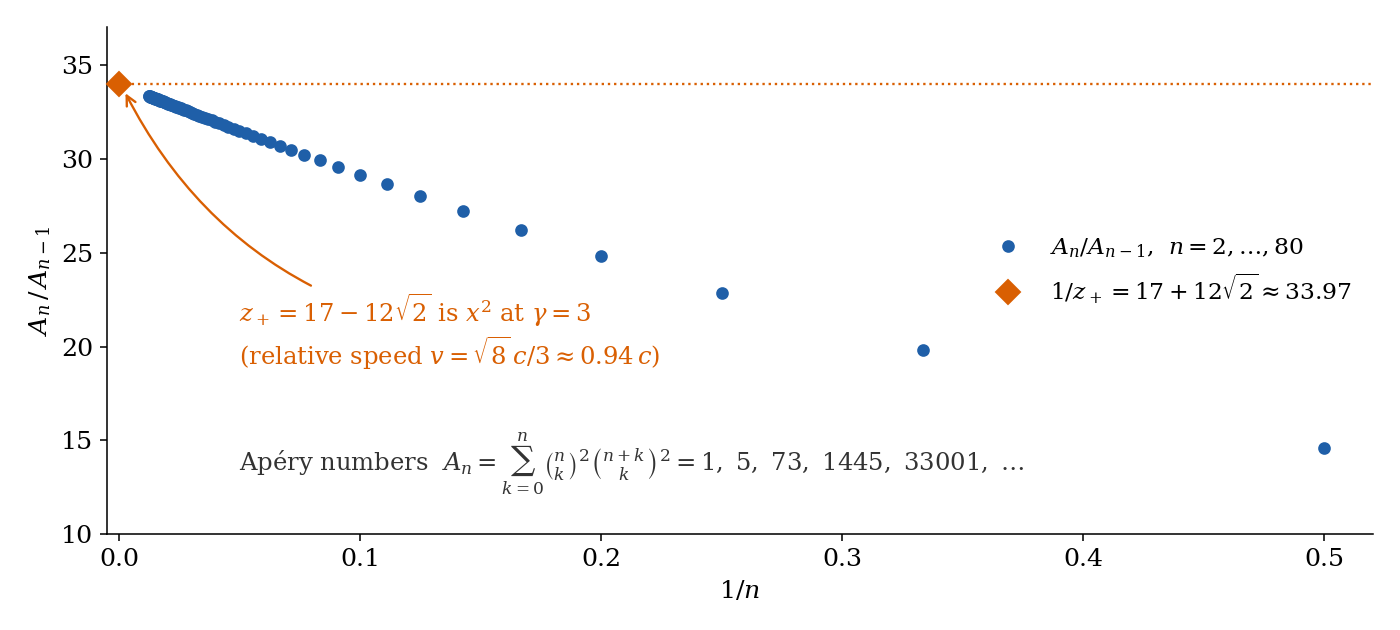
The growth of Apéry’s integers and the velocity at which the K3 sector’s differential equation is singular (plot drawn for this page from Eq. (13) of the paper). Blue dots: the ratio of successive Apéry numbers $A_n/A_{n-1}$ against $1/n$. A power series $\sum_nA_nz^n$ converges out to the nearest singular point of its differential equation, so the ratios approach the reciprocal of that point: $1/z_+=17+12\sqrt2\approx33.97$ (orange diamond), where $z_+=17-12\sqrt2$ is the Apéry operator’s singular point, which the paper identifies with relative Lorentz factor $\gamma=3$, a speed of $\sqrt8/3\approx0.94$ times that of light.
The factored form of $Q_6$ also determines where the cut integral can be singular in $x$: wherever branch points of $1/\sqrt{Q_6}$ merge and pinch the contour, which happens when $Q_6$ and both of its $t$-derivatives vanish together. Eliminating $t_1$ and $t_2$ gives a discriminant proportional to $x(x^2-1)(x^4-34x^2+1)$, whose quartic factor is the singular polynomial of $L_A$; its one root with $0\lt x\lt1$ is $x=3-2\sqrt2$, which is $\gamma=3$. In Landau’s analysis, the standard account of where a Feynman integral can be singular, $\gamma=3$ is thus the leading Landau singularity of the maximal cut of the K3 sector. There the curve $P_-=0$ crosses itself at $t_1=t_2=1$, a point on the integration torus, so the contour is pinched, at the same $\gamma$ as the spurious divergence of the potential region. The cut gives the location of the divergence and little else. Coleman and Norton’s criterion associates a singularity at physical momenta with a real classical process among on-shell particles; the on-shell conditions of the full sector have no real solution, so no such process is attached to this one. The author has not determined how the singularity arises in the full ten-propagator integral, as opposed to its maximal cut. The location by itself fixes neither the routing of the memory gravitons nor $c_M$, which is defined at the static point $\gamma=1$ and contains no K3 period.
Boundary constants with a built-in check
The rest of the paper prepares for the dissipative calculation, which is still to be done. Its main product is a set of boundary constants: values of master integrals at one reference velocity, from which differential equations in the velocity, once solved, would carry them to any other. The author takes over the four integral families of the conservative calculation. In each, four black-hole lines are cut, put on shell by delta functions, two per black hole as second order in the mass ratio requires; for the dissipative problem these are genuine two-sided cuts, and both $i0$ routings of the remaining black-hole propagators, retarded and advanced, are kept. Each family is then reduced once at a fixed depth. For the smallest family, PX2, this first-stage reduction returns $37$ master integrals, $12$ even and $25$ odd under reversal of all worldline frequencies; the odd block holds the radiation-reaction integrals. These counts come from that single pass; they have not been tested at greater depth and are not final basis sizes.
The paper studies PX2 further with the auxiliary-mass flow, which gives some propagators a large auxiliary mass, at which the integrals simplify, and then evolves that mass down to zero, the physical point. The flow is linear in its starting data: $M=A\,b$, with $b$ the values of the simplified integrals at large auxiliary mass, $M$ the masters at the physical point, and $A$ a response matrix. Each direction $v$ with $v^TA=0$, which the paper calls flow-free, therefore implies a linear relation $v^TM=0$ among the masters. On three of the four leading top sectorsA sector collects the integrals of a family that share the same set of propagators in the denominator. A top sector has the largest set, thirteen propagators here; every other sector is reached from a top sector by removing propagators. of PX2 the paper finds ten such directions, supported on $31$ master integrals of which at most $25$ are distinct once relabeling identities among them are used. It computes twelve of those $25$ at one reference point, $\gamma=5/4$, with Feynman propagators on the graviton lines. Apart from three finite parts known only numerically, the values are exact: $i\pi^5$ times polynomials in $\ln2$ and Euler’s constant with rational coefficients, plus real $\pi^4$ terms where an ultraviolet pole survives. These twelve values are the boundary constants.
All ten relations turn out to be exact reduction identities of the original family, with no auxiliary mass, that the first-stage reduction had not produced. Rerunning that reduction with the needed integrals as targets yields all ten, with coefficients rational in the dimension and $\gamma$. They hold whatever the starting data $b$, so they test the computed constants with nothing adjustable. One instance relates three integrals of the first sector:
$$I_0+\tfrac{16}{3}\,I_2-6\,I_3\;=\;0\,.$$The weights in this relation are independent of the dimension and of $\gamma$, and it holds order by order in $\epsilon$. At the pole it holds exactly; at the finite order, to the accuracy of the numerically known constants. Across the three sectors the computed constants satisfy all seven of the ten relations that involve only them. None of the $37$ PX2 masters contains a K3 or Calabi–Yau period; in dissipative PX2 the periods can enter only through $36$ further top sectors, which the paper enumerates but does not reduce.
The periods for bound orbits
A scattering event is a flyby, with $\gamma\gt1$. The binaries that detectors observe are bound, which in the paper’s variables means $\gamma=\cos\phi$ between $0$ and $1$ and $x=e^{-i\phi}$ on the unit circle. The periods, as solutions of their Picard–Fuchs equations, extend to that arc whether or not any map from scattering data to bound dynamics exists. Each geometry has its own variable $z$, in which the bound orbits trace their own curve, and a period can fail to be analytic only at the singular points of its operator. The fourth-order K3’s curve runs into a singular point exactly at the threshold $\gamma\to1$, and both threefolds’ curves end on singular points. Only the Apéry arc avoids them: on $|z|=1$ one has $z^2-34z+1=z\,(2\,\mathrm{Re}\,z-34)$, which cannot vanish. Of the four period bases, then, only the Apéry one is analytic over the whole bound range, threshold included.
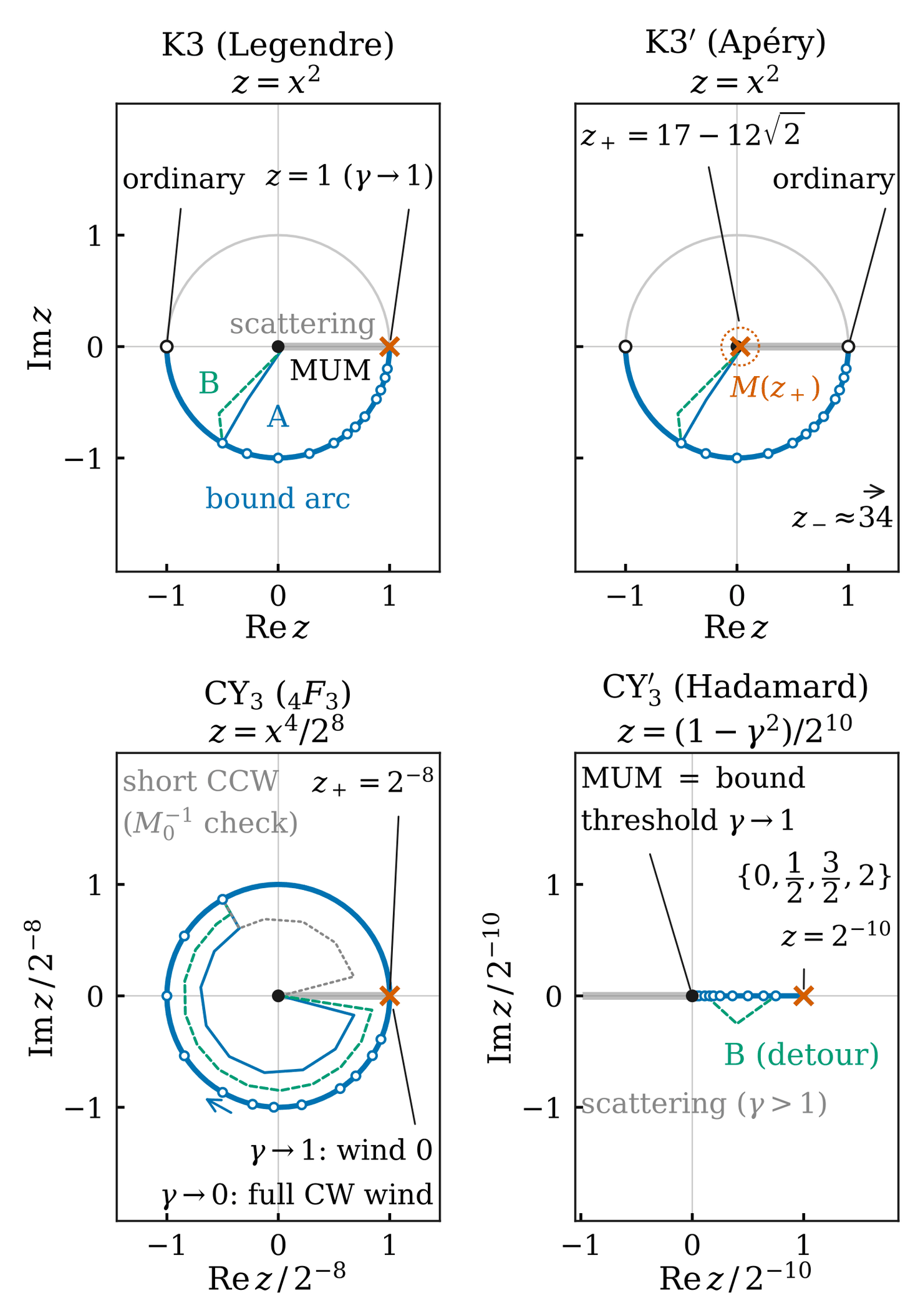
The four bound domains, one panel per geometry, each in its own variable $z$. Crosses are singular points of the Picard–Fuchs operator, the black dot (labeled MUM) is the expansion point $z=0$, and the gray segment is the image of scattering kinematics ($\gamma\gt1$). The thick blue curve with open circles is the bound arc with the twelve energies at which the periods are evaluated; the paths A (solid) and B (dashed green) are two equivalent continuation routes used as a cross-check. The fourth-order K3’s arc runs into its singular point at the threshold, the arc of the first-self-force-order threefold (labeled CY$_3$, ${}_4F_3$) is a full circle that starts and ends at the singular point $z_+=2^{-8}$, and the domain of the other threefold (CY$_3'$, Hadamard) is a real segment ending at a singular point; only the Apéry arc (the panel titled K3$'$, Apéry) is free of singular points, with $z_+=17-12\sqrt2$, the image of $\gamma=3$, well inside. (Figure 1 of the paper.)
The paper evaluates the full period bases at twelve bound energies spanning the inspiral regime down to $\gamma=1/2$, including the energy of the innermost stable circular orbit of a Schwarzschild black hole. Every value is computed along two equivalent paths in ball arithmetic, which attaches a guaranteed error bound to each result; the two paths agree within those bounds at all $48$ points (four geometries, twelve energies each), every bound below $10^{-167}$. Continuing instead along inequivalent paths, which wind differently around the singular points, multiplies the basis by a constant matrix, the monodromy of that winding. The computed monodromies match the expected matrices entry by entry, within error bounds of the same size. To the author’s knowledge the full period bases of the Apéry K3 and the first-self-force-order threefold had not been evaluated at bound kinematics before. These results are properties of the function space only: the boundary-to-bound dictionary of Kälin and Porto is known to fail for the nonlocal-in-time tail terms on generic bound orbits, and the paper claims no bound-orbit observable. The dissipative fluxes, though, are tail-free, so a direct map to bound orbits remains possible, as Jakobsen, Mogull, Plefka, and Sauer noted.
Open questions
None of the paper’s results is a fifth-order observable: the scattering angle, radiated energy, and recoil at order $G^5\nu^2$, with $\nu$ the mass ratio, need the coefficient of every master integral in the reduced integrand, and at 2SF those coefficients have not been published. The differential equations that would carry the boundary constants to general velocities are unsolved for every 2SF sector. The fourth leading top sector of PX2, its $36$ further top sectors with a K3 or Calabi–Yau subsector, and all but one of the $109$ top sectors of the other three families have not been analyzed. On the prescription, the paper fixes $c_M$ only for the retarded routing it takes as input. With Feynman propagators on the two memory gravitons the $\epsilon^{-4}$ pole of one of the two memory integrals survives, as Driesse et al. also report. The proponents of the Feynman prescription state that their version is free of poles, and this computation does not decide between the two statements. Deriving the routing, rather than assuming it, is also left open. Whether the K3 and Calabi–Yau periods survive in the energy radiated at this order, as they do at first self-force order, remains to be seen.
The paper
- Memory back-reaction in black-hole scattering at fifth post-Minkowskian order (PDF, 40 pp) — Matthew D. Schwartz; the version on this site is marked preliminary. Everything above is from this paper: Section 2 reviews gravitational memory; Section 3 sets up the fifth-order integral families, the four geometries, and the memory-region integrals; Section 4 derives the periods and the $\gamma=3$ singularity from maximal cuts; Section 5 gives the first-stage master counts, the boundary constants, and their linear relations; Section 6 continues the periods to bound orbits; and Section 7 evaluates the two memory-region integrals with the retarded routing of Driesse et al. as input, recovering their $c_M=1$. The four appendices cover the auxiliary-mass flow on worldline families, the fourth-order family beyond its maximal cut, the Landau analysis with linear propagators, and numerical checks.
Supplementary material
The paper’s ancillary files are hosted on this site under files/memoryeffect/anc/ (41 files, 3.7 MB): the machine-readable data behind its tables, to full precision, together with the scripts that wrote each file and a check script a reader can run (Python 3 with mpmath). Not included are the full reduction tables of the four families and the auxiliary-mass-flow solver itself.
- Supplementary material (PDF, 24 pp) — Sections S1–S7: the 31 master integrals on which the ten relations are supported, with their relabeling and reduction identities; the reduction of the computed boundary integrals to one- and two-dimensional frequency integrals; the specification of the continuation to bound kinematics and its per-point accuracy table; the numerical assembly of $c_M$ from two implementations and the leading terms with Feynman propagators on the memory gravitons; the first-stage master-integral lists, and the eleven masters of the Apéry sector alongside Duhr et al.’s propagator family and nine-element basis written in the paper’s labels; the rational master ratios of the three-loop family of Appendix B; and the sampled values of the fourth-order maximal cut.
- README.md — the guide to the package: the conventions (families, integration measure, the reference point $\gamma=5/4$, $q^2=-1$, Feynman graviton propagators, routing sign $\sigma=+1$), a table mapping every file to the section, table, and equation of the paper it supports, notes on each object, and a SHA-256 and size manifest of all forty data files and scripts.
- boundary_constants_PX2.json (137 KB) — the definitions, as propagator-exponent vectors, of the 31 master integrals on which the flow-free directions of the sectors $S_1$, $S_2$, $S_3$ of PX2 are supported; the twelve computed values to full precision with their exact forms in $\pi$, $\ln 2$, and Euler’s constant; and the ten left null vectors with their weights (Sections 5.2–5.4; Tables 3–5).
- boundary_ibp_identities_PX2.m — Kira reduction rules, symbolic in the dimension and $\gamma$, for the 42 boundary target integrals of $S_1$–$S_3$. They are reduction identities of the family with no auxiliary mass, and the ten relations are among them; the first rule is Eq. (36), the relation displayed above (Section 5.4; Table 5).
- cM_laurent.json — the assembly data for $c_M$: the sixteen sector integrals, the six core frequency integrals, the Laurent series of the prefactors and identity coefficients, $I_1^{(M)}$ and $I_3^{(M)}$ through order $\epsilon^1$ and $I_2^{(M)}$ through $\epsilon^{-2}$ from two implementations ($c_M-1=-2\times10^{-31}$ in the first), and the leading terms with Feynman propagators on the memory gravitons, including the uncanceled $\epsilon^{-4}$ coefficient $1/(6144\,\pi^6)$ (Section 7; Table 7).
- families_dissipative.json — the definitions of the four dissipative 5PM-2SF integral families P, PX1, PX2, and NP: loop momenta, kinematics, the 22 propagators, which of them are cut, the leading top sectors as propagator subsets, and the sector-label convention (Section 3.1, Eq. (6); Table 2). The $i0$ routings are not part of a family definition and enter only through the boundary constants.
- operators.txt — the four Picard–Fuchs operators in $\theta$ and $d/dz$ form with their variables, singular points, and local exponents, the Frobenius convention, and the continuation paths (Eqs. (8)–(11); Table 1; Section 6).
- priority_search.md — the dated literature searches behind the “to our knowledge” statements of Sections 1 and 6.
- bound_frobenius/README_bound.md, with values_K30_1_12.txt, values_K3P_1_12.txt, values_F43_1_6.txt, values_F43_7_12.txt, and values_HAD_1_12.txt — the full Frobenius matrices on the bound arc: the $3\times3$ matrices of the fourth-order K3 and the Apéry K3 and the $4\times4$ matrices of the two threefolds at the twelve bound energies (48 point blocks, every entry correct to at least 167 digits relative to the largest entry of its matrix), with the file format and per-point accuracy table in the README (Section 6.2; Table 6; Eqs. (49), (50)).
- kira/integralfamilies.yaml, kinematics.yaml, jobs_PX2_first_stage.yaml, and preferred — the Kira configuration of the PX2 first-stage reduction (propagators $D_1$–$D_{22}$ with $D_1$–$D_4$ cut; seeds $r=14$, $s=1$; sector symmetries on), which reproduces the count 37 of Table 2.
- masters/PX2_first_stage_37.txt, P_first_stage_195.txt, PX1_first_stage_256.txt, NP_first_stage_243.txt, and t40_even_44_eleven.txt — the four first-stage master-integral lists as exponent vectors with their seeds (the PX2 list with the parity split $12+25$ and the uncut linearized propagators of each master), and the eleven master integrals of the even Apéry sector at seeding $(4,4)$, nine of which remain once the worldline-exchange symmetry is imposed (Table 2; Section 5.5).
- response_matrices/A_S1.json (338 KB, $14\times27$), A_S2.json (879 KB, $27\times68$), and A_S3.json (1.7 MB, $44\times101$), with null_vectors_S1.json, null_vectors_S2.json, and null_vectors_S3.json — the response matrices $A(\epsilon)$ of the auxiliary-mass flow for the three sectors at twelve values of $\epsilon$, midpoints to 60 digits with rank checks, and their one, four, and five left null vectors (Eq. (27); Tables 3 and 5).
- tools/check_package.py — the reader’s check script: it verifies the manifest, $v^TA=0$ for every null vector at every $\epsilon$, Eq. (36) on the distributed values, the static-slice closed forms against the numerical values, the reassembly of $c_M=1$ with the $\epsilon^{-4}$ and $\epsilon^{-3}$ cancellation, the Feynman $\epsilon^{-4}$ coefficient, and the format of the value files.
- tools/build_boundary_constants.py, build_cM.py, build_operators.py, build_masters.py, build_t40_masters.py, build_response_matrices.py, build_ibp_identities.py, build_bound_readme.py, make_manifest.py, scrub_header.py, scrub_values.py, and common.py — the scripts that wrote the package’s files from the computation outputs, each recording the SHA-256 of its inputs inside the file it writes; make_manifest.py writes the README, and the two scrub scripts rewrite comment headers with a byte-identity check of every data line.
References
| Y. B. Zel’dovich and A. G. Polnarev, Radiation of gravitational waves by a cluster of superdense stars, Sov. Astron. 18 (1974) 17 | found the memory effect, for stars on unbound orbits |
| V. B. Braginsky and K. S. Thorne, Gravitational-wave bursts with memory and experimental prospects, Nature 327 (1987) 123 | named such signals “bursts with memory” |
| D. Christodoulou, Nonlinear nature of gravitation and gravitational-wave experiments, Phys. Rev. Lett. 67 (1991) 1486 | the nonlinear memory, sourced by the energy flux of the waves themselves |
| M. Driesse, G. U. Jakobsen, G. Mogull, C. Nega, J. Plefka, B. Sauer and J. Usovitsch, Conservative Black Hole Scattering at Fifth Post-Minkowskian and Second Self-Force Order, Phys. Rev. Lett. 137 (2026) 081402 | the conservative 5PM-2SF dynamics; source of the memory region, the $\gamma$-3 prescription, and $c_M$ |
| R. A. Porto and M. M. Riva, Black hole dynamics at fifth post-Newtonian order, JHEP 09 (2026) 075 | argue for the Feynman prescription at zero frequency; their fifth-post-Newtonian result with the retarded routing agrees with $c_M=1$ |
| H. Frellesvig, R. Morales and M. Wilhelm, Calabi-Yau Meets Gravity: A Calabi-Yau Threefold at Fifth Post-Minkowskian Order, Phys. Rev. Lett. 132 (2024) 201602 | the first Calabi–Yau threefold in a post-Minkowskian integral |
| A. Klemm, C. Nega, B. Sauer and J. Plefka, Calabi-Yau periods for black hole scattering in classical general relativity, Phys. Rev. D 109 (2024) 124046 | the period operators of the 5PM geometries; found the Apéry K3 at 2SF |
| D. Brammer, H. Frellesvig, R. Morales and M. Wilhelm, Classification of Feynman integral geometries for black-hole scattering at 5PM order, JHEP 10 (2025) 212 | exactly four geometries through fifth order; source of the surface $Q_6$ |
| Z. Bern, A. Jackman, G. Mansfield and M. S. Ruf, Classical Gravitational Scattering from the Ultraviolet and the Absence of Calabi-Yau Integrals in the Conservative Sector at $O(G^5)$, arXiv:2603.15383 (2026) | argue that neither Calabi–Yau nor complete elliptic integrals contribute to the conservative observables at $O(G^5)$ |
| C. Duhr, S. Maggio, C. Nega, B. Sauer, L. Tancredi and F. J. Wagner, Aspects of canonical differential equations for Calabi–Yau geometries and beyond, JHEP 06 (2025) 128 | the factored surface and the Apéry operator from the cut, in other variables; nine masters on the cut |
| F. Beukers and C. A. M. Peters, A family of K3 surfaces and $\zeta(3)$, J. Reine Angew. Math. 351 (1984) 42 | the K3 surface attached to Apéry’s numbers |
| L. D. Landau, On the Analytic Properties of Vertex Parts in Quantum Field Theory, Zh. Eksp. Teor. Fiz. 37 (1960) 62 | the conditions locating the singularities of a Feynman integral |
| S. Coleman and R. E. Norton, Singularities in the physical region, Nuovo Cim. 38 (1965) 438 | physical-region singularities as real classical processes; by this criterion no real process is attached to the $\gamma=3$ singularity |
| G. Kälin and R. A. Porto, From Boundary Data to Bound States, JHEP 01 (2020) 072 | the boundary-to-bound dictionary between scattering data and bound orbits |
| G. U. Jakobsen, G. Mogull, J. Plefka and B. Sauer, Dissipative scattering of spinning black holes at fourth post-Minkowskian order, Phys. Rev. Lett. 131 (2023) 241402 | noted that the tail-free dissipative fluxes admit a direct map to bound orbits |