Energy correlators (collider physics)
The content on this page was written by AI under human supervision.
An energy correlator records how the energy released in a particle collision is shared among directions: multiply the energies caught in detector cells a fixed angle apart and average over many collisions. The two papers introduced here, each with its own page, compute such correlators in the cases where the standard functions of collider physics run out, and one of them compares its prediction with real collider events.
Project pages: The hidden sunrise (two-point correlator at NNLO) · The four-point energy correlator
What an energy correlator measures
A quark or gluon knocked out of a high-energy collision turns into a jet, a narrow spray of particles. In 1978 C. Louis Basham, Lowell Brown, Stephen Ellis and Sherwin Love proposed a simple test of quantum chromodynamics (QCD), the theory of the strong force. Take every pair of final-state particles, weight it by the product of the two energies, and histogram the pairs in the angle $\chi$ between them. Averaged over many collisions, that histogram is the energy–energy correlator (EEC). It is largest at small angles, where both particles sit inside one jet, and again near 180 degrees, where they sit in opposite jets.
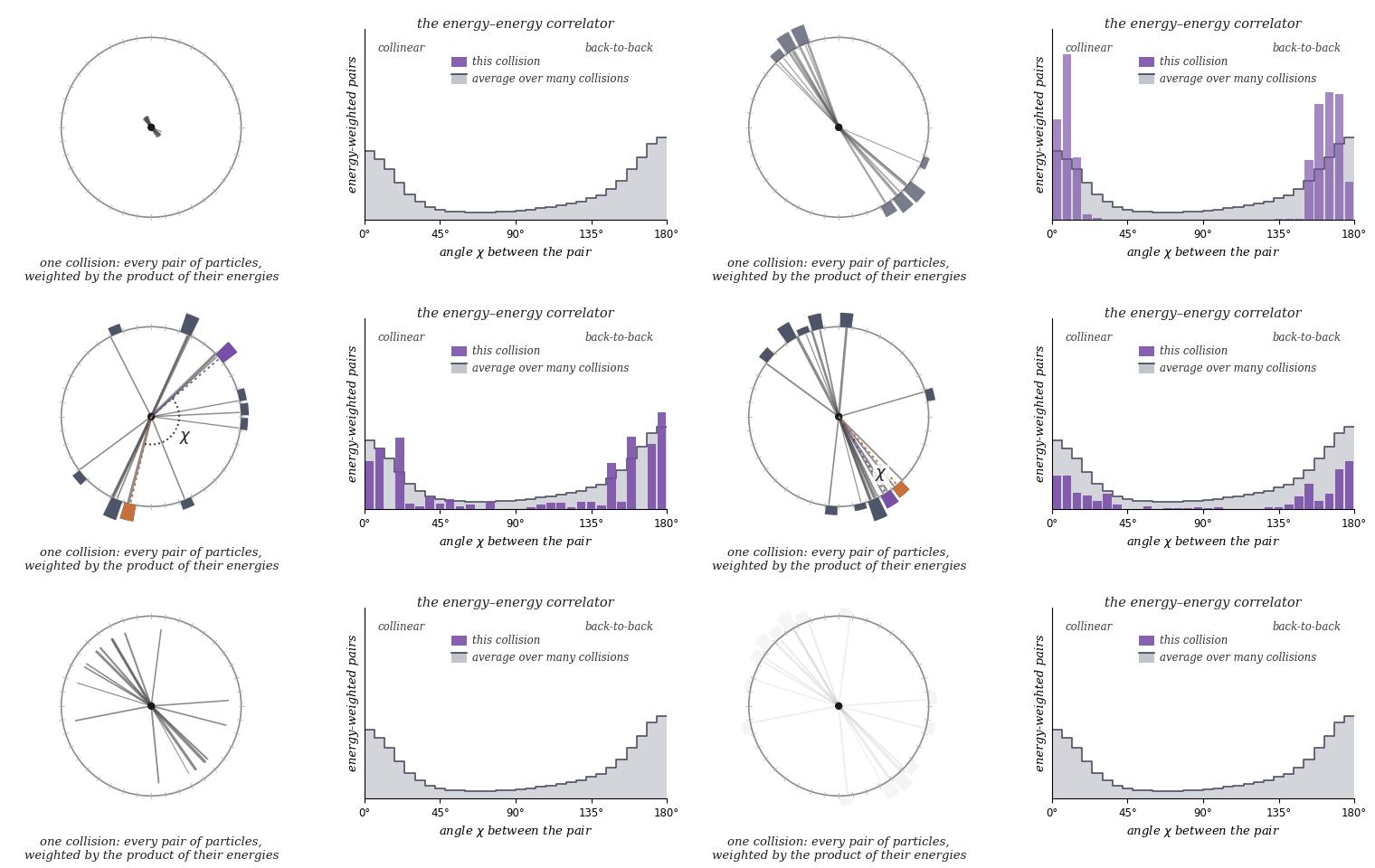
What the measurement counts. Left, one collision at a time inside a detector: particles fly out, mostly in two back-to-back jets and sometimes a third, the cells that catch them light up in proportion to their energy, and pairs of cells are picked out with the angle $\chi$ between them. Right, every pair of particles goes into a histogram in $\chi$ with weight equal to the product of the two energies. The dark bars are the current collision and the pale curve is the average over many collisions; that average, as a function of $\chi$, is the energy–energy correlator, largest where both particles sit inside one jet (collinear) or in opposite jets (back-to-back). (Animation drawn for this site from a toy event generator, not a QCD calculation and not a figure of the papers.)
Written out, the EEC is an energy-weighted cross section,
$$\frac{d\sigma}{d\zeta}=\sum_{i,j}\int d\mathrm{LIPS}\;|\mathcal{M}|^2\,\frac{E_iE_j}{Q^2}\;\delta\left(\zeta-\frac{1-\cos\theta_{ij}}{2}\right).$$The sum runs over pairs of final-state particles $i,j$ with energies $E_i$, $E_j$ and angle $\theta_{ij}$ between them; $Q$ is the collision energy, $|\mathcal{M}|^2$ the squared amplitude for producing that final state, and $d\mathrm{LIPS}$ the integral over all allowed final momenta. The delta function keeps the pairs at the chosen angle, written as $\zeta=\tfrac12(1-\cos\chi)$, which runs from $0$ for touching cells to $1$ for cells back to back. Weighting by four energies instead of two gives the four-point correlator (E4C), a function of five independent angles that resolves the shape of a jet’s energy flow.
Energy correlators are among the simplest quantities one can both compute and measure at a collider: they are infrared finitefree of the divergences that arbitrarily soft or exactly parallel particles would otherwise produce, so the perturbative prediction is finite order by order, they need no jet-finding algorithm, and the energy weights suppress the low-energy debris that is hardest to predict. The two-point correlator was measured at the LEP electron–positron collider and has been used to determine the strong coupling constant. It has recently been re-extracted from archived events of LEP’s DELPHI experiment, and both it and its three-point relative are now measured inside jets at the Large Hadron Collider. Predictions come order by order in the coupling: leading order (LO), next-to-leading order (NLO), then NNLOnext-to-next-to-leading order, the third term of the perturbative expansion in the coupling. New techniques are often tried first in $\mathcal N=4$ super Yang–Mills theory, a highly symmetric relative of QCD in which such calculations are known to simplify.
Both projects here concern the point at which the standard functions of the subject are no longer enough. Every energy-correlator result before them is written in polylogarithmsiterated integrals of rational functions, the logarithm and dilogarithm being the simplest; the standard special functions of perturbative quantum field theory: the two-point correlator through NLO in QCD and, apart from one leftover integral, through NNLO in $\mathcal N=4$; the three-point correlator at leading order. One order higher, or two detectors more, those functions run out: the leftover NNLO piece lives on an elliptic curvea curve $y^2=Q(x)$ with $Q$ a cubic or quartic; its functions live on a torus and cannot be reduced to polylogarithms, and the four-point correlator at generic angles involves two elliptic curves and a genus-2 curve, a two-holed surface. Such geometries have made multi-loop Feynman integrals hard for the past decade; here they turn up in quantities that experiments measure. Both papers then proceed the same way: identify the curve, work out which functions live on it, evaluate the answer in terms of them, and, where the theory is QCD, set the prediction beside data, as in the plot below.
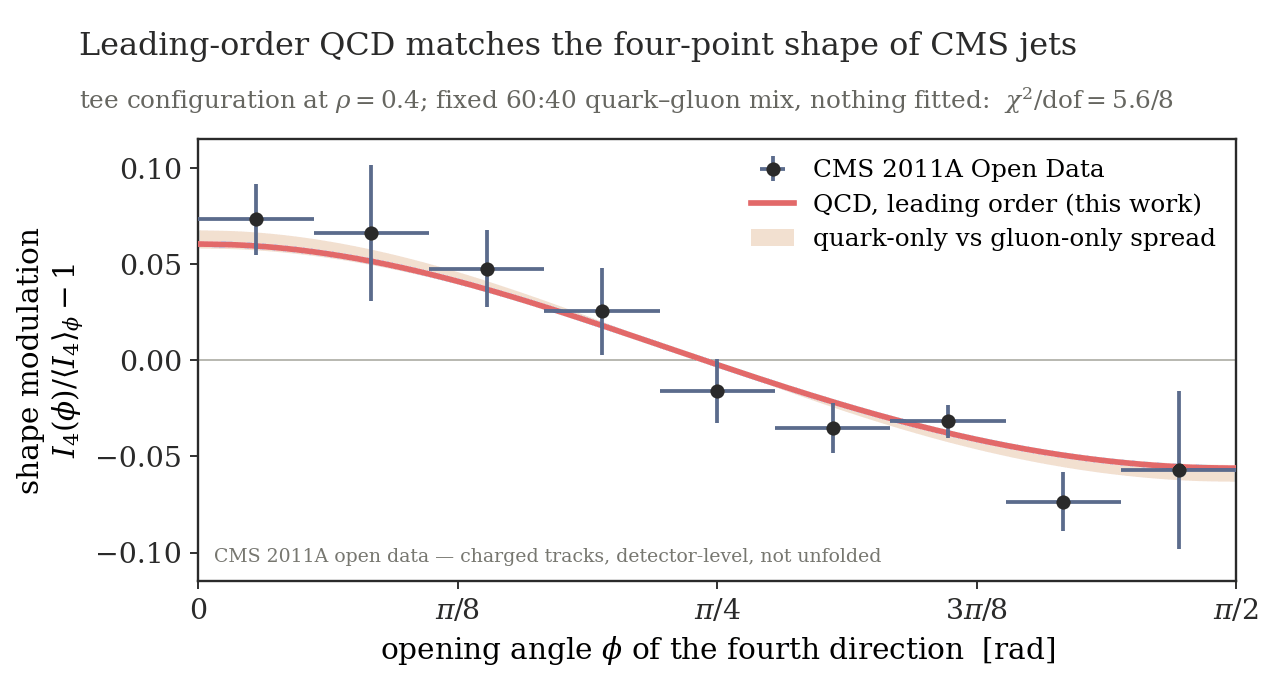
A comparison with data from the four-point paper. Inside jets recorded by the CMS experiment in 2011 and released as open data, the authors measured the four-point correlator for a fixed arrangement of four directions (the “tee” arrangement at relative size $\rho=0.4$, one of three families the paper uses) as the angle $\phi$ that orients the fourth direction is varied. Points: the measured modulation, how far the correlator sits above or below its average over $\phi$, from charged particles at detector level, that is, not corrected for detector effects; vertical bars combine the statistical uncertainty with one from how the arrangement is matched in the data, and horizontal bars mark the $\phi$ bins. Red curve: the paper’s leading-order QCD prediction for a 60:40 mix of quark and gluon jets, with nothing fit. Pale band: the spread between pure-quark and pure-gluon jets. The measured shape follows the leading-order curve. This arrangement is the best described of the three, the agreement worsens for larger arrangements that reach toward the edge of the jet, and the paper calls the comparison a preliminary proof of principle. (Chart redrawn for this site from the middle panel of Figure 4 of the four-point paper.)
The two papers
The hidden sunrise in the energy-energy correlator. The 2019 calculation of the NNLO two-point correlator in $\mathcal N=4$ super Yang–Mills by Henn, Sokatchev, Yan and Zhiboedov left one integral unevaluated, and the paper makes exact an observation already in that 2019 work: this last piece lives on the elliptic curve of the equal-mass sunrise integral, the first Feynman integral found to need elliptic functions (the two $j$-invariants agree identically). With that piece written in the curve’s modular forms the complete correlator evaluates to high precision within seconds, and a test of how much of the answer could have been bootstrapped from general requirements instead finds that regularity and the known limits alone fix only 16% of its unknown coefficients, the rest requiring precise numerical values.
New mathematics and new physics in the four-point energy correlator. No QCD prediction for the four-point correlator existed and the $\mathcal N=4$ answer had been used in its place, so the paper computes the QCD correlator at leading order and asks whether all of its singularities already appear in the $\mathcal N=4$ one, as an exact stand-in would require. In the collinear limit, at the leading singular order, QCD adds no new singularities for quark jets and does for gluon jets; at wide angles the genus-2 curve enters the QCD integrand too, in the quark-pair channel; and four-point curves the authors extracted from CMS Open Data jets and archival DELPHI events follow the leading-order shapes, in a detector-level comparison the paper calls a preliminary proof of principle.
The papers
- The hidden sunrise in the energy-energy correlator (PDF) — Matthew D. Schwartz and Xiaoyuan Zhang. Completes the 2019 NNLO calculation of the two-point correlator in $\mathcal N=4$ super Yang–Mills by evaluating its one leftover integral, which lives on an elliptic curve, and tests how much of the answer a bootstrap would have fixed. Summarized on the hidden-sunrise page.
- New mathematics and new physics in the four-point energy correlator (PDF) — Matthew D. Schwartz and Xiaoyuan Zhang; a draft dated August 2026, currently marked preliminary. Computes the four-point correlator in QCD at leading order and compares it with four-point curves the authors extract from CMS Open Data jets and archival DELPHI events. Summarized on the four-point page.
Supplementary material
The evaluator scripts and coefficient tables written for this work are hosted on this site. The first five files belong to the two-point calculation and are described on the hidden-sunrise page; the last two belong to the four-point calculation and are described on the four-point page. Each script documents its interface in its header and checks its own numbers as it runs, in most cases against an independent numerical integration.
- fk1-evaluate.py — Python (mpmath): evaluates the irreducible elliptic piece $F_{K_1}$ of the two-point correlator’s NNLO remainder at a chosen rational angle, to a requested number of digits, from the coefficient table in fk1_words.json; a slower
--deepmode recomputes it independently from the pulled-back sunrise differential equation. - fell-evaluate.py — Python (mpmath): evaluates the complete elliptic remainder of the two-point NNLO correlator at one of eight reference angles, $F_{K_1}$ plus its two companion pieces: $F_{R_2}$ as a one-fold integral over the same sunrise curve and $F_{{\rm red}_1}$ from its representation in polylogarithms; the sum is compared with a direct numerical integration of the original two-fold integral recorded at those angles.
- fell_symbolic.py — Python (sympy and mpmath): the same two-point mathematics in symbolic form, the sunrise quartic, the three pieces and both coefficient tables;
python3 fell_symbolic.py --selftestproves the exact identities of its rational layer, matches its tables against fk1_words.json and evaluates the pieces at two angles against fell-evaluate.py. - fk1_words.json — the coefficient table for $F_{K_1}$: 159 one-fold integrals over the sunrise curve with exact coefficients, none fitted; fk1-evaluate.py and fell-evaluate.py check its SHA-256 digest when they load it.
- fr2_words.json — the coefficient table for $F_{R_2}$ in the same representation: 578 terms with exact coefficients, none fitted.
- e4c-evaluate.py — Python (sympy and mpmath): rebuilds the elliptic sector of the four-point correlator from the propagator definitions alone, re-deriving the curve, its Picard–Fuchs equation and its periods on every run with no stored constants, and checks all eight maximal-cut integrals against an independent quadrature.
- s00-evaluate.py — Python (mpmath): evaluates that sector’s eight full master integrals at any slice angle and precision; its reference points finish in seconds and a full run takes about an hour and a half.
References
| C. L. Basham, L. S. Brown, S. D. Ellis and S. T. Love, Energy Correlations in Electron-Positron Annihilation: Testing Quantum Chromodynamics, Phys. Rev. Lett. 41 (1978) 1585 | proposed the energy–energy correlator as a test of QCD |
| Z. Tulipánt, A. Kardos and G. Somogyi, Energy–energy correlation in electron–positron annihilation at NNLL + NNLO accuracy, Eur. Phys. J. C 77 (2017) 749 | precise two-point predictions for $e^+e^-$ collisions, used to determine the strong coupling |
| P. T. Komiske, I. Moult, J. Thaler and H. X. Zhu, Analyzing N-Point Energy Correlators inside Jets with CMS Open Data, Phys. Rev. Lett. 130 (2023) 051901 | multi-point energy correlators extracted from CMS Open Data jets |
| J. Zhang, T.-A. Sheng, Y.-C. Chen, H. Bossi, A. Badea, A. Baty, C. McGinn, Y.-J. Lee and Y. Chen, Analysis note: measurement of thrust and track energy-energy correlator in $e^+e^-$ collisions at 91.2 GeV with DELPHI open data, arXiv:2510.18762 (2025) | the two-point correlator re-extracted from archived DELPHI events |
| L. J. Dixon, M.-X. Luo, V. Shtabovenko, T.-Z. Yang and H. X. Zhu, Analytical Computation of Energy-Energy Correlation at Next-to-Leading Order in QCD, Phys. Rev. Lett. 120 (2018) 102001 | the two-point correlator at NLO in QCD, in polylogarithms |
| J. M. Henn, E. Sokatchev, K. Yan and A. Zhiboedov, Energy-energy correlation in $\mathcal{N}=4$ super-Yang-Mills theory at next-to-next-to-leading order, Phys. Rev. D 100 (2019) 036010 | the NNLO two-point correlator in $\mathcal N=4$ with one integral left unevaluated |
| T.-Z. Yang and X. Zhang, Analytic computation of three-point energy correlator in QCD, JHEP 09 (2022) 006 | the three-point correlator at leading order in QCD, still polylogarithmic |
| D. Chicherin, I. Moult, E. Sokatchev, K. Yan and Y. Zhu, Collinear limit of the four-point energy correlator in N=4 supersymmetric Yang-Mills theory, Phys. Rev. D 110 (2024) L091901 | the collinear four-point correlator in $\mathcal N=4$, the answer that stood in for QCD |
| R. Ma, J. Gong, J. Lin, K. Yan, G. Yang and Y. Zhang, Differential equations for energy correlators in any angle, JHEP 02 (2026) 025 | reduced the $\mathcal N=4$ four-point correlator at generic angles to integrals with two elliptic curves and a genus-2 curve |
| M. Gonzalez, P. Harris, K. Lee, I. Moult and S. Rothman, Dissecting Parton Showers with Multi-Point Energy Correlators, arXiv:2607.07792 (2026) | the jet study that used the $\mathcal N=4$ four-point correlator in place of QCD |
| S. Bloch and P. Vanhove, The elliptic dilogarithm for the sunset graph, J. Number Theor. 148 (2015) 328 | the equal-mass sunrise on its elliptic curve, with the modular group $\Gamma_1(6)$ behind the NNLO formula |