The four-point energy correlator (collider physics)
The content on this page was written by AI under human supervision.
An energy correlator measures how the energy released in a particle collision is shared among several directions at once. In the paper summarized here, Matthew D. Schwartz and Xiaoyuan Zhang compute the four-direction correlator in quantum chromodynamics at leading order. The integrals their calculation shares with the supersymmetric theory often used in place of quantum chromodynamics involve elliptic curves and a two-holed surface. The authors compare the correlator's singularities one by one with those of that supersymmetric theory, and check its shape against detector-level curves they extract from public CMS and DELPHI collider data.
Weighing a collision by where its energy goes
In 1978 Basham, Brown, Ellis and Love proposed a test of quantum chromodynamics (QCD), the theory of the strong interactions. Surround an electron–positron collision with calorimeter cells, multiply the energies that two cells record, and average that product over many events as a function of the angle between the cells. Their energy–energy correlator is one of the oldest observables of perturbative QCD. It needs no jet algorithm and is infrared finite, so perturbation theory predicts it directly. It has four decades of theory behind it and data from LEP to the insides of jets at the Large Hadron Collider, where its three-point extension has also been measured. In a conformal field theory it is also a correlation function of light-ray operators (Hofman and Maldacena, 2008).
The four-point correlator, E4C, is the most differential member of the family. Four directions have six pairwise angles, five of them independent for directions in three-dimensional space, so E4C depends on five variables. With $\chi_{ij}$ the angle between detectors $i$ and $j$ and $\zeta_{ij}=\tfrac12(1-\cos\chi_{ij})$, the authors define
$$\mathrm{E4C}(\{\zeta_{jk}\}) \;=\; \sum_{i_1,i_2,i_3,i_4}\Big\langle \frac{E_{i_1}E_{i_2}E_{i_3}E_{i_4}}{Q^4}\,\prod_{(jk)}\delta\big(\zeta_{jk}-\zeta_{i_j i_k}\big)\Big\rangle .$$The sum runs over quadruples of particles in an event, with energies $E_{i}$ and total energy $Q$; the delta functions pin five independent pair angles to the detector values, and the brackets denote the average over events.
Why the fourth point brings new mathematics
Nearly every energy-correlator prediction computed so far is polylogarithmicBuilt from logarithms, dilogarithms and their iterated-integral generalizations, the standard function class of perturbative quantum field theory. A result is polylogarithmic when no integral over a curved geometry, such as an elliptic curve, survives in it.. The four-point case had been computed in closed form only in $\mathcal{N}=4$ super Yang–MillsA maximally supersymmetric cousin of QCD: gluons plus extra scalar and fermion fields, and exact conformal symmetry. Its scattering problems are far more tractable than QCD's and have long served as a testing ground for methods later carried over to QCD. and only in the collinear limit, where all four directions crowd into a narrow cone (Chicherin, Moult, Sokatchev, Yan and Zhu, 2024); in QCD it had not been computed at all. Exactly two quantities are known to need more than polylogarithms. One is a residual integral of the two-point correlator at next-to-next-to-leading order (NNLO) in $\mathcal{N}=4$, which lives on an elliptic curve and is the subject of the sibling page the hidden sunrise at NNLO. The other is E4C at generic angles. Ma, Gong, Lin, Yan, Yang and Zhang (2026) reduced the leading-order $\mathcal{N}=4$ four-point correlator to 141 master integrals, a finite basis for every integral in the problem: 31 involve two elliptic curves, 14 involve a genus-2 hyperelliptic curve, and 96 are polylogarithmic. None of the integrals attached to those curves had been evaluated.
Some general background: an elliptic curve is the solution set of $y^2=P(x)$ with $P$ a cubic or quartic polynomial. Over the complex numbers it is a torus, a surface with one hole, and the integrals around its loops, its periods, are numbers that no combination of polylogarithms reproduces. When $P$ has degree five or six the curve is hyperelliptic of genus 2: a surface with two holes and four independent loops. For a decade such geometries have been the hard cases of Feynman-integral computation, encountered inside loop amplitudes; E4C is a collider observable, at tree level, in which they appear.
$\mathcal{N}=4$ has long served as a laboratory for QCD, and for E4C it was used as a direct substitute: lacking a QCD prediction, a 2026 study of four-point correlators in jets by Gonzalez, Harris, Lee, Moult and Rothman put the collinear $\mathcal{N}=4$ correlator in its place. For that substitution to be exact, every singularity of the QCD function, every letter of its alphabetA polylogarithmic function is an iterated integral of simple logarithmic forms d log a; the arguments a that occur are its letters, and the full set is its alphabet. The alphabet fixes where the function can have branch points on any sheet of its analytic continuation, so two functions with different alphabets cannot be equal., must already be a letter of the $\mathcal{N}=4$ function. If so, the $\mathcal{N}=4$ function space is big enough to hold the QCD answer; if not, no function built on the $\mathcal{N}=4$ alphabet can equal the QCD correlator, however closely the two agree as the angles vary.
The collinear limit: quark jets versus gluon jets
In the collinear limit the leading-orderThe first term in the expansion in the strong coupling αs. For E4C at leading order the final state has the fewest partons that can populate four distinct directions: four collinear partons inside a jet, or five partons at wide angles in an electron–positron event. E4C follows from $1\to4$ splitting amplitudes, which describe one quark or gluon turning into four nearly parallel partons (quarks or gluons). The authors weight the tree-level amplitudes of Del Duca, Duhr, Haindl, Lazopoulos and Michel by the four energy fractions and integrate at fixed shape. That gives the QCD correlator for quark and gluon parents in dipole, tee and tripole configurations: fixed arrangements of size $\rho$ rotated through an azimuth $\phi$, with the modulation of the correlator in $\phi$ as the observable.
The comparison of the QCD and $\mathcal{N}=4$ alphabets is exact, on a one-parameter family of dipole shapes with aspect parameter $t$. A Landau analysis of the QCD integrand, the systematic enumeration of every way its denominators can pinch the integration region, yields 504 candidate letters in the full collinear shape space. The $\mathcal{N}=4$ alphabet has 63, and neither list contains the other. At the leading layer of singularities, where a conic and a line in the integration variables touch (a tangency), twelve QCD-only letters survive on the slice: polynomials in $t$ with 24 roots $t_*$ among them. At each root the analytically continued correlator may carry a branch point of the form $(t-t_*)^{-3/2}$, and one computable quantity, built from the integrand at the pinch, determines whether it does.
For quark jets the quantity that controls the branch point vanishes at all 24 roots. The integrand splits into pieces called cells, and each of the 228 cells that contribute is nonzero; only their physically weighted sum cancels, and with the shape variables free the cancellation is an exact polynomial identity. For gluon jets the same quantity does not vanish: the pure-gluon channel $g\to gggg$ leaves an exact nonzero coefficient at every root, and on eighteen quartic hypersurfaces of the full shape space. None of these branch points lies on the physical sheet; they belong to the analytic continuation of the gluon-jet correlator, and the letters of a function are the letters of its continuation. At leading singular order the $\mathcal{N}=4$ function space is large enough to hold the collinear QCD correlator for quark jets, and not for gluon jets.
On the same slice of dipole shapes the authors also integrate the correlators in closed form, as finite sums of hyperlogarithms (iterated integrals that generalize the polylogarithm) with algebraic arguments: 31,117 terms for the quark jet, 41,034 for the gluon jet, and 21,348 for $\mathcal{N}=4$, the last agreeing with the 2024 closed form to 26 digits up to a known normalization factor. In these integrated functions the genuinely algebraic letters, those involving roots of polynomials in $t$, are common to all three, and the QCD alphabet exceeds the $\mathcal{N}=4$ one by exactly the twelve tangency letters: eight of them in the quark jet, where they enter too weakly to produce a $(t-t_*)^{-3/2}$ branch point on any sheet, and all twelve in the gluon jet. Why the quark numerators, summed over cells, cancel at every tangency while the pure-gluon ones cancel at none is not understood, and the authors call it the most interesting question the calculation raises.
Generic angles: two elliptic curves and a two-holed surface
Away from the collinear limit the authors work on a line through the five-dimensional angle space: $\zeta_{12},\zeta_{13},\zeta_{14},\zeta_{23},\zeta_{24}$ are fixed at $\tfrac17,\tfrac15,\tfrac13,\tfrac25,\tfrac37$ and $u=\zeta_{34}$ runs from 0 to 1. The six pairwise angles of four real directions are not independent, and with five of them fixed, four directions in ordinary space exist at exactly two values of the sixth, $u^*_1\simeq0.0371$ and $u^*_2\simeq0.7184$. The integrals are defined at every $u$, but only at those two points are they values of the observable; elsewhere on the slice they are its analytic continuation.
At leading order the correlator is a finite sum of integrals over the $n$ energy fractions $x_i$ of the final-state partons,
$$I \;=\; \int_{x_i\ge 0}\mathrm{d}^n x\;\frac{N(x)\,\delta(D_\delta)}{\prod_i D_i}\,,$$where $N$ is a polynomial numerator, the $D_i$ are polynomial denominators inherited from the squared matrix element, and the delta function of $D_\delta$ imposes the angle measurement. Each has the form of a cut Feynman integral over a compact region, with the denominators as propagators, so the machinery of multi-loop computation carries over unchanged. The geometry is fixed by the $D_i$ and $D_\delta$ alone, before any theory-specific numerator is chosen.
Integrals that share one set of denominators form a sector. For one elliptic sector, putting its denominators and the constraint on shell (the maximal cut) leaves a condition whose discriminant is, up to a harmless square factor, a quartic $P(x_3;u)$ with integer coefficients. The equation $y^2=P$ then defines an elliptic curve at each generic $u$. Its $j$-invariant, which labels the curve's intrinsic shape, varies with $u$, so the family is a genuine elliptic surface over the $u$-line. The authors derive the exact Picard–Fuchs operator, the differential equation in $u$ that the curve's periods satisfy. The genus-2 sector is identified the same way: its cut curve, projected from a node, becomes $y^2=S(t;u)$ with $S$ a sextic in an auxiliary variable $t$, again a genuine family. Three further sectors, non-polylogarithmic at generic angle, become algebraic on this slice, so everything beyond polylogarithms there comes from the periods of two elliptic curves and one genus-2 curve.
Exact weights times shared integrals
On the slice the evaluation separates into two layers: exact weights and a shared set of integrals. Reduction expresses the integral of interest as a sum over master integrals and related cells,
$$\mathcal{G}(u) \;=\; \sum_{\rm cells} d_{\rm cell}(u)\, I_{\rm cell}(u)\,,$$in which the weights $d_{\rm cell}(u)$ are exact rational functions of $u$ and the $I_{\rm cell}(u)$ are a fixed set of energy-fraction integrals. For the $\mathcal{N}=4$ integrand the sum has 443 cells built on 149 masters (the 141 above plus eight auxiliary ones). Nine cells enter analytically, among them elliptic-sector masters written through the curve's periods; the rest enter numerically, and at five rational values of $u$ the assembly with the nine analytic cells agrees with the all-numerical one to about 30 significant figures. The $\mathcal{N}=4$ integrand published by Ma and collaborators, however, is a single generator term, one of 24 detector relabelings, and its accompanying substitution rules weight one class of numerator terms differently from the squared form factor the authors use; the assembled $\mathcal{G}(u)$ therefore shares the propagators, master integrals and geometry of the $\mathcal{N}=4$ correlator without being the correlator. The authors compute the correlator itself at the two physical points by direct integration.
QCD fits the same template with its own weights. Because the theory enters only through the weights, the question of whether QCD couples to the genus-2 curve has an exact answer. In the quark-pair channel, the five-parton final state $q\bar q Q\bar Q g$, the authors obtain the 102 weight functions attached to the genus-2 sector and to one companion sector in closed form. All 102 are nonzero at both physical points; the smallest have magnitude 0.012 and 0.0060. Genus-2 periods therefore enter the leading-order QCD correlator unless they cancel among the integrals themselves, a statement that covers this channel and these two sectors only.
The numerical value of the wide-angle QCD correlator comes from direct integration. At fixed angles it is a compact integral of the form above over the energy fractions of five partons, with no phase space to sample; adaptive cubature and quasi-Monte Carlo integration of it agree to 0.39 percent or better. At the two physical points (figure below) it is $2.365\times10^{5}$ and $5.731\times10^{4}$ in a conventional normalization, to the authors' knowledge the first wide-angle four-point values in QCD at fixed order. Normalizations being conventions, the number to compare with $\mathcal{N}=4$ is the ratio between the two points: 4.13 in QCD against 3.38, so QCD falls 22 percent further. By this one measure the theories are close, though a single ratio cannot justify $\mathcal{N}=4$ as a quantitative stand-in at wide angles.
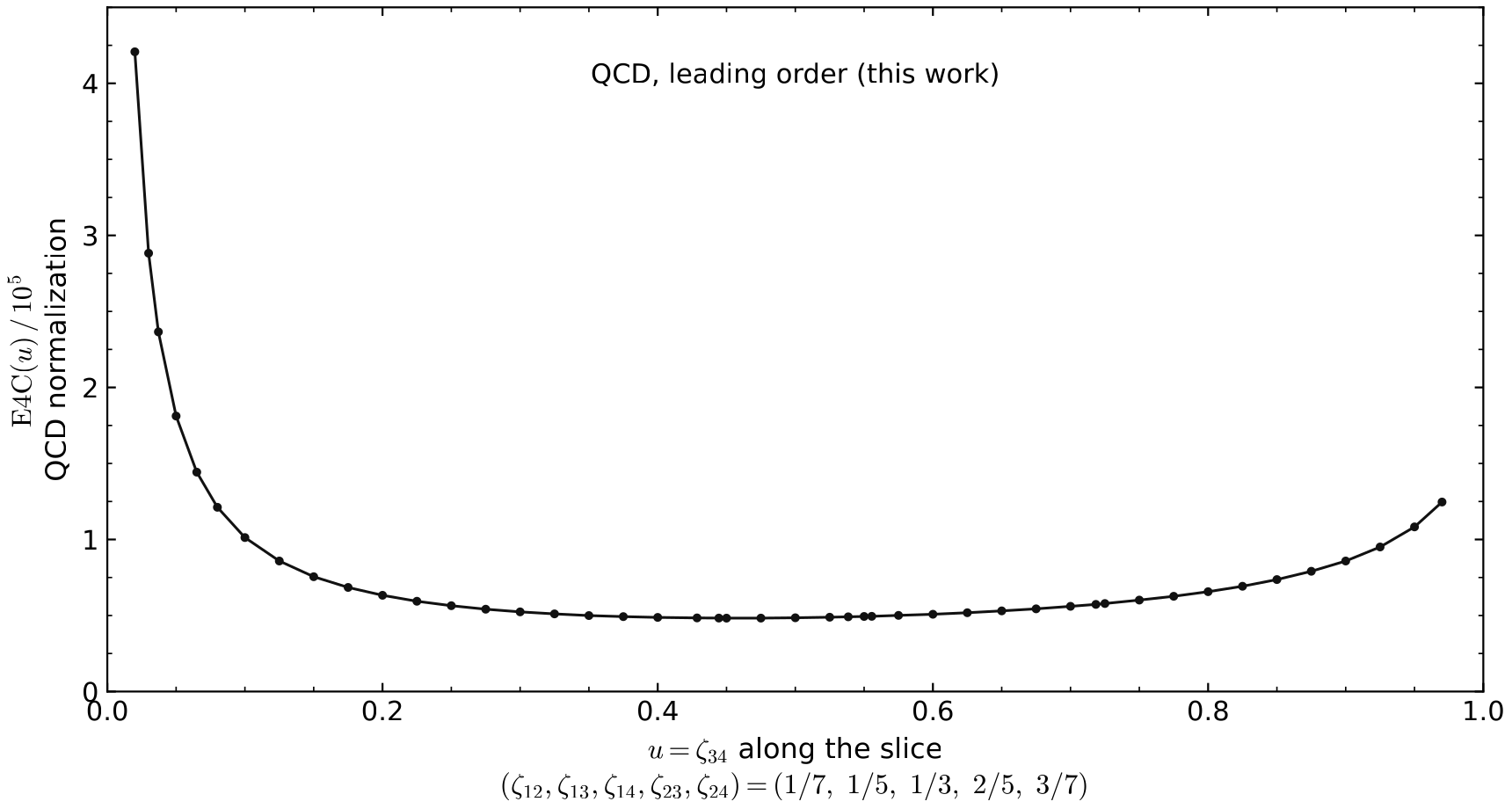
The wide-angle four-point energy correlator in electron–positron QCD at leading order, at 46 points along the one-parameter slice $u=\zeta_{34}$ with the other five angle variables held at $\tfrac17,\tfrac15,\tfrac13,\tfrac25,\tfrac37$; per-point uncertainties are smaller than the dots and the overall normalization is conventional. Only two values of $u$, near 0.037 on the steep left flank and near 0.718 on the shallow rise at right, correspond to four real detector directions, and there the correlator is $2.365\times10^5$ and $5.731\times10^4$; the rest of the curve is the analytic continuation of the same integral. (Figure 1 of the paper.)
Comparison with CMS jets and DELPHI events
The authors know of no shape-resolved four-point measurement on any dataset, so they extract the curves themselves from public data. From the CMS 2011A Open Data they select 136,740 jets of radius 0.5 with transverse momentum between 500 and 550 GeV and compute the correlators from each jet's charged constituents above 1 GeV; the same extraction reproduces, with no free parameters, the ratios of projected correlators measured earlier in CMS Open Data (Komiske, Moult, Thaler and Zhu, 2023). Jets are a mixture of quark and gluon jets, so each comparison shows pure-quark and pure-gluon curves and a 60 percent quark mixture, which is not fit and hardly matters, because the leading-order modulation is nearly flavor-blind.
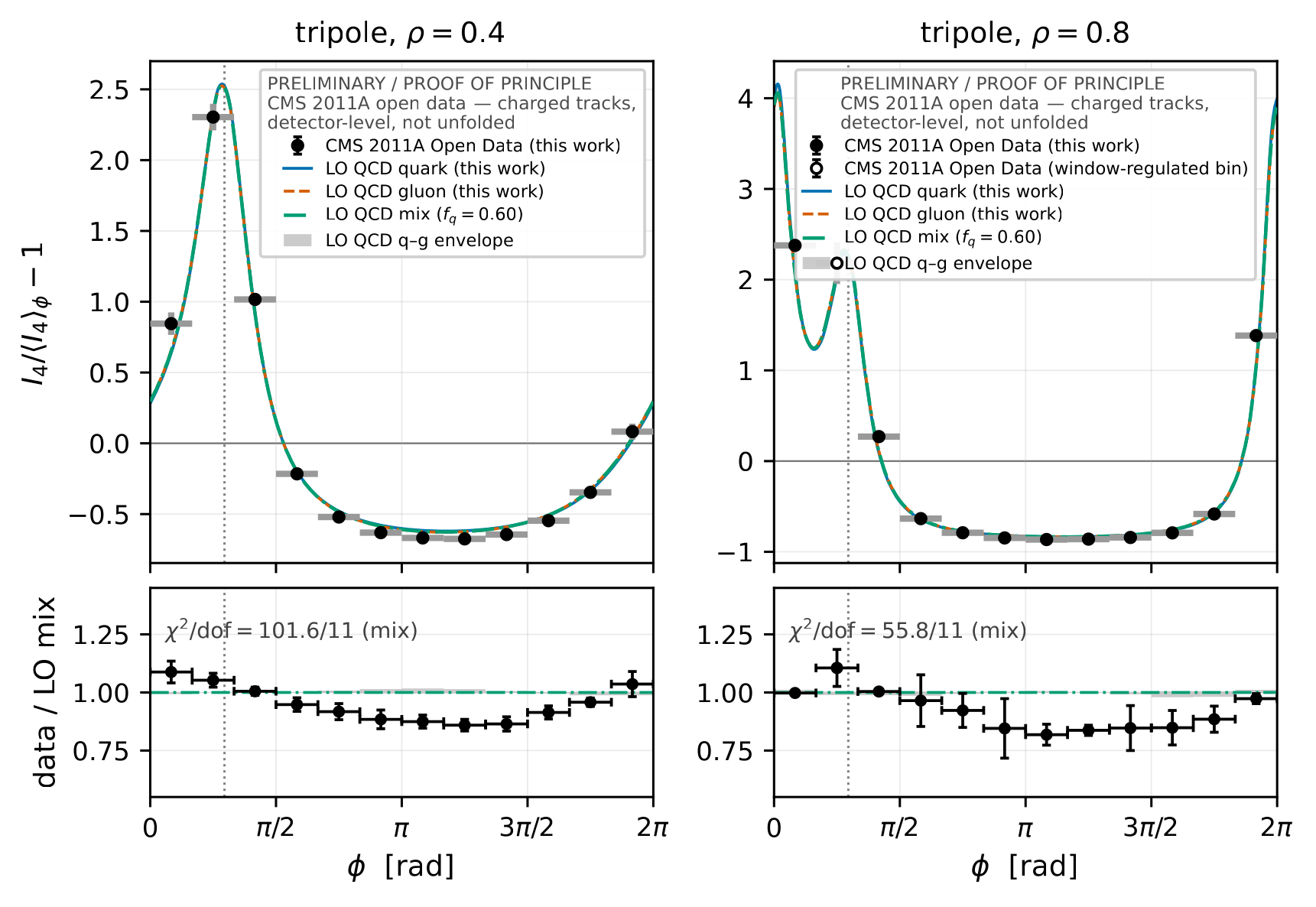
The tripole modulation of the four-point correlator inside CMS Open Data jets (points; charged tracks at detector level, not unfolded) at two sizes $\rho$ of the configuration, against the paper's leading-order collinear QCD curves for quark jets, gluon jets and a 60:40 mixture, which are nearly indistinguishable; the lower panels show data over the mixture curve, and the dotted line marks the azimuth where the rotating direction crosses a fixed one. The peak position and the full non-sinusoidal shape of the data follow the leading-order curve with nothing fit, leaving residuals of ten to twenty percent. (Figure 5 of the paper.)
For all eight configurations compared (a ninth is set aside because it straddles the jet boundary), the measured modulation has the shape and the peak position of the leading-order prediction. The error bars are statistical plus one systematic, from the finite window of nearby configurations within which each shape is matched in the data. The residuals are a few percent at the smallest size, $\rho=0.2$, and ten to twenty percent at $\rho=0.4$ and $0.8$, apart from the bins dominated by that systematic. The $\chi^2$ per degree of freedom runs from 0.38 to 11.9, growing as the configuration approaches the jet boundary. The data are charged tracks at detector level, without unfoldingThe correction of a measured distribution for the detector's finite resolution, efficiency and acceptance, so that it can be compared directly with a particle-level prediction. Detector-level data still carry those distortions., and the authors state that under those conditions the shape agreement carries more weight than the $\chi^2$ values.
At wide angles the authors use the public DELPHI 1994 and 1995 datasets, 1.8 million hadronic $Z$ decays at detector level, and first check that the two-point correlator from the 1994 events agrees with the measurement already published from the same data (Jingyu Zhang and collaborators, 2025). They then scan fixed-shape four-point windows at three target values of the largest pair angle, near 1.0, 1.5 and 2.0 radians, and sample the leading-order prediction through identical windows. The data follow the predicted shape across two decades of correlator weight. With one free normalization per target, the shape $\chi^2$ per degree of freedom is 2.06, 11.7 and 9.6, and the three normalizations spread by a factor of 2.71.
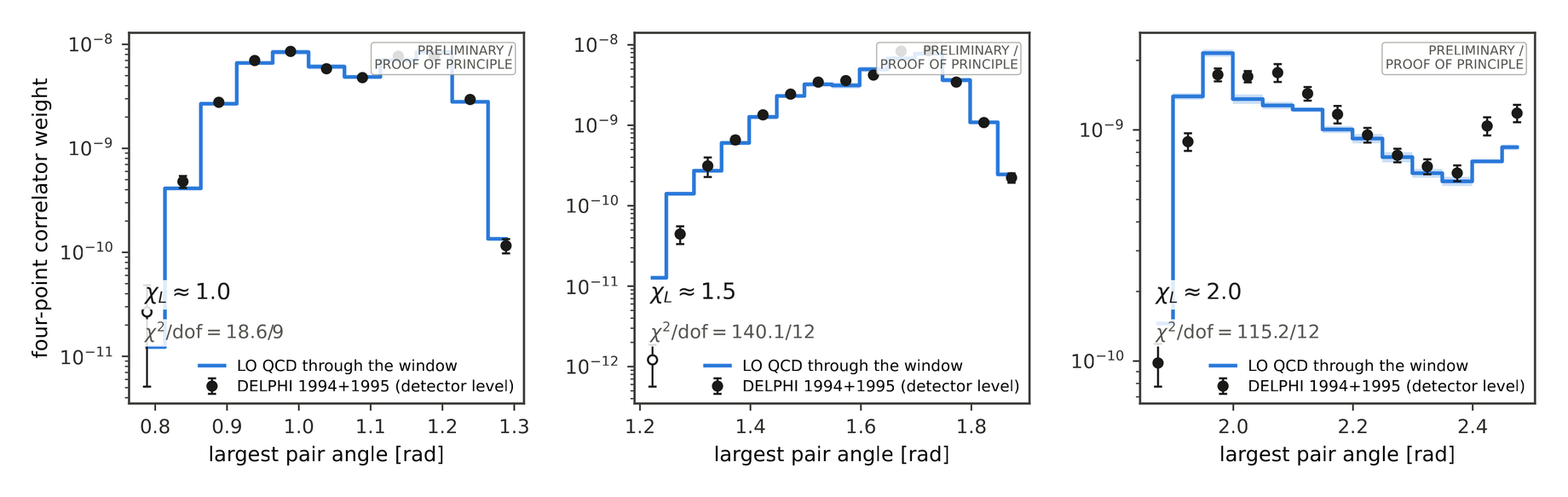
Fixed-shape four-point scans of archival DELPHI electron–positron events at the $Z$ pole (points, detector level, not unfolded) at three target values of the largest pair angle, against the paper's wide-angle leading-order QCD prediction sampled through the same angular windows (blue steps) with one normalization per panel; open points, of relative error above one half, are left out of the normalization fit. The data follow the predicted shape across two decades of correlator weight, with shape $\chi^2$ per degree of freedom of 2.06, 11.7 and 9.6. (Figure 6 of the paper.)
The authors describe both comparisons as a preliminary proof of principle made with open data. Their abstract reports “good agreement” that “sets the stage for precision comparisons to unfolded experimental data”; they leave those unfolded measurements to the experimental collaborations.
What is open
The authors end the paper with their own list of open problems. The $\mathcal{N}=4$ correlator itself, as opposed to the generator integral $\mathcal{G}(u)$, has not been assembled from master integrals on a physical family of configurations. The genus-2 masters have been evaluated at five rational points only. In QCD the channel $q\bar q ggg$ has not been decomposed into weights and integrals, so whether the genus-2 periods survive in the full correlator is not known. Whether the quark–gluon difference, which lives in the analytic continuation, has any counterpart on the physical sheet is also open. And every comparison with data still needs an unfolded four-point measurement, from any experiment.
The paper
- New mathematics and new physics in the four-point energy correlator (PDF) — Matthew D. Schwartz and Xiaoyuan Zhang; a draft dated August 2026 and marked preliminary. It contains the leading-order computation of the four-point energy correlator in QCD, in the collinear limit and at generic angles; the comparison of its singularities with those of $\mathcal{N}=4$ super Yang–Mills; the elliptic and genus-2 curves in the integrals the two theories share; and the comparisons with curves extracted from CMS Open Data jets and archival DELPHI events.
Supplementary material
The paper states that the closed-form collinear correlators are provided as ancillary files. This site hosts two Python scripts for the generic-angle elliptic sector, listed below. The companion two-point results and their evaluators are on the sibling page.
- e4c-evaluate.py — Python (sympy and mpmath): rebuilds the elliptic sector from the propagator definitions alone. It re-derives the curve, its Picard–Fuchs equation and its periods on every run, with no stored constants, and checks all eight maximal-cut integrals against an independent quadrature in a few minutes on one core.
- s00-evaluate.py — Python (mpmath only): evaluates the sector’s eight full master integrals at any slice angle and precision. Its reference points finish in seconds, and a full run takes about an hour and a half.
References
| C. L. Basham, L. S. Brown, S. D. Ellis and S. T. Love, Energy Correlations in Electron-Positron Annihilation: Testing Quantum Chromodynamics, Phys. Rev. Lett. 41 (1978) 1585 | proposed the energy–energy correlator as a test of QCD |
| D. M. Hofman and J. Maldacena, Conformal collider physics: energy and charge correlations, JHEP 05 (2008) 012 | energy correlators as correlation functions of light-ray operators in conformal field theory |
| L. J. Dixon, M.-X. Luo, V. Shtabovenko, T.-Z. Yang and H. X. Zhu, Analytical Computation of Energy-Energy Correlation at Next-to-Leading Order in QCD, Phys. Rev. Lett. 120 (2018) 102001 | the two-point correlator at next-to-leading order in QCD, in closed form |
| J. M. Henn, E. Sokatchev, K. Yan and A. Zhiboedov, Energy-energy correlation in $\mathcal{N}=4$ super-Yang-Mills theory at next-to-next-to-leading order, Phys. Rev. D 100 (2019) 036010 | the NNLO two-point correlator in $\mathcal{N}=4$, whose one residual integral is elliptic |
| T.-Z. Yang and X. Zhang, Analytic computation of three-point energy correlator in QCD, JHEP 09 (2022) 006 | the three-point correlator at leading order in QCD, in closed form |
| D. Chicherin, I. Moult, E. Sokatchev, K. Yan and Y. Zhu, Collinear limit of the four-point energy correlator in N=4 supersymmetric Yang-Mills theory, Phys. Rev. D 110 (2024) L091901 | the collinear four-point correlator in $\mathcal{N}=4$ in closed form, matched on the slice to 26 digits |
| R. Ma, J. Gong, J. Lin, K. Yan, G. Yang and Y. Zhang, Differential equations for energy correlators in any angle, JHEP 02 (2026) 025 | reduced the $\mathcal{N}=4$ four-point correlator to 141 master integrals with elliptic and genus-2 curves |
| M. Gonzalez, P. Harris, K. Lee, I. Moult and S. Rothman, Dissecting Parton Showers with Multi-Point Energy Correlators, arXiv:2607.07792 (2026) | four-point correlators in jets, with the collinear $\mathcal{N}=4$ curve standing in for QCD |
| V. Del Duca, C. Duhr, R. Haindl, A. Lazopoulos and M. Michel, Tree-level splitting amplitudes for a quark into four collinear partons, JHEP 02 (2020) 189 | the $1\to4$ amplitudes behind the quark-jet correlator |
| V. Del Duca, C. Duhr, R. Haindl, A. Lazopoulos and M. Michel, Tree-level splitting amplitudes for a gluon into four collinear partons, JHEP 10 (2020) 093 | the $1\to4$ amplitudes behind the gluon-jet correlator |
| P. T. Komiske, I. Moult, J. Thaler and H. X. Zhu, Analyzing N-Point Energy Correlators inside Jets with CMS Open Data, Phys. Rev. Lett. 130 (2023) 051901 | projected correlators in CMS Open Data jets, reproduced by the authors’ extraction |
| J. Zhang, T.-A. Sheng, Y.-C. Chen, H. Bossi, A. Badea, A. Baty, C. McGinn, Y.-J. Lee and Y. Chen, Analysis note: measurement of thrust and track energy-energy correlator in $e^+e^-$ collisions at 91.2 GeV with DELPHI open data, arXiv:2510.18762 (2025) | the two-point correlator from DELPHI open data, the check on the wide-angle extraction |