Cosmological correlators (cosmology)
The content on this page was written by AI under human supervision.
The faint pattern of warm and cool spots on the microwave sky descends from quantum fluctuations in the first moments of the universe, and its statistics test theories of that era. In 2024 an elliptic curve, the geometry of a doughnut, turned up inside the simplest unsolved one-loop calculation of this kind, the triangle diagram. The finding suggested that such predictions go beyond the standard functions of particle physics already at one loop. Amara McCune and Matthew D. Schwartz find that the curve cancels in the triangle’s physical answer, which is built from ordinary dilogarithms for all positive external energies. The periods of an elliptic curve (the integrals around the doughnut’s two loops), and those of a K3 surface, its two-dimensional analog, appear in the next diagram, the four-site box.
Primordial fluctuations and the wavefunction
In the inflationary picture, quantum fluctuations of the primordial fields, stretched to astronomical size by the expansion of space, seeded the temperature variations of the microwave background and the clustering of galaxies. Inflation predicts their correlation functions, how strongly the fluctuation at one place or wavelength is tied to that at another, and surveys of the microwave background and of the distribution of galaxies measure them. The measurements improve with every survey, while the calculations lag behind. Beyond the simplest models and the lowest orders of perturbation theory the integrals have resisted computation, and for diagrams with a closed loop even the kind of function the answer should be is mostly unknown.
The object behind these calculations is the wavefunction of the universe, $\Psi[\phi]$: the quantum amplitude for the fields to end the primordial era with spatial profile $\phi$. Expanding $\log\Psi$ in powers of the field defines wavefunction coefficients $\psi_n$, computed graph by graph as scattering amplitudes are. Feynman integrals for amplitudes evaluate to restricted classes of functions: first the polylogarithmsiterated integrals that generalize the logarithm; the dilogarithm Li2, with two nested integrations, is the simplest new member and is said to have weight two, then integrals over elliptic curvesthe curve defined by the square root of a cubic or quartic polynomial; over the complex numbers it is a torus, and the integrals around its two independent loops, the periods, cannot be reduced to logarithms and beyond. Once the class is known, an amplitude can often be built from its singularities and symmetries without evaluating any integral. Beginning in 2018, Arkani-Hamed, Baumann, Lee and Pimentel carried that strategy into cosmology as the “cosmological bootstrap.” It needs the same input: the space of functions in which the answer lives.
Sites, edges and a triangle of momenta
The benchmark model here is a conformally coupled scalar with polynomial self-interactions in a universe whose scale factor grows as a power of conformal time $\eta$. After the field is rescaled, the expansion survives only as a weight $(-\eta)^{-(1+\sigma)}$ on each vertex, with $\sigma=0$ for a cubic vertex in de Sitter space, the idealized inflationary spacetime. That weight can be traded for an integral over a shift of the energy entering the vertex, a “site integral.” The flat-space coefficient, the object the paper computes, is thus the seed for de Sitter space and every power-law background.
Flat-space coefficients have a simple anatomy (Arkani-Hamed, Benincasa and Postnikov, 2017). A graph has sites (its vertices), each carrying the total energy $X_v$ of its external legs, and internal edges with energies $y_e$. Two sites joined by an edge give $\psi_2=1/[(X_1+X_2)(X_1+y)(X_2+y)]$: one pole wherever the energy flowing into a connected subgraph vanishes. At the pole where the total energy of a tree graph vanishes, the residuewhat remains of a function at a pole once the vanishing denominator is stripped off; the residues of an integrand constrain which functions the integral can produce is an ordinary flat-space scattering amplitude, and the main results below rest on that fact.
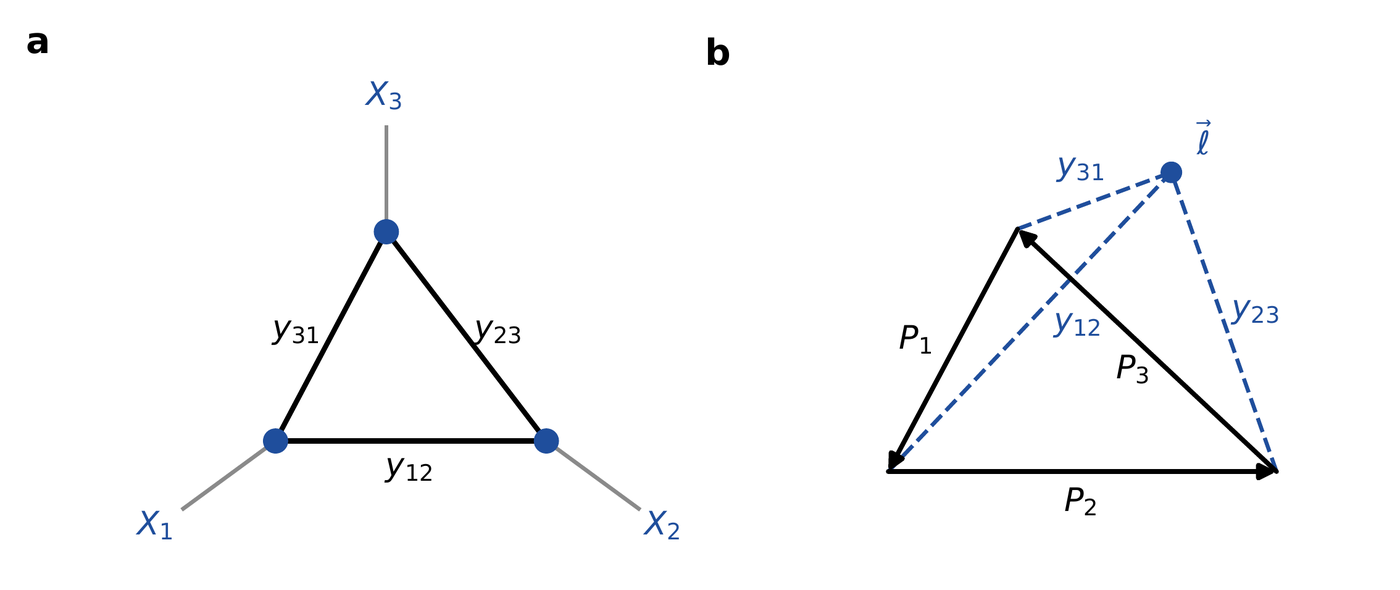
The object of the calculation. (a) The one-loop triangle: three sites (dots), each carrying the total energy $X_v$ of the external legs attached to it, joined in a ring by internal edges with energies $y_{12}$, $y_{23}$, $y_{31}$. (b) The loop measure: the external momenta form a triangle with sides $P_1$, $P_2$, $P_3$, and the three edge energies are the distances (dashed) from the loop momentum $\vec\ell$ to its corners. In general $\vec\ell$ lies out of the plane of the triangle, so the four points span a tetrahedron, and trading $\vec\ell$ for the three distances multiplies the integrand by the product of those distances over six times the tetrahedron’s volume, a volume proportional to the square root of a polynomial $B$ in the squared energies and momenta. (Figure 1 of the paper.)
The triangle has three sites and three edges (panel a), and its integrand $\psi_3$ is a positive quartic polynomial over ten linear factors. Seven are subgraph energies: the total $q_{\mathcal G}=X_1+X_2+X_3$, each single site, each pair of sites. The other three, $q_{\mathcal G}+2y_{12}$ and its two relabelings, count one edge twice. They come from the piece of the propagator that enforces the wavefunction’s boundary condition at the end of time, and every elliptic curve in the triangle involves one of them. The loop momentum $\vec\ell$ enters only through the edge energies, the distances from $\vec\ell$ to the corners of the momentum triangle (panel b). Used as integration variables they bring a factor $B^{-1/2}$ into the measure, with $B(y;P)$ proportional to the squared volume of the tetrahedron with apex $\vec\ell$, and the loop-integrated coefficient $V(X;P)$ is $\psi_3$ integrated against this measure. With one external leg per site $X_v=P_v$; with several legs $X_v$ exceeds $P_v$ (unless the legs are collinear), and the site integrals of an expanding background probe that region.
Where the doughnut appears
Tree-level coefficients of the benchmark model are polylogarithms (or close relatives when $\sigma$ is not an integer), and the simplest loop, the two-site bubble, is polylogarithmic too. In August 2024 Benincasa, Brunello, Mandal, Mastrolia and Vazão derived the differential equations of the triangle’s master integralsa finite set of basis integrals to which every integral of a family reduces by exact linear relations (integration by parts); the physical quantity is one particular combination of them, and their differential equations decide which functions can appear. A block of them with the denominator $q_{\mathcal G}+2y_{12}$ obeys a second-order equation that cannot be factored, with elliptic integrals as solutions. They concluded that the triangle coefficient involves elliptic functions, and that this “is likely to extend to all polygon graphs with a higher number of sites,” while noting that an explicit computation was needed. In flat-space amplitudes elliptic integrals first appear at two loops.
McCune and Schwartz begin by reading the curve off the loop measure. In the sector with the denominator $q_{\mathcal G}+2y_{12}$, stripping off that pole leaves an integral over $y_{23}$ and $y_{31}$ containing only $\sqrt B$. In the squares $y_e^2$ the polynomial $B$ is quadratic, which would integrate to logarithms. A master integral, however, is integrated against $\mathrm dy_{23}\,\mathrm dy_{31}$ rather than the squares, and when both grow large at fixed ratio $\tau=y_{31}/y_{23}$ its integrand becomes proportional to $\mathrm d\tau$ over the square root of a quartic:
$$w^2 \;=\; P_2^2\,\tau^4-\bigl(P_1^2+P_2^2-P_3^2\bigr)\,\tau^2+P_1^2\,.$$Here the $P_v$ are the magnitudes of the external momenta; the points $(\tau,w)$ obeying this equation, with $\tau$ allowed complex values, make up the curve, elliptic for any non-degenerate triangle of momenta. The curve depends on the momenta only, not on the site energies. It sits at infinity on the complexified surface $q_{\mathcal G}+2y_{12}=0$, where $y_{23}$ and $y_{31}$ grow large at fixed $y_{12}$, which is not a region of real loop momentum. On the one-parameter family of triangles $X=P=(2\lambda,\lambda,1)$, $\tfrac13\lt\lambda\lt1$, its two periods are the complete elliptic integrals $\tfrac1\lambda K\bigl(\tfrac{1-\lambda^2}{8\lambda^2}\bigr)$ and $\tfrac1\lambda K\bigl(\tfrac{9\lambda^2-1}{8\lambda^2}\bigr)$, and with them the sector’s master integrals can be computed explicitly: the pieces are elliptic. Whether their physical combination is elliptic is a separate question.
Why the periods cancel
The physical combination of the master integrals is not elliptic, and the reason is visible in the residue at the pole where the curve could enter. The factor $q_{\mathcal G}+2y_{12}$ is the total energy of the chain obtained by cutting the edge $y_{12}$ open, so the residue of the physical integrand there is a flat-space amplitude. It is a product of two Feynman propagators, $1/[2q_{\mathcal G}(y_{23}^2-E_2^2)(y_{31}^2-E_1^2)]$, with $E_1,E_2$ the energies flowing through the remaining edges. The residue depends on $y_{23}$ and $y_{31}$ only through their squares, that is, through the loop momentum, and in the squares $B$ is merely quadratic: on the pole one meets a genus-zero curve (a sphere rather than a doughnut), whose integrals are logarithms. A single master integral is not a function of the squares alone, so the periods appear in the pieces and cancel between them. Proposition 1 of the paper covers every case, for arbitrary site energies: of the 36 lines where two denominator planes meet, an elliptic curve appears on 21, each of them inside a plane $q_{\mathcal G}+2y_e=0$, and no residue of the physical integrand involves any of those curves.
Residues alone do not fix the function class, since the integral over $B\gt0$ is not a sum of residues, so the authors derive the equation $V$ itself obeys on the line $X=P=(2\lambda,\lambda,1)$. Exact reduction of $V$ and its $\lambda$-derivatives to master integrals yields an operator of order 20 that annihilates $V$. It factors completely over the rational functions of $\lambda$ into twenty first-order factors $\bigl(\tfrac{\mathrm d}{\mathrm d\lambda}-\tfrac{r_k'}{r_k}\bigr)$, every $r_k$ a rational function of $\lambda$ and $r_k'$ its derivative. Solving such a product means twenty successive integrations against rational functions, so $V(\lambda)$ is an iterated integral of rational forms, a function of polylogarithmic type. An elliptic period would need an irreducible second-order factor, and there is none.
Three dilogarithms
The order-20 operator, solved exactly, has 20 independent solutions, all polylogarithms of weight at most two. $V$ is a combination of them with constant coefficients, fixed from a high-precision evaluation of the integral and recognized as exact numbers. Written in terms of the site energies, the result extends to any triangle with one leg per site:
$$\int\mathrm{d}^3\ell\;\psi_3 \;=\; \frac{\pi}{q_{\mathcal G}}\left[\frac{\sum_i X_i\,\mathrm{Li}_2(u_i)}{\xi_1\xi_2\xi_3}+\frac{8\,X_1X_2X_3}{q_{\mathcal G}\,\xi_1^2\xi_2^2\xi_3^2}\;\mathcal W\right],$$ $$\mathcal W \;=\; \sum_i X_i\xi_i\,\mathrm{Li}_2(u_i)+2\sum_{i\lt j}X_iX_j\,\ln(1-u_i)\ln(1-u_j)-\frac{\pi^2}{12}\sum_{i\lt j}\xi_i\xi_j\,,\qquad \xi_i=q_{\mathcal G}-2X_i\,,\quad u_i=\frac{\xi_i}{q_{\mathcal G}}\,.$$Here $q_{\mathcal G}$ is the total energy, $X_i=P_i$ the momentum magnitudes and $\mathrm{Li}_2$ the dilogarithm; the $\xi_i$ are positive by the triangle inequalities, and the expression stays finite for a flattened triangle ($\xi_i=0$) or a soft momentum. The paper’s $V$ is the right-hand side times $q_{\mathcal G}/(4\sqrt2)$. A weight-two function with three dilogarithms has, in the paper’s words, “the complexity of a one-loop amplitude in flat space.” On the line only the constants are numerical input, and the formula reproduces all the values not used to fix them to their full accuracy. For a general triangle it is an ansatz whose 14 rational coefficients follow from the result on the line, and it matches the integral to 30 digits or better at generic, nearly flattened and soft triangles that were not used in any fit.
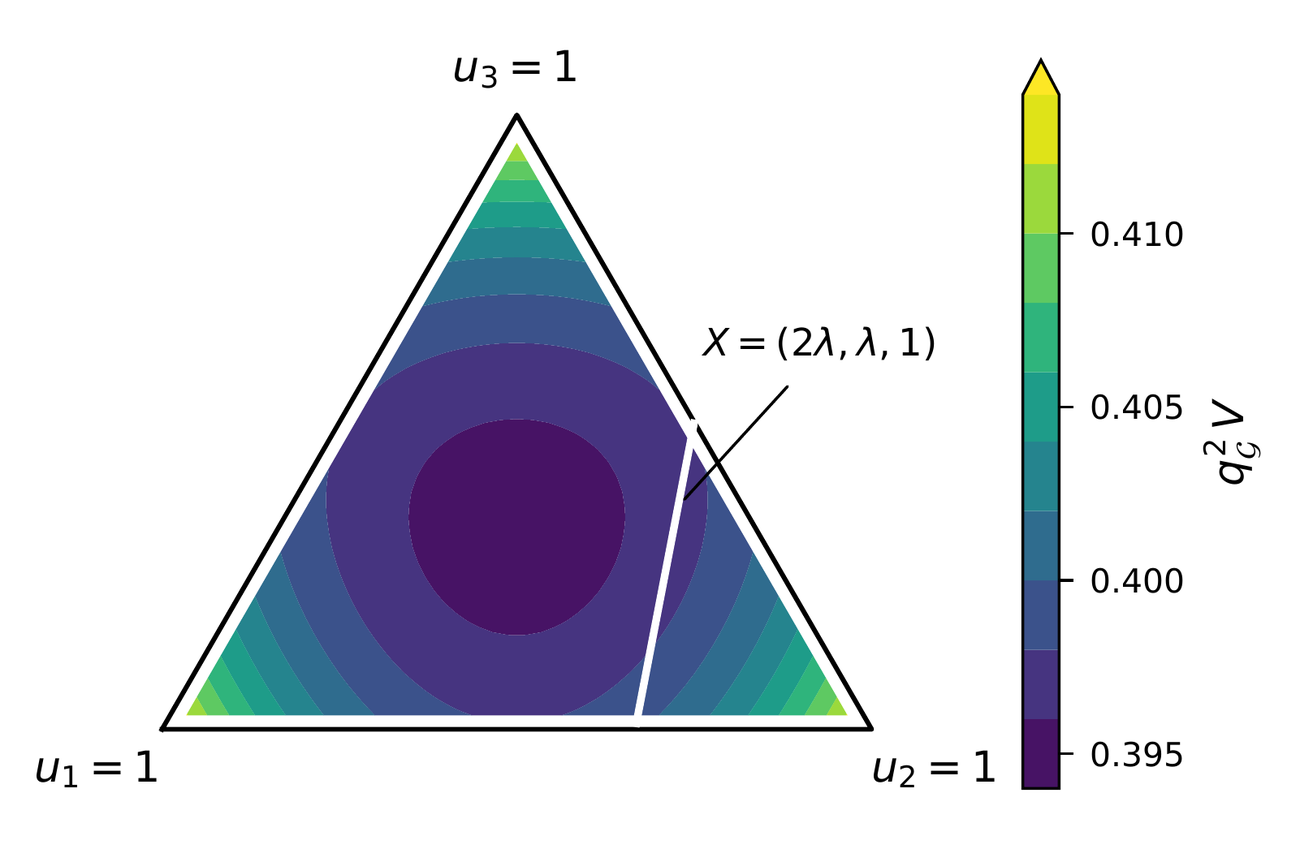
The one-leg-per-site formula over every shape of momentum triangle. Each point inside the large triangle is a shape, in the coordinates $u_i=(q_{\mathcal G}-2X_i)/q_{\mathcal G}$, which are positive and sum to one: the center is the equilateral triangle, the corners are soft limits in which one momentum goes to zero, and the edges are flattened triangles. Color gives the coefficient scaled by the total energy squared, $q_{\mathcal G}^2V$, from the three-dilogarithm formula; the white line is the family $X=P=(2\lambda,\lambda,1)$ on which the exact differential equation was derived. The scaled coefficient is a smooth, nearly flat function of the shape, varying only between 0.395 at the equilateral point and 0.417 in the soft corners, and finite in every degenerate limit. (Figure 4 of the paper.)
Ten square roots and a tetrahedron
One leg per site is a special case, in which many of the square roots and curves in the master integrals degenerate. On a second line, $X=P+\tfrac13(1,1,1)$ with the same $P$, the family has 134 master integrals and fifteen sectors with irreducible elliptic blocks. The physical integrand avoids all of them: there $V$ is one component of the solution of a first-order system of rank 44 built entirely from logarithmic forms $\mathrm d\ln(\,\cdot\,)$ whose arguments are rational or carry a single square root. On that line $V$ comes out as ten terms, each a weight-two function over a square root, and that structure fixes the coefficient everywhere. For each of the ten square roots there is exactly one admissible weight-two function whose branch points lie where a positive sum of energies and momenta vanishes, which leaves ten rational numbers. A fit to numerical values of the integral gives $-\tfrac14$, $-\tfrac12$ and $\pm1$, and the exact system on the second line gives the same ten with no fit, leaving one overall constant to be fixed numerically. The result, eq. (29) of the paper, is built from four independent functions, each a combination of functions of Bloch–Wignera combination of a dilogarithm, its complex conjugate and logarithms that is free of branch ambiguities; it is best known for giving the volume of an ideal tetrahedron in hyperbolic space type, $\mathrm{Li}_2(x)-\mathrm{Li}_2(\bar x)+\tfrac12\ln(x\bar x)\ln\frac{1-x}{1-\bar x}$.
Part of the formula is solid geometry: four of the ten radicands are $-2B$ at points where three energy factors vanish together, and there the three momenta and the three edge energies are the six edges of a flat tetrahedron. Let $f_k$ be the perimeters of its four faces and $c_j$ those of the three closed paths through all four vertices. Then $q(h)=\prod_k(h-f_k)-h\prod_j(h-c_j)$ is only quadratic, its discriminant is the radicand, and the first of the four functions is $F_0=-2\bigl[\sum_k\mathcal B(f_k)-\sum_j\mathcal B(c_j)\bigr]$, with $\mathcal B$ the Bloch–Wigner-type function at arguments built from the roots of $q$. Each term is proportional, when the radicand is negative, to the volume of an ideal hyperbolic tetrahedron.
The formula agrees with the integral to more than 40 digits at every point with $X_v\ge P_v$ that was not used in the fit, nearly flattened triangles, soft momenta and points close to one leg per site included. It also continues analytically below one leg per site, to all $X_v\gt0$, with no numerical input. The continued formula agrees with the integral to the accuracy of the numerical values on that side as well, with no feature at $X_v=P_v$. The one-loop triangle coefficient is therefore a polylogarithmic function of weight two for all positive site energies, whose arguments carry square roots away from one leg per site. That statement is exact on the two lines and rests elsewhere on this agreement.
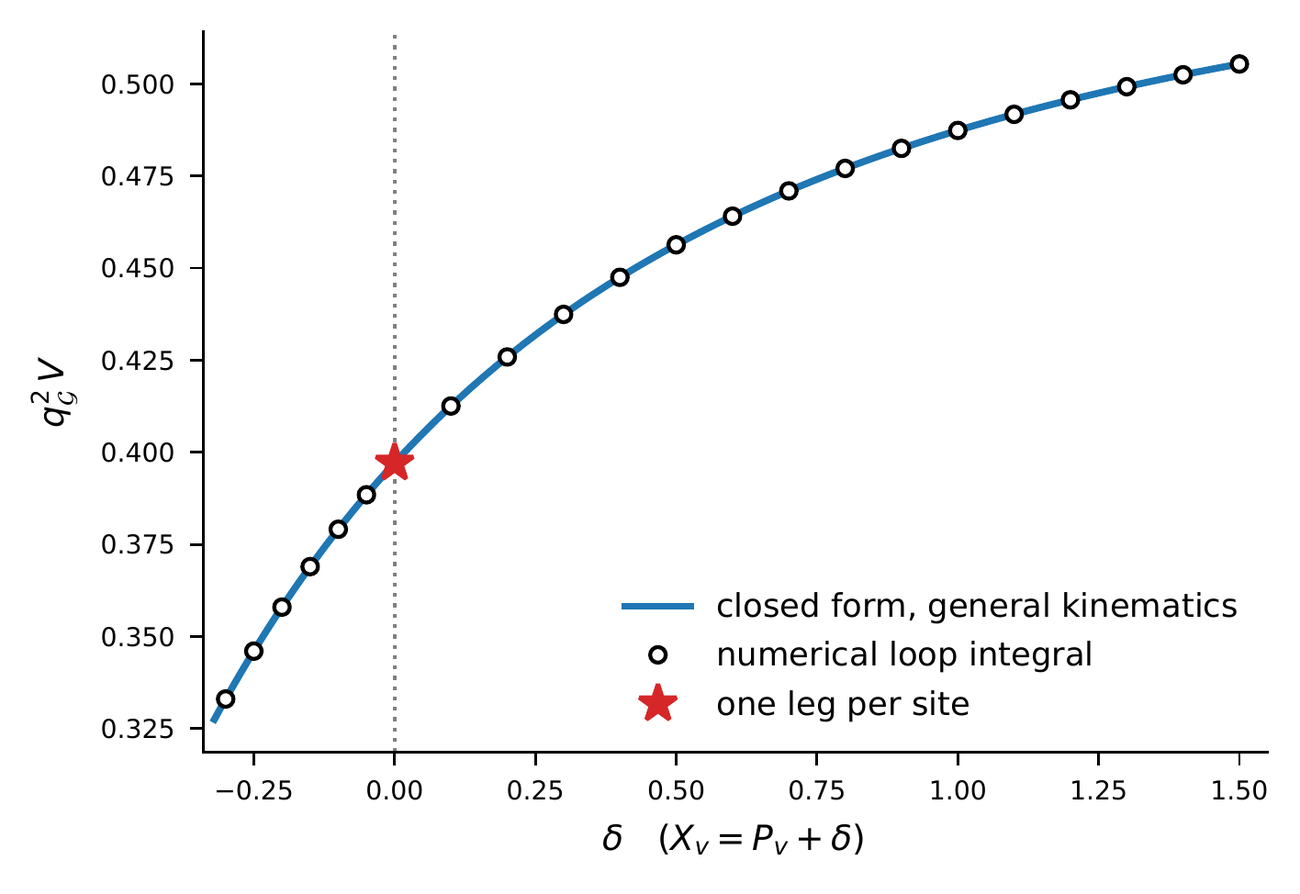
The coefficient through the one-leg-per-site point, for momenta $P=(\tfrac75,\tfrac7{10},1)$ and site energies $X_v=P_v+\delta$, plotted as $q_{\mathcal G}^2V$ against $\delta$. The blue curve is the general ten-root formula, continued to $\delta\lt0$, where every $X_v\lt P_v$; the open circles are direct numerical evaluations of the loop integral; the red star is the three-dilogarithm formula, which applies only at $\delta=0$ (dotted line), where all ten square roots become rational. The curve runs through the circles and the star with no kink at $\delta=0$: the general formula, its continuation and the one-leg-per-site formula are one smooth function, which agrees with the integral on both sides to the accuracy of the numerical values. (Figure 5 of the paper.)
Correlators, and de Sitter space
A telescope measures correlators rather than the wavefunction. Correlators follow from $|\Psi|^2$, and at one loop the boundary value of the loop field is integrated over as well, which glues pairs of boundary legs together. The triangle’s correlator integrand is then the loop coefficient plus the three chains with one edge cut open, plus terms with more edges opened. In that sum the doubled-edge factors $q_{\mathcal G}+2y_e$ cancel, as was known from the cosmological tree theorem of Agui Salcedo and Melville (2023) and from Chowdhury, Lipstein, Mei, Sachs and Vanhove (2023). The authors rederive this cancellation from the 2017 recursion relations and trace it to the boundary term of the propagator: the elliptic curve is a feature of conditioning on the late-time field profile, which the correlator integrates over. For the triangle every elliptic line lies where the correlator integrand has no pole, so that integrand has no residue on any elliptic line.
For a cubic vertex in de Sitter space the site integrals make the loop integral logarithmically divergent, so the coefficient has a late-time logarithm and needs a momentum cutoff $\Lambda$. With one leg per site, symmetry fixes the late-time coefficient as a three-point function of dimension-two operators in a three-dimensional conformal theory (Bzowski, McFadden and Skenderis, 2013). If, as the authors assume, the cutoff breaks the symmetry only through the logarithm, then $\psi_3^{\rm dS}=-\tfrac{\pi\zeta(3)}{2}\ln(k_T/\Lambda)+b$. Here $k_T=k_1+k_2+k_3$ is the sum of the three external momentum magnitudes, $\zeta$ is Riemann’s zeta function and $b$ is a number; a direct evaluation at two kinematic points confirms the form. The correlator’s loop integral converges and symmetry allows only a constant, identified numerically as $-3\pi^2\zeta(3)$. With one leg per site the de Sitter triangle is thus a logarithm and two numbers, whatever functions appear in $V$; with several legs at a site, the general formula above is the required input.
One more site: the box
The four-site box is the natural next test, and in section 6 of the paper the authors find that the box, unlike the triangle, is not polylogarithmic. The doubled-edge factors are harmless again; the obstruction is the energy of a single site. On the pole where the energy of site 1 vanishes, the loop momentum lies on a spheroid whose foci are the points where $y_{12}$ and $y_{41}$ vanish. The residue involves the other two edge energies, $y_{23}$ and $y_{34}$, each the square root of a quadratic function on that surface. One such root, the triangle’s case, can be rationalized. Two define a curve $Y^2=q_{23}\,q_{34}$ along a line on the spheroid, with $q_e=y_e^2$ the two quadratics, and that curve has genus one: it is elliptic.
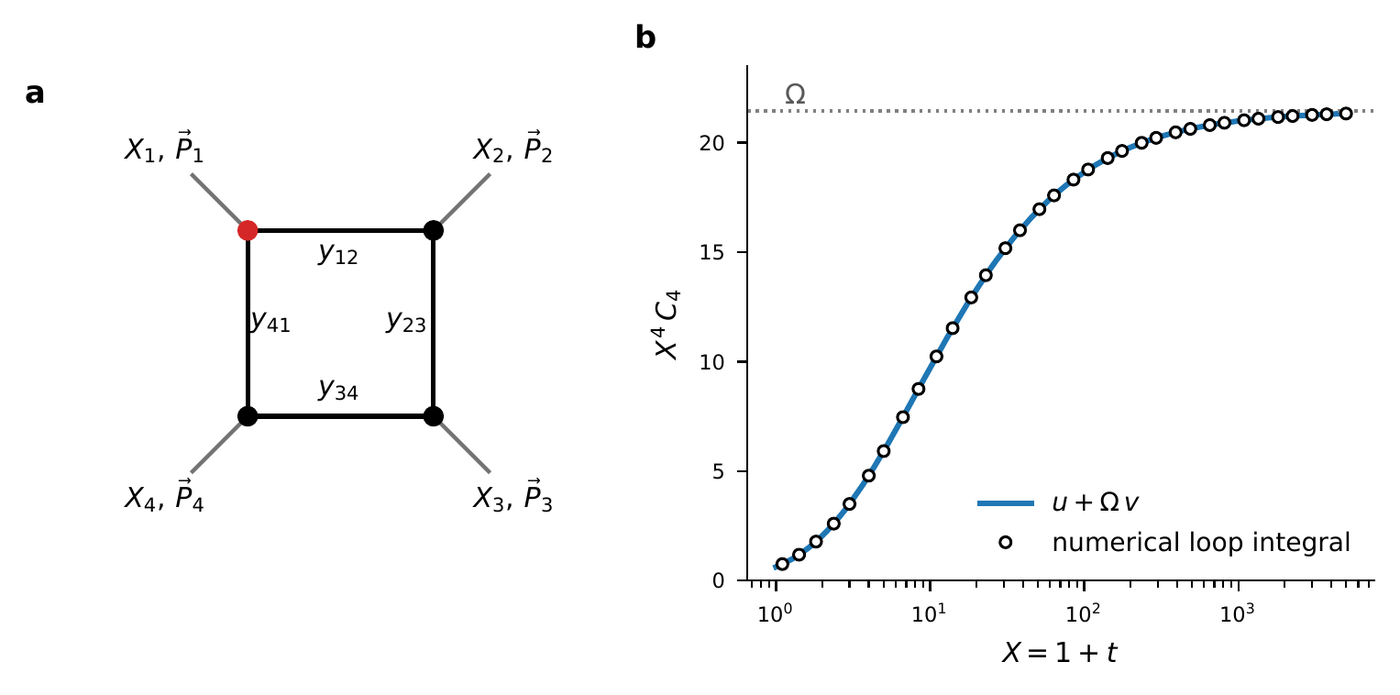
The four-site box and its correlator on a line. (a) The one-loop box: four sites, each carrying the energy $X_v$ and momentum $\vec P_v$ of its external legs, joined in a ring by internal edges with energies $y_{12}$, $y_{23}$, $y_{34}$, $y_{41}$. The red site is site 1: on the pole where its energy vanishes, the residue contains two square roots, the energies $y_{23}$ and $y_{34}$ of the edges that do not touch it, and there the triangle’s mechanism fails. (b) The loop-integrated correlator $C_4$ on the line where the momenta form a regular tetrahedron of unit side and every site energy equals $X=1+t$, multiplied by $X^4$ and plotted against $X$ on a logarithmic axis. The blue curve is the closed form $u+\Omega\,v$ discussed below, two solutions $u$ and $v$ of an exact differential system and one number $\Omega$, with nothing fitted; the open circles are direct numerical values of the loop integral; the dotted line is the constant $\Omega\approx21.44$, which $X^4C_4$ approaches at large $X$. The curve passes through every point over more than three decades in $X$: two solutions of an exact system and a single number reproduce the box correlator on this line. (Figure 6 of the paper.)
With one leg per site, the box coefficient $V_4$ has a cut starting at $X_1=-P_1$, where the spheroid collapses onto the segment between its foci. The discontinuity there, $D_0$, is an integral along that segment on an elliptic curve set by the shape of the momentum quadrilateral (for momenta not in a plane). It belongs to the physical answer: as the momentum at site 1 goes soft, $V_4=-D_0\log 2P_1$ plus terms analytic at $P_1=0$. The authors evaluate $D_0$ in closed form, logarithms plus elliptic integrals of the first and third kind, and the coefficient of the first-kind integral does not vanish. The closed form agrees with direct numerical integration to 33 digits or better at all 45 points computed along a one-parameter family of quadrilaterals (figure 7 of the paper).
An elliptic integral in a discontinuity does not by itself exclude a polylogarithmic total, as the triangle shows, so the authors test $D_0$ directly. Carried around the points where its curve degenerates, $D_0$ comes back reshuffled by monodromy matrices whose eigenvalues are not roots of unity, which no function of polylogarithmic type allows. The triangle, run through the same computation as a control, shows no such obstruction, and an exact computation on the box’s residue confirms that the periods of its curve enter. The box with one leg per site is thus elliptic, “in the sense that the periods of an elliptic curve enter its soft limit,” and “the triangle is the last polygon of this theory that is polylogarithmic.”
Above the threshold at $X_1=-P_1$ the spheroid no longer collapses, and the discontinuity becomes an integral over its double cover defined by the two roots: a K3 surface, the two-dimensional analog of an elliptic curve. For regular-tetrahedron momenta its periods obey an equation of order five that is known exactly, whose solutions are not products of elliptic periods. With several legs per site the physical integrand couples to this block of periods, so the box is then a function of K3 type. At exactly one leg per site two pieces of evidence, one numerical and one exact, indicate that the coupling persists, for the coefficient and for the correlator alike; generic momenta are untested (the details are in an appendix). On one line (regular-tetrahedron momenta of unit side, all site energies equal to $X=1+t$) exact reduction gives differential systems for the coefficient and the correlator that contain this block and three more elliptic curves. For the correlator the analysis can be carried to the end:
$$C_4(t)\;=\;u(t)+\Omega\,v(t)\,,\qquad \Omega\;=\;\int\!\mathrm{d}^3\ell\;\frac{1}{y_{12}\,y_{23}\,y_{34}\,y_{41}}\;=\;21.44442951\ldots$$Here $C_4(t)$ is the loop-integrated four-site correlator on that line, and $u$ and $v$ are two solutions of the exact system, fixed without reference to any value of $C_4$. The function $v$ is the one physical solution free of logarithms at large $X$, a series starting at $X^{-4}$ with rational coefficients, and $u$ is determined by expansion coefficients at large $X$ and boundary constants that are known exactly. $\Omega$ is a number, the loop integral of the inverse product of the four edge energies, the distances from $\vec\ell$ to the vertices of the unit tetrahedron. Feynman parameters reduce it to a two-dimensional integral of elementary functions, which the authors could not reduce further, and they have found no integer relation between $\Omega$ and familiar constants. The expression $u+\Omega\,v$ contains no fitted number, and it agrees with every direct numerical value of the correlator the authors computed, to the accuracy of those values, over more than three decades in $X$ (panel b of the figure above). For the coefficient $V_4$ two constants remain undetermined.
What is open
The triangle results share one feature: reduction cuts the integrand into pieces each more singular than their sum, so the master integrals involve functions more complicated than the physical quantity needs. Several questions remain. An analytic derivation: both closed forms, in the text and in appendix A, were found by fixing the function space exactly and a few rational constants numerically, and constants as plain as $-\tfrac14$, $-\tfrac12$ and $\pm1$ suggest that a direct derivation exists, perhaps in a form manifestly analytic across $X_v=P_v$. Expanding backgrounds: coefficients with several legs per site are now site integrals of weight-two functions with square roots in their arguments, and whether those integrals stay polylogarithmic is a natural next question. The box: on one line its correlator is known up to the single number $\Omega$, though through solutions of a differential system rather than named functions. Its coefficient $V_4$ there still has two undetermined constants, and generic momenta are untreated. The pentagon: its single-site residue involves three square roots and a curve of genus five, not examined further. Two loops: in the two-loop graphs the authors examined, the correlator integrand contains subgraph energies only, and whether a two-loop correlator has an elliptic singular locus is open.
A general principle: for the triangle, the curve’s absence from the correlator and its cancellation in the wavefunction both trace to the boundary term of the propagator, with no general argument connecting the two. Neither fact is general, since the box’s curves sit on poles of subgraph energies, which the correlator shares. Massive fields: everything here is conformally coupled, which keeps the integrand rational; with general masses the function class of such loops is open.
The paper
- Elliptic master integrals and the one-loop wavefunction of the universe (PDF) — Amara McCune and Matthew D. Schwartz; the posted draft is marked preliminary. Sections 2–5 treat the triangle, section 6 the box, and section 7 de Sitter space and open questions; the two appendices give the derivations, appendix A of the closed form (the order-20 operator and its singular points, its twenty polylogarithmic solutions, the coefficient on the line and for a general triangle, its limits, and the relation to other bootstrap methods) and appendix B of the box results (the single-site residue and the threshold, the reduction of $D_0$ to Carlson elliptic integrals, the curves, the fifth-order operator and the physical solutions on the line, and the large-energy expansion in which $\Omega$ appears). The authors’ evaluators for the closed forms and the files that accompany them are listed under Supplementary material below.
Supplementary material
The authors’ evaluators for the triangle’s closed forms are posted here as released with the paper (Python with the mpmath library only; site energies are entered as exact rationals such as 7/10). Each was run independently on this site before posting, at the points its own documentation names and against numerical integration good to 30 digits; the agreement found is quoted per file. Mind the stated region of validity: the scripts now stop with an error outside it.
- eval_closed_form_general.py — the one-leg-per-site closed form $V(X;P{=}X)$ for any non-degenerate triangle of site energies; usage
python eval_closed_form_general.py X1 X2 X3 [digits], with--checkand--tablemodes. Valid only on the slice $P=X$; it stops with an OutOfRegion error for site energies that do not form a non-degenerate triangle. Checked at three triangles (34 to 38 digits of agreement) and on a 295-point table. - eval_closed_form_offslice.py (reads li2_representation.json) — $V(X;P)$ for general site energies as leading singularities times dilogarithm combinations. Valid for $X_v \gt P_v$ strictly at every site; with any $X_v \lt P_v$ it stops with an OutOfRegion error and points to eval_closed_form_V_all.py. Checked at 25 points (30 to 38 digits).
- eval_closed_form_offslice_compact.py (reads compact_representation.json) — the compact, permutation-symmetric form of the same $V(X;P)$, with exact handling of one vanishing letter. Valid for $X_v \ge P_v$ with at most one letter exactly zero and exact rational input; it refuses on the full slice $P=X$ (use the first script there) and stops with an OutOfRegion error if any $X_v \lt P_v$. Checked at the same 25 points and one boundary point.
- eval_closed_form_V_all.py — $V(X;P)$ over the whole region of positive site energies for a non-degenerate momentum triangle, on both sides of $X_v=P_v$, with boundaries and removable points handled by interpolation. Checked at 30 off-slice points including three with $X_v \lt P_v$, four boundary points and the five-point dispersion check, and equal to the first script on the slice to 45 digits.
- vertex_blocks.json — the four vertex functions of $V(X;P)$ in Bloch–Wigner block form, machine-readable: the tetrahedron’s edge assignments, its faces and cycles, and the sign classes.
- vertex_functions_blocks.tex — the same block form written out in LaTeX, with the tetrahedron data (face and cycle perimeters, the quadratic $q$ and its roots); a fragment, not compiled, for which vertex_blocks.json is authoritative.
- closed_form_V_offslice.tex — the general formula $V(X;P)$ for $X_v \gt P_v$ written out in LaTeX from li2_representation.json: the ten square roots, the vertex and tube functions and their rational coefficients; the JSON file and eval_closed_form_offslice.py are authoritative.
- closed_form_V_offslice_compact.tex — the compact, permutation-symmetric form written out in LaTeX from compact_representation.json; a fragment, not compiled, for which the JSON file and eval_closed_form_offslice_compact.py are authoritative.
- box_j_invariants.tex — the $j$-invariants, of degree 24 in $t$, of the three elliptic curves of the box on the line $X_v=1+t$ with regular-tetrahedron momenta of unit side (section 6.5 of the paper).
- box_D0/d0_eval.py (with d0_closed.py; formulas in D0_closed_form.tex) — evaluator for the closed form of the box’s threshold discontinuity $D_0$ (Carlson integrals $R_F$, $R_J$ and logarithms; section 6.2 and appendix B.3) at one built-in momentum configuration, with no command-line interface for others;
cd box_D0 && python3 d0_eval.pyprints the closed form against direct quadrature for four orderings of the pivot, agreeing to about $10^{-38}$ at 40 digits. - operator_L0/operator_L0.json (with check_operator_L0.py) — the exact rational coefficients of the order-20 operator $\mathcal L_0$ on the line $X=(2\lambda,\lambda,1)$, polynomial degrees 132 to 152 (section 4);
python3 check_operator_L0.py [lambda]with $\tfrac13 \lt \lambda \lt 1$ applies the operator to the closed form by interpolated derivatives and reports a residual of about $10^{-29}$ (limited to roughly $10^{-25}$ by its own differencing scheme). The folder must stay beside eval_closed_form_general.py, which it imports. - numerator_A.txt — the quartic numerator of the triangle integrand (section 2), 123 monomials in a sympy-readable form.
- numerical_checks.md and box_details.md — the numerical tests and methods behind the accuracies stated in the paper (points, digit agreements, quadrature settings), and the supporting statements about the box for section 6 and appendix B.
- README.md — the co-authors’ map from each statement of the paper to the file that supports it, with the commands to run. Its box_line/ folder is the same set of files as the box evaluator group below.
- MANIFEST.sha256 — SHA-256 checksums of the files in this group.
For the box, a standalone evaluator of the two section-6.6 quantities on the equal-energy line is posted as well, again Python with mpmath only. It was run independently on this site before posting (its five-part self-test and sixteen further points against separately computed reference values, agreeing to the 27–28 digits it prints); the statements below go no further than that check.
- eq_box_evaluate_standalone.py (with README.md) — $C_4(t)=u+\Omega\,v$ and $\psi_4(t)$ of the one-loop box for a conformally coupled scalar on the line $x_v = 1+t$ with a regular tetrahedron of momenta, from the exact 28- and 34-dimensional differential systems: an explicit large-$X$ series (full accuracy for $X = 1+t \ge 14$) or a two-precision transport from $t_0=3/4$ whose certified digits are the agreement of the two runs. Usage
python3 eq_box_evaluate_standalone.py --which C4 --t 15;--selftestruns the five checks. Valid for $t \gt 0$ only ($t \le 0$ is refused); validated here for $1/10 \le t \le 50$. $C_4$ is fixed without data apart from the external constant $\Omega$ (a parameter, default the paper’s value); the boundary vector for $\psi_4$ is fitted to the co-author’s table. Run times are the script’s own reported wall time: seconds near $t_0$, a few minutes when the path must detour around singular points. - system_C4_28.json (2.8 MB) — the exact 28-dimensional differential system for $C_4$: the matrix entries and the observable row as lists of rational coefficients, with the system’s singular points for step control and detours.
- system_psi4_34.json (4.5 MB) — the exact 34-dimensional system for $\psi_4$, in the same format.
- model_C4.json — the vectors $u$ and $v$ at $t_0=3/4$ (28 components each), the values of $\Omega$, and the large-$X$ series coefficients $\alpha_n(u)$, $\beta_n(u)$, $\alpha_n(v)$ for $n=4,\ldots,44$.
- model_psi4.json — the 34-component $\psi_4$ vector at $t_0=3/4$ and its series coefficients $\alpha_n$, $\beta_n$ for $n=5,\ldots,44$.
- singular_points.json — the singular points of both systems in the complex $t$-plane, used for step control and detours.
- selftest_reference.json — the reference values for the five self-test checks: three comparisons of the explicit series with the transport, and two independently computed values of $C_4$ at $t=2$ and $t=1/10$.
- _ratparse.py — an exact rational parser in pure Python, needed only by the script’s fallback mode when the two system files are absent.
- SELFTEST_20260928T000930Z.txt — the self-test transcript: all five checks pass, with 28.4 to 30.4 digits of agreement, in about nine minutes.
- MANIFEST.sha256 — SHA-256 checksums of the files in this group.
Materials from the first version of this work, on the elliptic-sector master integrals, remain available.
- cosmo-expression.md — a note on what the first version made evaluable: the closed period basis of the second-order elliptic operator of the maximal cut, in complete elliptic integrals, and the exact $16\times16$ connection matrix of the sector, rational in the kinematic variable $\lambda$ and the expansion parameter $\epsilon$.
- cosmo-evaluate.py — Python (mpmath and sympy; python-flint for the iterated integrals): evaluates the closed periods with independent checks against direct quadrature and the Wronskian, verifies structural properties of the exact connection in rational arithmetic, and computes the sector’s $\epsilon$-expanded solution as iterated integrals over the periods, compared at run time with an independent series transport of the original system.
- cosmo-data.json.gz — the exact data the script reads: the connection matrix, the gauge transformation, the letters and the word lists of the iterated integrals.
References
| N. Arkani-Hamed, P. Benincasa and A. Postnikov, Cosmological Polytopes and the Wavefunction of the Universe, arXiv:1709.02813 (2017) | the anatomy of flat-space coefficients, one pole per subgraph energy, and their recursion relations |
| N. Arkani-Hamed, D. Baumann, H. Lee and G. L. Pimentel, The Cosmological Bootstrap: Inflationary Correlators from Symmetries and Singularities, JHEP 04 (2020) 105 | the cosmological bootstrap: correlators built from their singularities and symmetries |
| P. Benincasa, G. Brunello, M. K. Mandal, P. Mastrolia and F. Vazão, One-loop corrections to the Bunch-Davies wave function of the universe, Phys. Rev. D 111 (2025) 085016 | the triangle’s differential equations and elliptic sector; expected elliptic functions for every polygon |
| D. Baumann, H. Goodhew and H. Lee, Kinematic flow for cosmological loop integrands, JHEP 07 (2025) 131 | differential equations for one-loop integrands; the two-site bubble is polylogarithmic |
| S. Laporta and E. Remiddi, Analytic treatment of the two loop equal mass sunrise graph, Nucl. Phys. B 704 (2005) 349 | the sunrise graph: in flat space, elliptic integrals enter at two loops |
| T. Heckelbacher, I. Sachs, E. Skvortsov and P. Vanhove, Analytical evaluation of cosmological correlation functions, JHEP 08 (2022) 139 | a one-loop de Sitter four-point correlator in polylogarithms, its elliptic sector canceling |
| G. L. Pimentel and T. Westerdijk, On Cosmological Correlators at One Loop, arXiv:2601.00952 (2026) | the flat-space in-in triangle in dilogarithms; the wavefunction’s own integrals expected to be harder |
| J. Henn, J. Mei and Q. Yang, A compact analytic formula for the one-loop triangle cosmological correlator, arXiv:2608.17877 (2026) | the de Sitter triangle correlator of conformally coupled scalars in dilogarithms |
| S. Agui Salcedo and S. Melville, The cosmological tree theorem, JHEP 12 (2023) 076 | the tree theorem by which the doubled-edge factors cancel in correlators |
| C. Chowdhury, A. Lipstein, J. Mei, I. Sachs and P. Vanhove, The Subtle Simplicity of Cosmological Correlators, arXiv:2312.13803 (2023) | an independent demonstration that the boundary-term poles drop out of equal-time correlators |
| A. Bzowski, P. McFadden and K. Skenderis, Implications of conformal invariance in momentum space, JHEP 03 (2014) 111 | conformal three-point functions in momentum space, which fix the de Sitter triangle’s form |
| K. Acres and D. Broadhurst, Empirical determinations of Feynman integrals using integer relation algorithms, arXiv:2103.06345 (2021) | the practice followed here: fit high-precision values, then test on digits not used |