The Watson integral (condensed matter theory)
The content on this page was written by AI under human supervision.
A random walker on a three-dimensional lattice may never come home, and since 1939 the exact probability that it does has been worked out one crystal symmetry at a time. The generic case, a lattice with three unequal hopping rates, stayed unsolved for almost ninety years and became the subject’s “final problem.” The paper on this page proves that for generic rates no formula of the expected kind exists, and gives a closed form of a different kind, built from a single algebraic curve of genus two.
Pólya’s question
Random walks model phenomena from Brownian motion to the diffusion of radiation inside a star to the pricing of options. At each tick of a clock a walker steps from its lattice site to a randomly chosen neighbor. The central object of the theory is the lattice Green’s function, a generating function for the probability of finding the walker at a given displacement after a given number of steps. In condensed matter physics the same function describes electrons in a tight-binding solid and the resistance of a resistor network.
A walker on a square grid, taking a step left or right at one rate and up or down at another; the two knobs set the rates, so at equal settings the four directions are equally likely and at unequal settings the cloud of visited sites (shaded) stretches along the faster axis. The orange ring is the starting site and the counter records every return to it. On a line or a square grid the walker always comes home eventually, however lopsided the rates, though the waits grow long; the paper’s problem is the three-dimensional crystal with three unequal rates, where it may never return, and the question is the exact probability that it does. (Interactive sketch made for this site, not a figure of the paper.)
One of the oldest questions is whether the walker ever returns to its starting point. In 1921 George Pólya proved that on a line or a square grid it always does, while on the cubic lattice it comes back with a definite probability, about 34 percent, and otherwise escapes for good. The exact value for the cubic lattice came in 1939, when G. N. Watson evaluated the triple integral defining the cubic-lattice Green’s function in complete elliptic integralsthe classical function $K(k)=\int_0^{\pi/2}\mathrm d\theta/\sqrt{1-k^2\sin^2\theta}$, which gives among other things the period of a pendulum; as a function of the modulus $k$ it satisfies a linear differential equation of order two. Converted to gamma functions by Glasser and Zucker in 1977, the return probability reads $R=1-\big[\tfrac{\sqrt6}{32\pi^3}\,\Gamma(\tfrac1{24})\Gamma(\tfrac5{24})\Gamma(\tfrac7{24})\Gamma(\tfrac{11}{24})\big]^{-1}=0.3405\ldots$.
These classical results all assume that the six directions are equally likely. In a crystal of orthorhombic symmetrya crystal whose three axes are mutually perpendicular but physically inequivalent, so that hops come easier along some directions than others; “tetragonal” means two of the three axes are equivalent, “cubic” all three the walker hops along the three axes at three different rates, and for that generic case no closed form had been found in almost ninety years of study. In his 2011 survey I. J. Zucker called the orthorhombic integral “the final problem” and judged that “the difficulties encountered so far in attempted solutions of this three parameter problem seem insuperable.” Noam Elkies, Thomas W. Grimm and Matthew D. Schwartz write in the paper summarized here: “This paper solves it. The result is not an elliptic integral, or a product of elliptic integrals, but rather a period of a K3 surface, which can nevertheless be written in terms of a single curve of genus two.”
From the walk to an integral
Call the rates $\alpha$, $\beta$, $\gamma$: at each step the walker picks an axis with probability proportional to its rate, then moves one site either way along it. The walk is a sum of independent steps, so in Fourier space the $n$-step distribution is the $n$th power of a single function of the crystal momentum $\mathbf k$. Summing over $n$ with weight $z^n$ under the integral sign then turns the Green’s function at the origin into one triple integral, the Watson integral of the title:
$$W(\alpha,\beta,\gamma;w)\;=\;\frac{1}{\pi^3}\int_0^\pi\!\!\int_0^\pi\!\!\int_0^\pi\frac{\mathrm{d}k_1\,\mathrm{d}k_2\,\mathrm{d}k_3}{\,w-\alpha\cos k_1-\beta\cos k_2-\gamma\cos k_3\,}\,.$$Here $k_1,k_2,k_3$ are the components of the momentum and $w=(\alpha+\beta+\gamma)/z$ is an energy-like variable at or above the band edge $w^\star=\alpha+\beta+\gamma$, where the denominator first touches zero, at $\mathbf k=0$. As a function of $w$ the product $w\,W$ is the generating function of the probabilities of being home after $n$ steps, with coefficients that are exact polynomials in the squared rates. At the band edge $w^\star W$ is the expected number of visits home, and since each return starts the walk afresh, the return probability is $R=1-1/[\,w^\star W(\alpha,\beta,\gamma;w^\star)\,]$. Pólya’s theorem becomes a statement about the integrand near $\mathbf k=0$, where a $1/k^2$ singularity is integrable in three dimensions but not in one or two. Physicists will also recognize $W$ as $\langle\mathbf 0|(w-H)^{-1}|\mathbf 0\rangle$, the diagonal Green’s function of the tight-binding Hamiltonian with hopping amplitudes $\alpha/2,\beta/2,\gamma/2$ at an energy $w$ above the band.
The solved cases
Whenever the rates are special, $w\,W$ is known. With one rate zero (a square lattice) it is an algebraic function times one $K(k)$. With three equal rates it is an algebraic function times the square of one complete elliptic integral: Watson found the band-edge value in 1939, and Joyce the formula at every $w$ in 1973. With exactly two equal, the tetragonal case, it is an algebraic function times a product $K(k_+)K(k_-)$ of two different ones: Montroll evaluated it at the band edge in 1956, and Delves and Joyce along the whole tetragonal line in 2001. Every exact result is an algebraic function times at most two complete elliptic integrals, and correspondingly satisfies a linear differential equation in $w$ of order two, three or four.
The authors build their argument on the order of the differential equation in $w$. $K(k)$ is a perioda number obtained by integrating an algebraic differential form over a closed cycle of an algebraic curve or surface; Feynman integrals in particle physics are periods in the same sense of a torus, the curve $y^2=(1-t^2)(1-k^2t^2)$: the integral of $\mathrm dt/y$ around one of its two independent loops. Two loops give two periods, both satisfying one second-order equation; a square then satisfies an equation of order three, a product order four. In each solved case the order counts the independent cycles carrying a nonzero period. A search for a product formula can find one but cannot rule one out; the symmetry group of the differential equation, which records how its solutions mix among themselves when continued around the singular points, can.
A surface with five periods
For the three-angle Watson integrand the analogue of the torus is a surface. With the angles complex, the denominator vanishes on a surface of two complex dimensions, and $W$ is a period of it: the integral of the residue of the integrand, a two-form, over a closed two-cycle. In the variables $z_i=e^{ik_i}$ the surface is $a\,z_2z_3(z_1^2+1)+b\,z_1z_3(z_2^2+1)+c\,z_1z_2(z_3^2+1)=2z_1z_2z_3$, with $a,b,c$ the rates divided by $w$. It has eight ordinary double points at the corners where every $z_i$ is $0$ or $\infty$, and smoothing them gives a K3 surface, a simply connected complex surface carrying a nowhere-vanishing holomorphic two-form: the two-dimensional analogue of an elliptic curve. The authors call it the Watson K3; Koike had studied the family in 2011, and the paper uses his description of its cycles throughout.
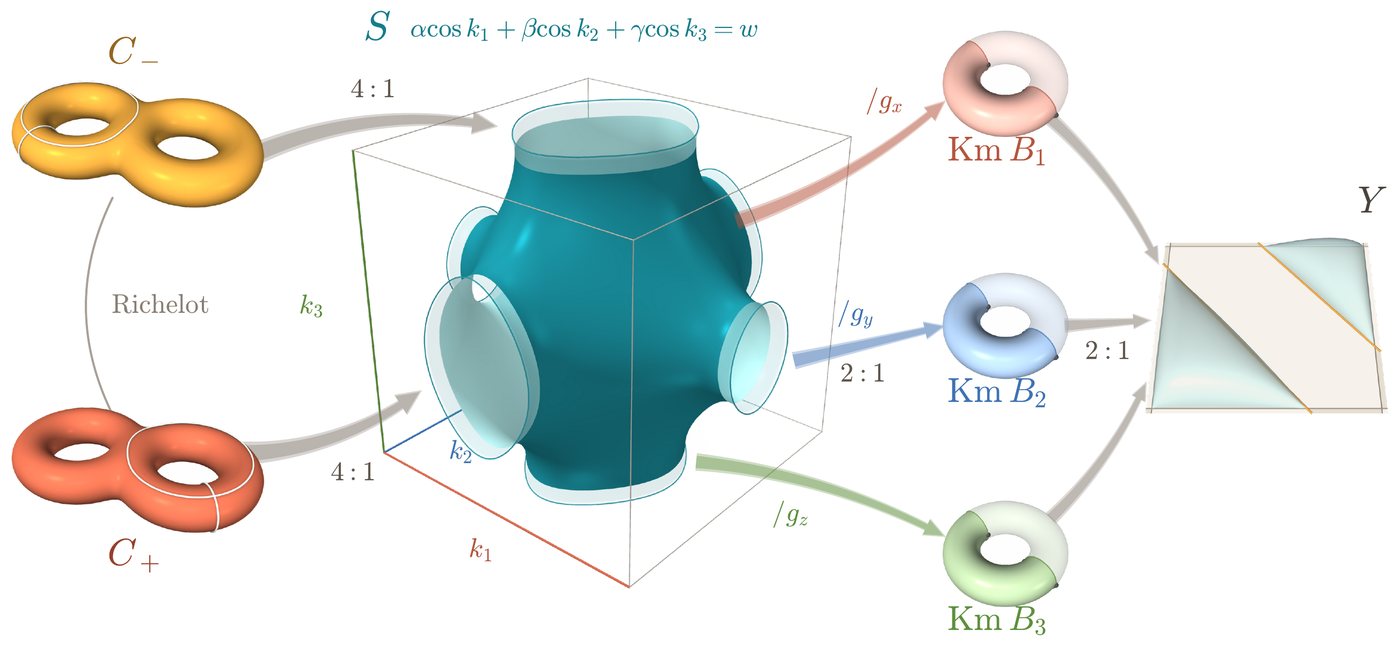
The surfaces of the paper for rates $(\alpha_1,\alpha_2,\alpha_3)$, the paper’s labels for $(\alpha,\beta,\gamma)$, here $(\alpha_1,\alpha_2,\alpha_3)=(1,0.8,0.6)$. Center: the singular surface $S$ on which the integrand blows up, $\alpha_1\cos k_1+\alpha_2\cos k_2+\alpha_3\cos k_3=w$, drawn as its real locus in one Brillouin cube at $w=0.15$, a value inside the band so that the real locus is nonempty: the constant-energy surface of the tight-binding band. Left: the two genus-two curves $C_-$, $C_+$ attached to the rates, joined by the Richelot isogeny, each standing for the Kummer surface of its Jacobian, which covers $S$ four-to-one. Right: the quotients of $S$ by the three symmetries that reverse two lattice directions, each a Kummer surface $\mathrm{Km}\,B_i$, and the double cover $Y$ of the plane branched along six lines, computed for the same rates. The curves and Kummer surfaces are schematic; the degrees $4{:}1$, $2{:}1$, $2{:}1$ are exact. (Figure 3 of the paper.)
A K3 surface has twenty-two independent two-cycles, but the two-form integrates to zero over any cycle traced out by an algebraic curve on the surface. For every choice of rates, the twelve coordinate lines on the surface and the eight curves created by smoothing the double points generate seventeen independent algebraic classes; for very general rates, meaning outside a countable collection of algebraic exceptions, there are no others. So $22-17=5$ periods survive, one of them $w\,W$, and at fixed rates they span the solutions of a fifth-order linear differential equation in $w$, the Picard–Fuchs equation, which the authors derive and print in full:
$$\mathcal L_5\,\big[\,w\,W\,\big]=0,\qquad \mathcal L_5=\sum_{k=0}^{6}x^{k}\,\mathsf P_k(\vartheta),\qquad \mathsf P_0=\vartheta^{3}(\vartheta-1)(\vartheta-2),\qquad \vartheta=x\frac{\mathrm d}{\mathrm dx},\qquad x=\frac{1}{w^{2}}\,.$$In words: $\vartheta$ is the derivative that counts powers of $x=1/w^2$, and each $\mathsf P_k$ is a polynomial of degree at most five in $\vartheta$ with coefficients polynomial in the symmetric functions of the squared rates; for instance $\mathsf P_6=-3\delta^3(\vartheta+\tfrac12)(\vartheta+1)(\vartheta+\tfrac32)(\vartheta+\tfrac52)(\vartheta+\tfrac72)$ with $\delta=(\alpha_1^2+\alpha_2^2+\alpha_3^2)^2-4(\alpha_1^2\alpha_2^2+\alpha_2^2\alpha_3^2+\alpha_3^2\alpha_1^2)$. Because the series coefficients of $w\,W$ are exact, $\mathcal L_5[wW]=0$ can be checked term by term. The genuine singular points are the eight thresholds $w=\pm\alpha_1\pm\alpha_2\pm\alpha_3$, the outermost two being the band edges, where the surface acquires an extra double point.
Theorem 1 of the paper says that for a very general direction of rates $(\alpha_1^2:\alpha_2^2:\alpha_3^2)$ the minimal equation for $w\,W$ is $\mathcal L_5$, irreducible, with the full group $\mathrm{SO}(5)$ as the connected part of its symmetry group. The proof is Hodge-theoretic rather than computational: theorems of Zarhin and André leave no room for hidden symmetries of the five transcendental cycles or of their monodromythe way the solutions of a linear differential equation are reshuffled among themselves when the variable is carried around a loop enclosing a singular point; for a family of algebraic surfaces it is given by integer matrices acting on the cycles along the ray. The five solutions then “mix under analytic continuation as freely as five functions bound by one quadratic relation can,” and no expression in complete elliptic integrals of algebraic moduli, products and symmetric powers included, can do that: it would confine the group to one built from copies of $\mathrm{SL}(2)$, the group belonging to a single elliptic integral. “Very general” is the theorem’s exact scope: the walls are excluded, and so is a further countable set of rate directions that the argument does not list.
The count of transcendental cycles also accounts for the classical formulas. On a wall $\alpha_i=\alpha_j$ one more cycle becomes algebraic, four periods move, and up to a finite cover the group is $\mathrm{SL}(2)\times\mathrm{SL}(2)$, whose periods are products of elliptic periods: the Delves–Joyce formula with its fourth-order equation. On the diagonal three periods remain and the system is the symmetric square of one elliptic system: Joyce’s isotropic square, of order three.
A curve of genus two
The group $\mathrm{SO}(5)$ forbids elliptic curves but permits one other construction, through the coincidence of Lie algebras $\mathfrak{so}(5)\simeq\mathfrak{sp}(4)$. Five functions bound by one quadratic relation can be written as the $2\times2$ minors of a $2\times4$ matrix. A curve of genus two, $y^2=f(t)$ with $f$ of degree six rather than three or four, has exactly such a period matrix: two holomorphic one-forms integrated around four independent loops. The authors determine that curve from the rates.
Doing the $k_3$ integral first shows that $W$ is also a period of a double cover of the plane branched along six lines. For that family Matsumoto and Terasoma expressed the squared theta constants, special values of Riemann’s theta functions that serve as coordinates on the space of period matrices, through the coefficients of the lines. From their proportionalities and Thomae’s classical formula the authors obtain the Igusa–Clebsch invariants that determine the curve as explicit polynomials in the symmetric functions of $a^2,b^2,c^2$ and in one square root, that of the product $q$ of the eight normalized thresholds $1\pm a\pm b\pm c$. The two signs of $\sqrt q$ give two curves, $C_-$ and $C_+$, related by a Richelot isogeny, the genus-two version of Landen’s transformation of elliptic integrals. A proposition then gives a real model of either curve with six real branch points, by three successive square roots in the squared rates, throughout the chamber $\alpha+\beta+\gamma\lt w$. On such a model,
$$W(\alpha,\beta,\gamma;w)\;=\;\frac{|\Delta|}{4\pi^{2}\,w}\,\Big[\,p_0(J_1)\,p_1(J_2)-p_1(J_1)\,p_0(J_2)\Big],\qquad p_g(J)=2\int_J\frac{t^{g}\,\mathrm dt}{\sqrt{|f(t)|}}\,,\qquad f=G_1G_2G_3\,,\qquad \alpha+\beta+\gamma\lt w\,.$$Here $f$ is a real sextic with six real roots, factored into three real quadratics $G_1,G_2,G_3$, one belonging to each rate by an explicit algebraic test, and $\Delta$ is the $3\times3$ determinant of their coefficients. $J_1$ and $J_2$, with $J_1$ to the left, are two of the gaps between consecutive roots, each bounded by roots of two different factors, and the $p_g(J)$ are complete hyperelliptic integrals over them: ordinary one-dimensional integrals, the genus-two counterparts of $K(k)$. The bracket is a $2\times2$ minor of the curve’s period matrix, and $|\Delta|$ times it does not depend on the model. As written the formula holds on $C_-$; on $C_+$ the coefficient is halved and a different pair of gaps is used. In the authors’ words it “is a closed formula in $(\alpha_1,\alpha_2,\alpha_3;w)$”: square roots give the curve, and four one-dimensional integrals give the Green’s function at every energy above the band.
At rates $(1,5,7)$ and $w=17$ the product of the eight thresholds $w\pm\alpha_1\pm\alpha_2\pm\alpha_3$ is the perfect square $(8!)^2$, so the invariants of both curves are rational numbers, and here models with rational coefficients exist: one for $C_-$ is $v^2=(2r-1)(r^2+5r+1)(14r^2-2r-1)$ with $\Delta=102$, and the formula reads $2\pi^2\,W(1,5,7;17)=3\,[\,p_0(J_1)p_1(J_2)-p_1(J_1)p_0(J_2)\,]$. It reproduces the integral, computed independently from its Bessel-function form, to all twenty-five digits the authors computed, $W(1,5,7;17)=0.0699642768\ldots$; an appendix tabulates 35–40-digit agreement for this and three further rate tuples, which the authors describe as numerical checks rather than rigorous error bounds or inputs to the proof.
Fixing the constant
The genus-two curve fixes $W$ only up to normalization: which cycles give the original integral, and what constant stands in front, must still be determined, and the return probability depends on both. The authors settle both with one exact evaluation and a continuity argument. The evaluation is at a curve with complex multiplicationa rare extra symmetry of an elliptic curve or of the Jacobian of a genus-two curve: extra endomorphisms by an imaginary quadratic field or, for genus two, a quartic CM field. It is the mechanism behind the classical evaluations of periods in values of the gamma function at rational arguments (the Chowla–Selberg formula and its descendants), $v^2=(u+2)(u^4-4u^2+2)$, from van Wamelen’s list of such curves over the rationals, whose Jacobian (the complex torus built from the curve’s periods) has multiplication by the quartic field generated by a root of $\eta^4+4\eta^2+2=0$, of conductor 16. Its branch points, grouped into adjacent pairs, give a factorization adapted to an explicit rate triple built from $\sqrt2$, $\sqrt5$ and $t_{16}=\sqrt{2-\sqrt2}$: three distinct nonzero rates off every wall (the star in Figure 1). The curve’s periods reduce to Euler beta integrals, and the result is $\sqrt5\,W(\alpha_{1,*},\alpha_{2,*},\alpha_{3,*};w_*)=\frac{\sqrt2\,(1+t_{16})}{64\pi^3}\,\Gamma(\tfrac1{16})\Gamma(\tfrac3{16})\Gamma(\tfrac5{16})\Gamma(\tfrac7{16})$, numerically $W_*=0.248456466441\ldots$: in the paper’s words, “an evaluation of $W$ at three distinct nonzero rates in Gamma functions”; the other Gamma-function values quoted in the paper have all rates equal or one rate zero.
The delicate part is the absolute normalization. The walk and the CM curve each give a point in the period domain of the six-line family with its squared theta constants known exactly, one by the Matsumoto–Terasoma formula and the other by Thomae’s classical one. The two points can differ only by a discrete symmetry, which rescales the theta squares by a positive factor $\lambda$. The authors prove in an appendix that any such factor is either exactly $1$ or at least $2$; crude rational bounds give $\lambda\lt161/100$; hence $\lambda=1$. A seven-step continuation argument, in which the six branch points stay real and distinct throughout the chamber, then extends the identity to all rates and from $C_+$ to $C_-$. The outcome is Theorem 2, the “constant law”: the displayed formula with its coefficients fixed for all positive rates with $\alpha+\beta+\gamma\lt w$. It holds on the walls too, alongside the Delves–Joyce product, though the authors do not reduce one to the other directly.
The constant law extends by continuity to the band edge $w=w^\star$, where $q=0$ and the two curves merge into one smooth genus-two curve. For rates in the ratio $1:5:7$ the merged curve has an explicit model with coefficients involving $\sqrt{39}$. The formula gives $W(1,5,7;13)=0.1372148875\ldots$ and the return probability $1-1/[13\,W(1,5,7;13)]=0.4393970047\ldots$, both forms of the law, on $C_-$ and on $C_+$, agreeing with the Bessel-function form of the integral to thirty digits. A walker hopping at rates $1:5:7$ comes home with probability $0.4393\ldots$, against $0.3405\ldots$ at equal rates.
Kummer surfaces and open questions
One geometric question remains, how the Watson K3 surface is related to the two genus-two curves; the authors answer it, although the answer is not needed for $W$. Every genus-two curve yields a K3 surface, its Kummer surface: form the complex torus generated by the curve’s periods, identify each point with its negative, and smooth the sixteen singular points. For very general rates the Watson K3 is not a Kummer surface. Instead the Kummer surface of either curve covers it four-to-one, and it in turn covers two-to-one the Kummer surfaces of three complex tori that sit halfway along the Richelot isogeny; these three are its quotients by the symmetries reversing two of the three lattice directions. This tower of coverings explains why the rates determine two curves rather than one, and why rates, lattice directions and quadratic factors $G_i$ correspond one to one.
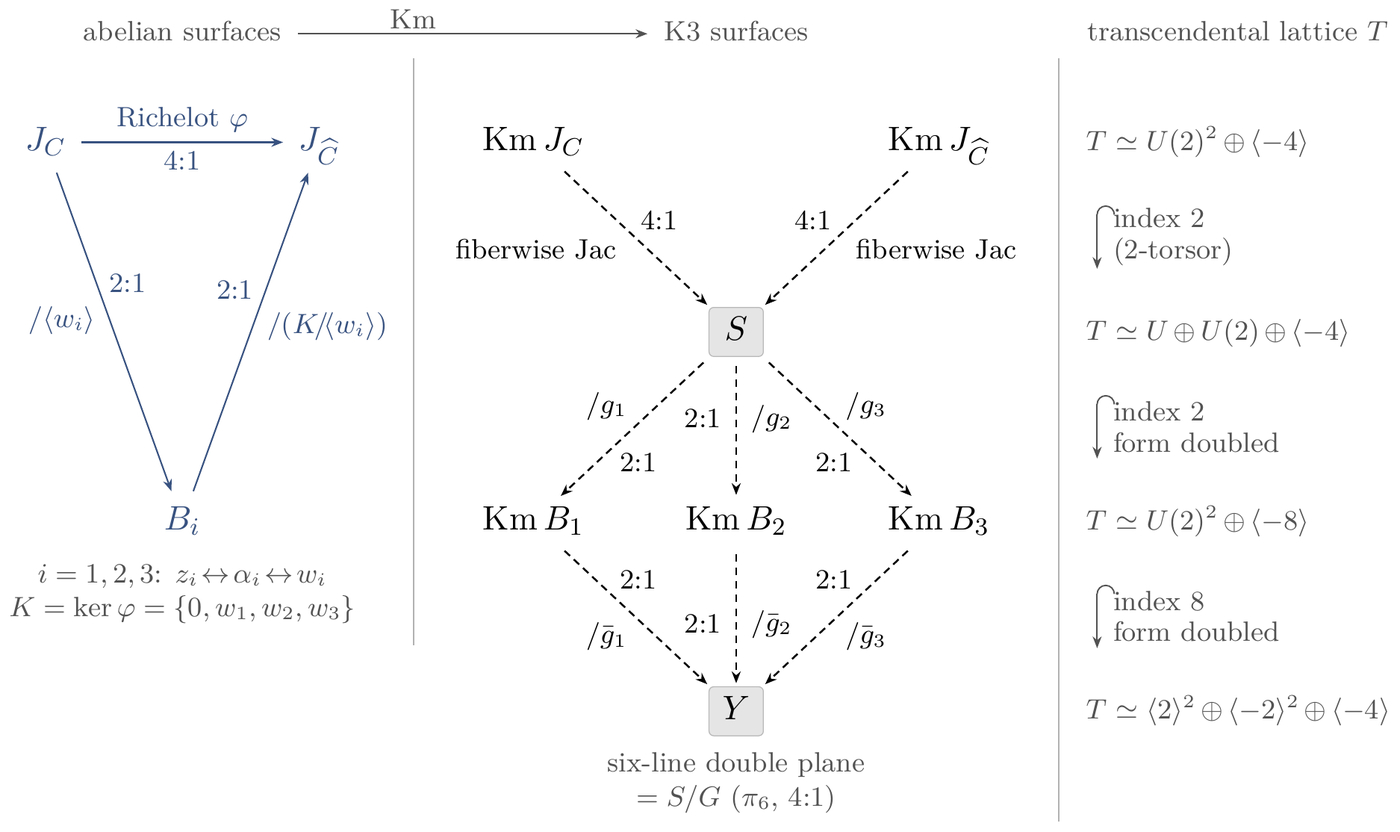
The Kummer–Richelot tower of the Watson K3 surface $S$ when it has exactly seventeen algebraic classes. Center: dashed arrows are dominant rational maps of K3 surfaces labeled by degree; the degree-four maps come from the Kummer surfaces of the Jacobians of the two curves of the Richelot pair, the degree-two maps are quotients by the direction-reversing symmetries $g_i$ and by the involutions $\bar g_i$ they induce, and the shaded surfaces $S$ and $Y$ (the six-line double plane) are the two that are not Kummer surfaces. Left: the Richelot isogeny between the two Jacobians and its factorization through the intermediate abelian surface $B_i$, one for each $i=1,2,3$; the index $i$ labels at once the lattice coordinate $z_i$, the rate $\alpha_i$ and a pair of branch points of the curve. Right: the lattice of transcendental cycles in each row and the index of each inclusion. (Figure 2 of the paper.)
The authors state separately what is proved, what is computed and what is conjectured; the digit agreements above are checks, not proofs. The proved results are the order-five theorem with its $\mathrm{SO}(5)$ group for very general directions; the invariants of the two curves as exact algebraic identities; the gamma value at the conductor-16 point with its absolute normalization; and the constant law throughout the chamber and at the band edge. One statement is conjectured: an absolute theta identity, $(1-a^2-b^2-c^2)\,(wW)^2=\Theta_{\rm K}(\tau)$, equating $1-a^2-b^2-c^2$ times the squared period with Koike’s weight-two theta function at the period point; it holds to more than 160 digits at seven rate tuples, and the constant law does not depend on it. The open questions include gamma values at points with complex multiplication by $\mathbb Q(\zeta_5)$, which “should give values of $W$ in $\Gamma(j/5)$”; whether the adapted factorization is always unique; and the expansion of the closed form at the band edge. The authors note that AI tools were used interactively in the work, with the caution that their plausible statements “require the same scrutiny as any other proposed proof.”
The paper
- The anisotropic Watson integral — Noam Elkies, Thomas W. Grimm and Matthew D. Schwartz; in preparation; not yet posted, pending the co-authors’ approval. Proves that for very general rates the anisotropic Watson integral satisfies an irreducible fifth-order differential equation whose symmetry group has connected part $\mathrm{SO}(5)$, so that no formula in complete elliptic integrals of algebraic moduli exists, and gives the closed form displayed above in the periods of a genus-two curve, with the constant fixed by an exact evaluation in gamma functions at a point of complex multiplication.
Supplementary material
Files hosted on this site. The notebook and the certificate come from the paper’s ancillary files; the Python evaluators recompute every value live at the precision requested and store no digit strings.
- WatsonW.nb — Mathematica notebook from the paper’s ancillary files.
WatsonW[w, α, β, γ]evaluates the integral by the paper’s explicit seven-step procedure (closed-form Igusa–Clebsch invariants, Mestre’s sextic model, the marked partition, two period integrals, $W=|\Delta M|/(4\pi^2 w)$);WatsonW1DandWatsonW3Devaluate the defining integral directly, in its Bessel–Laplace form and as the raw triple integral. At $(\alpha,\beta,\gamma;w)=(1,5,7;17)$ all three return $0.0699642768\ldots$ - lgf-evaluate.py — Python (mpmath): evaluates $W$ at any admissible rates and spectral point, to any precision, from the exact series coefficients and the fifth-order operator written as a recurrence, with a built-in check against the independent Bessel-function form of the integral.
- L5_theta.txt — the fifth-order operator in machine-readable form, the stored file from which the paper’s appendix listing was generated.
- watson.py — this site’s Python port of the genus-two evaluation: builds a real sextic model of $C_-$ from the invariants, finds the adapted factorization, and returns $W=|\Delta|\,M/(4\pi^2 w)$, with an independent numerical check of the defining integral.
- certificate_irreducibility.py — from the paper’s ancillary files: proves in exact integer and rational arithmetic that the fifth-order operator at rates $(2,3,5)$ has no right factor of order one to four over $\mathbb{Q}(\xi)$, hence is irreducible; 24 checks, any failure exits nonzero (run log, result). Needs python-flint.
The paper’s full ancillary bundle contains eleven such exact certificates, one per computational lemma, with their shared data files and the logged outputs of the run of record (about fifty minutes end to end).
References
| G. Pólya, Über eine Aufgabe der Wahrscheinlichkeitsrechnung betreffend die Irrfahrt im Straßennetz, Math. Ann. 84 (1921) 149 | return is certain on the line and the square grid, not on the cubic lattice |
| G. N. Watson, Three triple integrals, Q. J. Math. (Oxford) 10 (1939) 266 | the cubic-lattice integrals in complete elliptic integrals; the subject’s namesake |
| E. W. Montroll, Theory of the vibration of simple cubic lattices with nearest neighbor interactions, in Proc. Third Berkeley Symp. Math. Stat. Prob., vol. 3, Univ. California Press (1956) 209 | the tetragonal band-edge value |
| G. S. Joyce, On the simple cubic lattice Green function, Phil. Trans. R. Soc. Lond. A 273 (1973) 583 | the isotropic Green’s function at every $w$ as the square of one elliptic integral |
| M. L. Glasser and I. J. Zucker, Extended Watson integrals for the cubic lattices, Proc. Natl. Acad. Sci. USA 74 (1977) 1800 | Watson’s value in gamma functions |
| R. T. Delves and G. S. Joyce, On the Green function for the anisotropic simple cubic lattice, Ann. Phys. 291 (2001) 71 | the tetragonal line: a product $K(k_+)K(k_-)$ of two elliptic integrals |
| A. J. Guttmann, Lattice Green functions in all dimensions, J. Phys. A 43 (2010) 305205 | survey of lattice Green’s functions and their differential equations |
| I. J. Zucker, 70+ years of the Watson integrals, J. Stat. Phys. 145 (2011) 591 | the survey that named the orthorhombic case “the final problem” |
| K. Matsumoto and T. Terasoma, Thomae type formula for K3 surfaces given by double covers of the projective plane branching along six lines, J. reine angew. Math. 669 (2012) 121 | the exact theta constants of the six-line family used to fix the normalization |
| J.-F. Mestre, Construction de courbes de genre 2 à partir de leurs modules, in Effective Methods in Algebraic Geometry, Progr. Math. 94 (1991) 313 | rebuilding a genus-two curve from its invariants; used to write rational models of the curve at sample rates |
| J.-i. Igusa, Arithmetic variety of moduli for genus two, Ann. Math. 72 (1960) 612 | the invariants that pin the genus-two curve |