The fifteen validated integrals
Before any new result was trusted, BootLoops had to prove it could not fool itself. Fifteen of the most challenging loop integrals in the literature — objects whose answers were known, or independently checkable — were recomputed without taking any published value as a fitted input at any step (where a reproduction uses published structure, such as a curve, a differential equation or a boundary condition, the row says so), and each was compared at the end against independent values never used in the derivation. Every one matched. These fifteen reproductions calibrate the pipeline that the new results on this site then run through, under the same checks.
The content on this page was written by AI under human supervision.
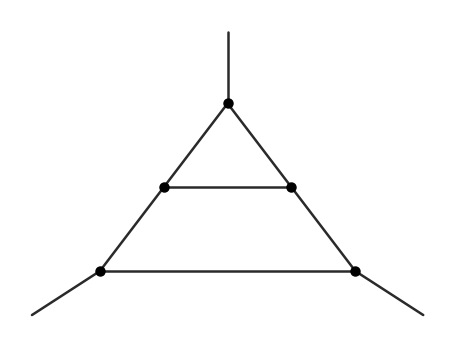
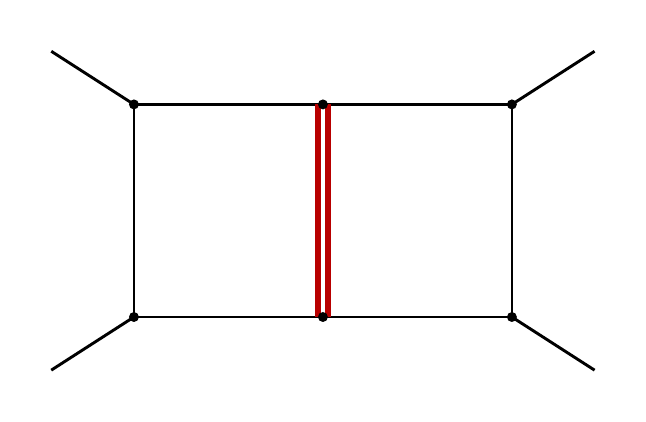
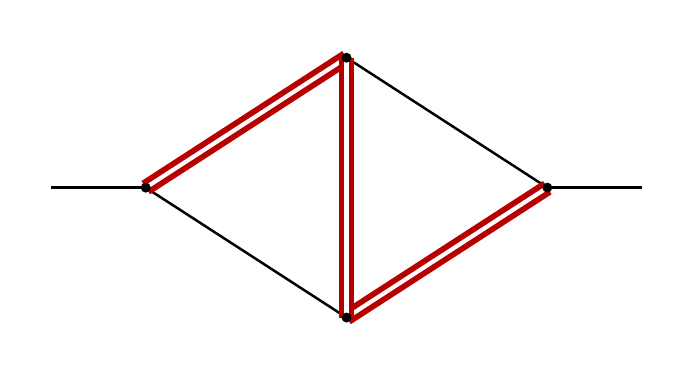
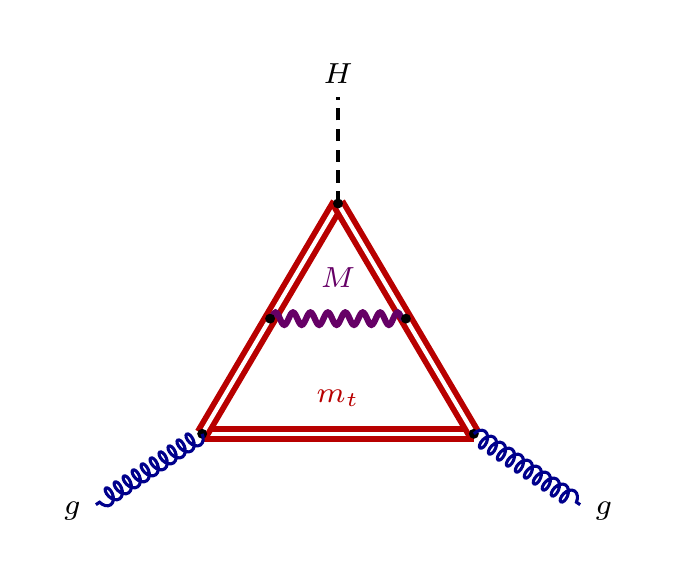
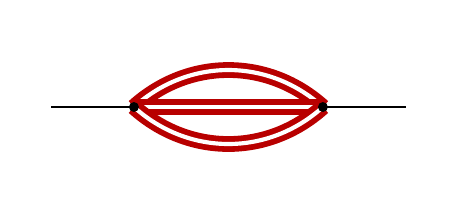
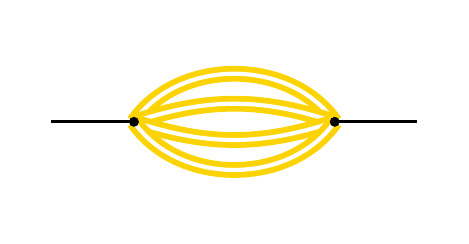
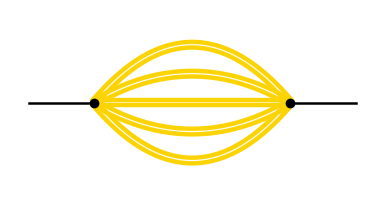
The fifteen reproductions span eleven diagrams: five classic multiple-polylogarithmthe "easy" function class below elliptic — iterated integrals of rational one-forms; where every loop-integral method is first calibrated landmarks, collected on one page; a sixth polylogarithmic box, the central-mass double box, re-derived independently of its 2024 computation; two elliptic benchmarks with their own pages; and the equal-mass banana ladder — the 2-loop (sunrise), 3-loop, and 4-loop members, climbing from elliptic curve to K3 surface to Calabi–Yau threefold. Each linked page states the integral, displays the reproduced closed form in full, and says where its machine-readable version lives.
What was reproduced
| checks | integral | geometry | reproduced result |
|---|---|---|---|
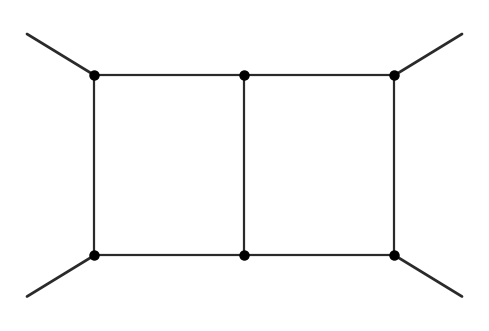
| 1 | massless planar double box | polylog | Smirnov's closed form (hep-ph/9905323): the harmonic-polylogarithm tower on $\{x,\,1+x\}$ from $\varepsilon^{-4}$ through $\varepsilon^0$, every rational coefficient exact |
| 1 | outer-mass double box | polylog, three square roots | the Caron-Huot–Henn weight-four symbol (arXiv:1404.2922), matched exactly, vector for vector — the fit had one honest way to succeed, a single unit coefficient, and returned it |
| 1 | $C_5$ three-loop ladder | polylog | the 1993 Usyukina–Davydychev ladder: the four-term tower of classical polylogarithms displayed below, all coefficients recovered exactly |
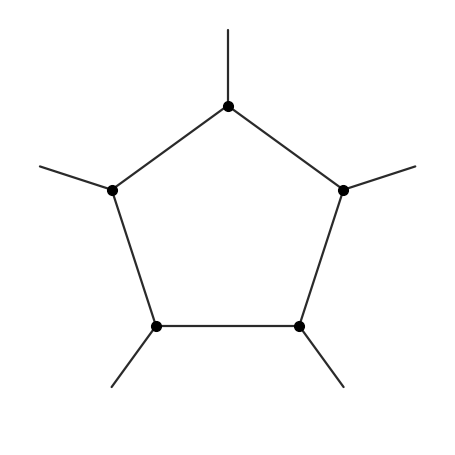
| 1 | one-loop pentagon | polylog, 16 letters | the Bern–Dixon–Kosower reduction (hep-ph/9306240): the finite part as the sum of five one-mass box functions, all five coefficients equal to one |
| 1 | two-loop Sudakov ladder | polylog, single scale | exact closed form from the family's own reduction onto three Gamma-function masters (Gehrmann–Huber–Maître); a pure zeta-value tower of uniform weight through $\varepsilon^8$, agreeing with an independent numerical evaluation to at least 78 digits at every order from $\varepsilon^{-4}$ through $\varepsilon^6$ (a recomputation: the computation first archived for this row was found to describe a different integral) |
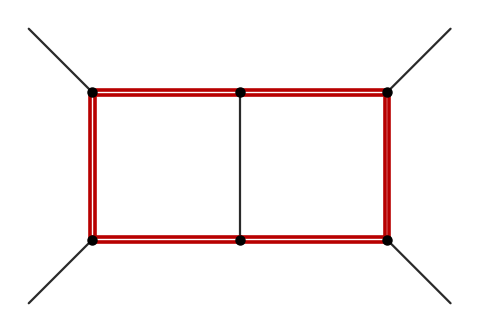
| 1 | central-mass double box | polylog, seven letters | topology C of Schwanemann and Weinzierl (arXiv:2412.07522): the scalar top-sector master re-derived as explicit two-variable iterated integrals through weight four with only classical constants, agreeing with their published program at two Euclidean points |
| 1 | equal-mass kite | elliptic Γ₁(6) | the Adams–Bogner–Schweitzer–Weinzierl elliptic-polylogarithm form (arXiv:1607.01571), its five-term word list recovered blind |
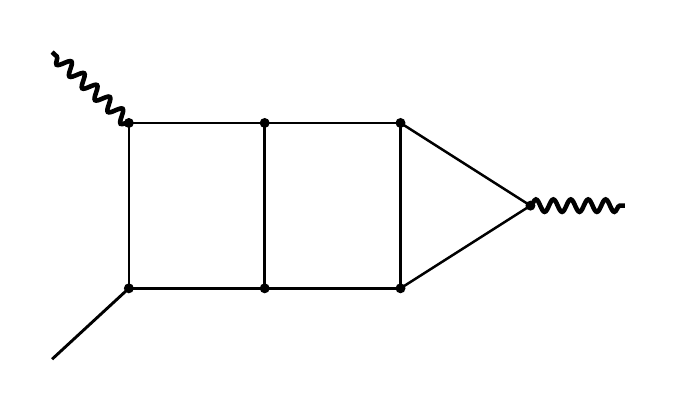
| 1 | $gg\to H$ elliptic masters | elliptic | the two elliptic functions $G_1$, $G_2$ of Marzucca–McLeod–Nega (arXiv:2501.14435), re-evaluated from the source paper's own one-fold period-integral definitions and checked to 48 digits against an auxiliary-mass-flow evaluation through the source's canonical rotation at one point never used in the derivation; the elliptic-polylogarithm form of the masters, which the source leaves to future work, is not attempted |
| 5 | sunrise family — equal-mass $\varepsilon^0$; masses $(1,1,2)$, $(1,2,3)$, $(1,1,4)$; $\varepsilon^1$ | elliptic Γ₁(6) | the Adams–Weinzierl modular-form representation (arXiv:1704.08895) reproduced blind, the boundary constant recognized — without being told what to look for — as $-\tfrac{3}{2}\sqrt3\,L(\chi_{-3},2)$; plus the three unequal-mass configurations |
| 1 | three-loop equal-mass banana | K3 | the published three-loop banana (arXiv:2008.10574, arXiv:2207.12893): the $\varepsilon^0$ closed form displayed below, its particular solution built on the published inhomogeneity of the Picard–Fuchs equation |
| 1 | four-loop equal-mass banana | Calabi–Yau 3-fold (AESZ-34) | the explicit symbolic form — an exact log-Frobenius solution with all boundary constants in the $\zeta$-ring, reproducing the known Calabi–Yau boundary formula exactly — checked three independent ways |
Three of the reproduced closed forms
One from each stratum of the ladder — polylogarithmic, elliptic, K3; each is stated in full, with its conventions, on its own page. The three-loop ladder closed at $\varepsilon^0$ as the Usyukina–Davydychev tower of classical polylogarithms $\mathrm{Li}_n$ in the Mandelstam ratio $x=s/t$,
$$120\,\mathrm{Li}_6(-x)\;-\;60\,\ln x\,\mathrm{Li}_5(-x)\;+\;12\,\ln^2 x\,\mathrm{Li}_4(-x)\;-\;\ln^3 x\,\mathrm{Li}_3(-x),$$
all four integer coefficients recovered exactly by the blind fit. The equal-mass sunrise closed at leading order, in the variable $t=p^2/m^2$, as the Γ₁(6) modular representation
$$J^{(0)}(t) \;=\; -\,\frac{\psi_1(t)}{\pi}\,\Bigl(\,\tfrac{3}{2}\sqrt{3}\,L(\chi_{-3},2) \;+\; I(1,f_3;\,q_C)\Bigr),$$
with $\psi_1$ the elliptic period of the sunrise curve, $L(\chi_{-3},2)$ the Dirichlet L-value the integer-relation search recognized blind, and $I(1,f_3;q_C)$ the Eichler integral of the weight-three modular form $f_3$ on Γ₁(6), evaluated at the nome $q_C = -e^{i\pi\psi_2/\psi_1}$ built from the curve's second period $\psi_2$. And the three-loop banana closed at leading order (same variable $t$) as the two-term K3 formula
$$m_1^{(\varepsilon^0)}(t) \;=\; 7\zeta_3\,\varpi_0(t)\;-\;\mathrm{Part}_{\rm reg}(t),$$
with $m_1$ the top master integral, $\varpi_0$ the holomorphic K3 period (the Domb series) and $\mathrm{Part}_{\rm reg}$ the particular solution driven by the sub-diagram source — both explicit power series with three-term integer recursions, given on the banana page.
Every reproduction collected on this page was validated against independent evaluations at points never used in the construction, to at least 39 digits; the four fully massless polylogarithmic integrals, which admit no independent numerical evaluator, were checked against their published closed forms instead, to at least 60 digits.