The polylogarithmic warm-ups
Five classic multiple-polylogarithm loop integrals, every answer known or independently checkable, recomputed blind — the bootstrap ran start to finish without looking at the known results — as evidence that BootLoops reproduces settled answers when it cannot see them.
The content on this page was written by AI under human supervision.
Before BootLoops was pointed at anything elliptic or Calabi–Yau, it had to earn trust on integrals whose function spaces are settled. The five graphs on this page are landmarks of the loop-integral literature. Each is a scalar Feynman integral of the standard form
$$I_G \;=\; \int \prod_{\ell=1}^{L} d^d l_\ell \;\prod_{e\in G}\frac{1}{q_e^2-m_e^2}\,,\qquad d=4-2\varepsilon,$$
where the product runs over the internal lines of the graph $G$, $q_e$ is the momentum flowing through line $e$ and $m_e$ its mass; each section below specifies its graph, its masses, and its kinematic variables. Every one was recomputed blind: the bootstrap fixed the alphabetthe finite list of algebraic functions (letters) whose logarithms build the answer as iterated integrals, filtered the word spacethe candidate sequences of letters (words) that could appear in the answer at each transcendental weight, and fitted the exact coefficients without consulting the published answer, and the comparison happened only at the end, at kinematic points never used in any fit. They are five of the fifteen validation integrals behind the validated integrals list.
All five have explicit closed forms, and every answer is a multiple polylogarithm over a finite, explicit letter alphabet — no elliptic or Calabi–Yau geometry anywhere. The outer-mass double box closes as its leading singularity times a single weight-four symbol vector; the massless planar double box as a uniform-weight harmonic-polylogarithm tower on the two-letter alphabet $\{x,\,1+x\}$ with $x=t/s$, from $\epsilon^{-4}$ through $\epsilon^0$; the three-loop ladder as a four-term tower of classical polylogarithms at weight six; the one-loop pentagon through $\epsilon^0$ as the Bern–Dixon–Kosower sum of its five one-mass boxes with the rational prefactors $1/(v_{j-2}v_{j-1}v_j)$; and the two-loop Sudakov vertex as an elementary $\Gamma$-product exact in $d$, with its pure zeta-value tower carried through $\epsilon^8$ (weight 12). Each section displays the complete closed form.
Four of the five graphs are fully massless, and each of the four is checked against auxiliary-mass flowAMFlow: an independent high-precision numerical evaluator for Feynman integrals, used throughout BootLoops as the cross-check numerics: the three-loop ladder against a fresh run of its nine-line family at one never-used point, the pentagon against auxiliary-mass flow directly, the massless double box at two points never used in its fit, and the Sudakov vertex by a direct evaluation of its single-scale family; the ladder, the pentagon and the double box are also checked against their published closed forms evaluated on an independent stack, and the Sudakov vertex against the exact form built from its three known masters (see their sections).
Outer-mass double box

The integral
A planar two-loop diagram: two boxes sharing a central rung, with all six propagators around the perimeter carrying a common mass $m$ and the central rung and four external legs massless. The kinematics is carried by the two Mandelstam invariants, packaged into dimensionless ratios:
$$u=\frac{4m^2}{-s},\qquad v=\frac{4m^2}{-t},\qquad s=(p_1+p_2)^2,\quad t=(p_2+p_3)^2,$$
both positive in the Euclidean region $s,t<0$. In strictly four dimensions ($d=4$; no $\varepsilon$ expansion is needed) the integral is finite, and once the leading singularitythe algebraic prefactor from the maximal cut; dividing by it leaves a "pure" function of uniform weight is stripped it is a single pure function of uniform weight four. The only non-rational structure is three square roots, $\beta_u=\sqrt{1+u}$, $\beta_v=\sqrt{1+v}$ and $\beta_{uv}=\sqrt{1+u+v}$.
Why it matters
Caron-Huot and Henn used this integral to launch the modern differential-equation treatment of massive double boxes arXiv:1404.2922, and it appears as the integral $I_5$ of the analytic-regression paper arXiv:2507.17815. For BootLoops it is the ideal calibration point: a known answer, no elliptic or Calabi–Yau geometry, and a fit that must land on exactly one rational coefficient — anything else would expose the pipeline. The regression must return unity, and that one number must then reproduce independent numerics at points it has never seen.
What was hard
The raw weight-four word space over twelve letters carrying three square roots is far too large to fit directly. Three structural filters — symbol integrabilitythe condition $d\mathcal{S}\wedge d\mathcal{S}=0$ that a tensor of logarithms actually comes from a function, the physical-first-entry condition (only genuine $s$, $t$ and pseudo-threshold branch cuts may open), and Galois parity under the three square roots — cut it to 161 basis vectors over the twelve-letter alphabet of arXiv:2410.02424, with no use of the published maximal cuts. The fit then had one honest way to succeed: return a single unit coefficient.
The result
The $d=4$ finite part is the leading singularity times a single basis word:
$$g_{10} = -\tfrac18\,s^2 t\,\beta_u\beta_{uv}\, I_5 = \mathrm{LS}\cdot G_{52},\qquad \mathrm{LS}=\tfrac18\sqrt{s(s-4m^2)}\,\sqrt{st\,(st-4m^2(s+t))},$$
where $I_5$ is the raw double-box integral at $m=1$, $g_{10}$ is its normalized pure weight-four part, and $G_{52}$ is the 52nd vector of the 161-dimensional constrained basis. The integer-relation fit on a Euclidean grid returned the single nonzero coefficient $c_{52}=1$, height and denominator both one; the regressed symbol equals the symbol published in the Landau-bootstrap paper arXiv:2410.02424 exactly, vector for vector, and $s\leftrightarrow t$ symmetry comes out as a consistency check rather than an input. The symbolthe tensor of logarithms recording the iterated-integral structure of a polylogarithmic function; two functions with the same symbol differ at most by lower-weight pieces times constants of $G_{52}$ has eighteen terms over the twelve-letter alphabet
$$\Big\{\,u,\ v,\ 1{+}u,\ 1{+}v,\ u{+}v,\ 1{+}u{+}v,\ \tfrac{\beta_u-1}{\beta_u+1},\ \tfrac{\beta_v-1}{\beta_v+1},\ \tfrac{\beta_{uv}-1}{\beta_{uv}+1},\ \tfrac{\beta_{uv}-\beta_u}{\beta_{uv}+\beta_u},\ \tfrac{\beta_{uv}-\beta_v}{\beta_{uv}+\beta_v},\ \tfrac{\beta_{uv}-\beta_u\beta_v}{\beta_{uv}+\beta_u\beta_v}\,\Big\},$$
where $\beta_v=\sqrt{1+v}$ enters through three of the six algebraic letters, and each letter is fixed up to a constant factor. Writing $L_6=(\beta_u-1)/(\beta_u+1)$ and $L_9=(\beta_{uv}-\beta_u)/(\beta_{uv}+\beta_u)$, its leading terms read
$$\mathcal S(G_{52}) = -L_6{\otimes}u{\otimes}L_6{\otimes}L_9 + L_6{\otimes}(1{+}u){\otimes}L_6{\otimes}L_9 - L_6{\otimes}u{\otimes}L_9{\otimes}L_6 + L_6{\otimes}(1{+}u){\otimes}L_9{\otimes}L_6 + \cdots$$
(fourteen more terms), with $L_9$ the parity-odd letter carrying the last-entry structure; the full eighteen-term symbol is written out in Polylogarithmic, elliptic, and Calabi–Yau Feynman integrals from a hybrid bootstrap, Section 4.5 (the outer-mass double box). The function is singular only on the physical loci $s=0$, $t=0$, the normal threshold $s=4m^2$ and the pseudo-threshold $st=4m^2(s+t)$, and it vanishes as $u,v\to\infty$. The answer has been in the literature since 2014; this recomputation was blind, the published maximal cuts were never used, and the ancillary Amatrix29D.txt of Caron-Huot–Henn remains available for independent re-checks.
---
Downloads: outer-dbox-evaluate.py · outer-dbox-data.json
Massless planar double box (the calibration anchor)

The integral
Two boxes sharing a central rung, all seven propagators massless, four on-shell massless external legs. Because nothing else carries a scale, the two invariants collapse to a single dimensionless ratio:
$$x=\frac{t}{s},\qquad s=(p_1+p_2)^2,\quad t=(p_2+p_3)^2.$$
In $d=4-2\epsilon$ dimensions the Laurent series runs from $\epsilon^{-4}$ up: the order-$\epsilon^j$ coefficient is a pure function of uniform transcendental weight $w=4+j$, so the tower closed here spans weights 0 through 4, from the leading pole to the finite part. This is the simplest genuinely two-loop, two-scale massless integral, and its maximal cut is rational, so the answer is a uniform-weight harmonic-polylogarithm tower on the two-letter alphabet $\{x,\,1+x\}$, with branch points only at $x=0$ ($t=0$) and $x=-1$ ($u=0$, the third Mandelstam channel) — exactly the cuts a planar box is allowed.
Why it matters
Smirnov solved this integral in closed form in 1999 arXiv:hep-ph/9905323, the first analytic result for the two-loop massless on-shell double box, and everything about its function space has been settled since. That total transparency makes it the right place to ask whether the pipeline is honest before it is trusted on anything new: the alphabet, the weight grading, and the physical branch cuts are all known in advance, so any deviation the bootstrap produced would be unambiguous evidence of a defect.
What was hard
Honestly, little — which is the point of a calibration anchor. The discipline was to run it purely top-down: geometry fixes the letters before any number is fitted, then the fit at each weight ran over the $2^w$ pure words together with the products of lower-weight words and $\zeta$ values of complementary weight — an ansatz of dimension $(1,2,5,11,23)$ at weights 0–4; at weight four that is sixteen words, plus four words times $\zeta_2$, two times $\zeta_3$ and one $\zeta_4$ — with integrabilitythe shuffle/first-entry conditions a word list must satisfy to be the symbol of an actual function, with the first letter a physical threshold and the physical-channel projection (discontinuities only in $s$ and $t$, none in $u$) imposed on top, so the ansatz was over-determined and a single integer-relation pass per weight pinned the rational coefficients. The answer has been known for 27 years; the fitted tower was compared against Smirnov's closed form only at the end, at points never used in the fit. The auxiliary-mass-flow values at the two Euclidean points held out of the fit, $x=2/5$ and $x=3/4$, are reproduced by the served tower to at least 89 digits at every order.
The result
The full Laurent tower is the two-letter HPLharmonic polylogarithm: an iterated integral over the kernels $dx/x$ and $dx/(1+x)$, encoded as Goncharov indices $0$ and $-1$ tower
$$I=\frac{1}{-2s^2t}\sum_{|\vec a|=w}c_{\vec a}\,G(a_1,\dots,a_w;x),\qquad a_i\in\{0,-1\},\quad c_{\vec a}\in\mathbb{Q},\quad w=4+j \text{ at } \epsilon^j,$$
where $G(a_1,\dots,a_w;x)$ is the Goncharov iterated integral with indices $a_i=0$ and $a_i=-1$ standing for the integration kernels $dx/x$ and $dx/(1+x)$, $c_{\vec a}$ are the fitted rational coefficients — all exact, with denominators in $\{1,3,4,12\}$ — and the prefactor $1/(-2s^2t)$ is the stripped leading singularity. The leading pole is the rational seed $c_{\varnothing}=1$ at weight 0, so $I=\mathrm{LS}\,(1+O(\epsilon))$ at $\epsilon^{-4}$, and the higher weights fill in the $G$-tower over $\{x,1+x\}$ with per-weight ansatz dimensions $(1,2,5,11,23)$ — exactly as Smirnov's hypergeometric expansion prescribes. The only branch points of the whole tower are $x=0$ and $x=-1$. Because the coefficients are exact and explicit, a reader can reproduce the comparison against Smirnov's formula end to end at any Euclidean point.
---
Downloads: massless-dbox-evaluate.py · massless-dbox-data.json
Three-loop ladder (C5)

The integral
The $L=3$ member of the Usyukina–Davydychev conformal-ladder family $\Phi^{(L)}$: a three-point ladder with nine massless internal lines, two of its three legs off shell. The function is $\Phi^{(3)}(X,Y)$ with $X=p_1^2/p_3^2$ and $Y=p_2^2/p_3^2$; it has no $Y\to 0$ limit (it diverges as $\ln^3 Y$), and the row's digits belong to its holomorphic block $f_3$ — the $\Lambda$-finite part of $(1-X)\,\Phi^{(3)}$ in the expansion organised in $\Lambda=\ln((1-X)/Y)$, times $3!$, with the two constants left by the polylogarithm inversion subtracted — which, after the leading singularity is stripped, depends on the single ratio $x$ through the slice map
$$X=\frac{p_1^2}{p_3^2}=\frac{x}{1+x},\qquad x=\frac{p_1^2}{p_3^2-p_1^2},$$
and the $\epsilon^0$ order — the piece closed here — is a pure function of weight $w=2L=6$. The answer lives on the same two-letter alphabet $\{x,\,1+x\}$ as the massless double box, with branch points only at $x=0$, $x=-1$ and $x=\infty$; the weight-6 word space over two letters has dimension 64, so the function space is tiny for a genuinely three-loop object.
Why it matters
The ladder family was computed in closed form by Usyukina and Davydychev in 1993 (Phys. Lett. B 298 (1993) 363; 305 (1993) 136), one of the founding exact results of the multiloop era: a single tower of depth-one classical polylogarithms at every loop order $L$, with $L=1$ reproducing the famous one-loop box function and $L=2$ the off-shell massless double box. For BootLoops it is the cleanest possible three-loop stress test: the function space is small, the answer is known independently, and the loop order is high enough that any hidden weight-counting or normalization error would surface.
What was hard
Trusting the reference as much as the fit. Two top-down constraints and a normalization fix the ansatz before any numerics — the first-entry conditionthe first letter of the symbol must be a physical singular point — for this off-shell ladder the two letters $x=0$ and $x=-1$ restricts discontinuities to those two points, symbol integrability selects the depth-one classical-polylog subspace, and the normalization is the Usyukina–Davydychev prefactor of the closed form (no maximal cut and no leading-singularity step enter for this graph) — and a lattice (integer-relation) fit then recovers all four rational coefficients exactly. No auxiliary-mass-flow run of this family existed when the fit was completed, so the published closed form was the first check (the auxiliary-mass-flow run described below came afterwards); before it was trusted, it was built two structurally different ways — the Broadhurst–Davydychev integral representation (arXiv:1007.0237) and the Isaev–Derkachov–Shumilov polylog form (arXiv:2302.11238) — and the two agree to 35–40 digits at $L=1,2,3$.
The result
The $\epsilon^0$ value is a single tower of depth-one classical polylogarithms over $\{x,\,1+x\}$,
$$f_3(x)=120\,\mathrm{Li}_6(-x)-60\,\ln x\,\mathrm{Li}_5(-x)+12\,\ln^2 x\,\mathrm{Li}_4(-x)-\ln^3 x\,\mathrm{Li}_3(-x),$$
where $\mathrm{Li}_n$ is the classical polylogarithm of weight $n$ and the four integer coefficients are the $L=3$ instance $c^{(3)}=\{120,-60,12,-1\}$ of the all-orders Usyukina–Davydychev pattern $c^{(L)}_k=(-1)^k\,(2L-k)!/(k!\,(L-k)!)$. Equivalently, as a Goncharov word combination over the single-$(-1)$ words, $f_3=-6\,G(0,0,0,-1,0,0;x)+6\,G(0,0,-1,0,0,0;x)$ — two weight-six words with a single $(-1)$ each. The singular locus is $x\in\{0,-1,\infty\}$. All four coefficients were recovered exactly by the lattice fit, blind, and matched the 1993 closed form. Off the slice, the same closed form evaluated at generic $(X,Y)$ agrees with the record's independent one-fold integral at two points never used in the fit to 60 digits, and the fit's predictions match the closed form at three further values of $x$ to more than 460 digits. A fresh auxiliary-mass-flow run of the nine-line Feynman family (all three legs off shell, at a point never used before, $(X,Y)=(\tfrac23,\tfrac34)$) reproduces $\Phi^{(3)}$ to 72 digits (the run's own two-precision pair agrees to 72.49; the higher-precision leg agrees with the closed form to 95); c5-ladder-xy-evaluate.py · MANIFEST.sha256 (every file of the bundle with its checksum) runs those checks (--point PF the fresh-point one) and evaluates the ladder at any point of the region.
---
Downloads: c5-ladder-evaluate.py · c5-ladder-xy-evaluate.py (generic $(X,Y)$ points with the recorded reference values in vendor_row04_xy/points.json; the whole battery runs in about five seconds)
One-loop pentagon (wide-alphabet stress test)

The integral
The one-loop scalar pentagon: five massless propagators, five massless external legs (all incoming, $p_i^2=0$, $\sum_i p_i=0$), computed in $d=4-2\epsilon$ dimensions. The kinematics is carried by the five cyclic Mandelstam invariants
$$v_i=s_{i,i+1}=(p_i+p_{i+1})^2,\qquad i \text{ read mod } 5,$$
the squared momenta of adjacent leg pairs. Given here is the pentagon through $\epsilon^0$ — its Bern–Dixon–Kosower form as a sum over the five one-mass boxes, checked against auxiliary-mass flow at thirteen points; the $O(\epsilon)$ remainder, where the parity-odd letter first appears at weight three, was counted and sampled as a scope extension: over the one-loop alphabet of 21 letters the parity-odd weight-three symbol allowed by first entry, integrability and cyclic symmetry is unique, and auxiliary-mass flow at thirteen points pins the $O(\epsilon)$ pentagon as the boxes' $O(\epsilon)$ terms plus $c_0$ times the six-dimensional pentagon (checked against values that entered no fit to 60 digits); the six-dimensional pentagon itself is the one-fold integral of that symbol, checked the same way to 45 digits. The alphabet is the widest on this page: 16 letters, 15 rational ones in three cyclic orbits of five plus the parity-odd square root $\sqrt{\Delta_5}$ of the five-point Gram determinant $\Delta_5=\det(2\,p_i\!\cdot\!p_j)_{i,j=1}^{4}$.
Why it matters
The pentagon is a classical object — Bern, Dixon and Kosower reduced it in dimensional regularization to a sum of five one-mass boxes plus an $O(\epsilon)$ remainder arXiv:hep-ph/9306240 — and it earns its slot in the validation suite as the widest-alphabet member: one loop, genus zero, but 16 letters. At weight two the word count already sits near $k^2\approx 256$, right at the sample-budget ceiling, so this is the cell that maps how a weight-graded fit feels the curse of the ansatz as the number of legs grows. The wider 26-letter pentagon alphabet of Gehrmann–Henn–Lo Presti arXiv:1511.05409 is only needed at the orders that enter two-loop amplitudes; the finite weight-$\le 2$ part lives in the 16-letter subalphabet.
What was hard
Getting the alphabet right, and proving an absence. The parity-odd letter $\sqrt{\Delta_5}$ is a genuine pentagon letter but first appears at weight three, so its coefficient was imposed to vanish through weight two from the geometry — and the fit then confirmed it comes back zero to the precision floor rather than assuming it. And the five difference letters $d_i=v_{i+2}-v_i$ arising from the $\mathrm{Li}_2$ numerators are easy to miss: a naive count gives 11 letters, and the bootstrap confirmed that 16 is the correct closed weight-$\le 2$ count.
The result
Through $\epsilon^0$ the scalar pentagon — written $I_5$ below, the pentagon's own label, distinct from the double-box $I_5$ earlier on this page; measure $\int d^{4-2\epsilon}l/(i\pi^{2-\epsilon})$, propagators $1/q_k^2$ — is the Bern–Dixon–Kosower sum over its five one-mass boxes,
$$I_5=r_\Gamma\sum_{j=1}^{5}\frac{1}{v_{j-2}\,v_{j-1}\,v_j}\left[\frac{(-v_{j-2})(-v_{j-1})(-v_j)}{(-v_{j+1})(-v_{j+2})}\right]^{-\epsilon}\left[\frac{1}{\epsilon^2}+2\,\mathrm{Li}_2\!\Big(1-\tfrac{v_{j+3}}{v_{j+1}}\Big)+2\,\mathrm{Li}_2\!\Big(1-\tfrac{v_j}{v_{j+2}}\Big)-\frac{\pi^2}{6}\right]+O(\epsilon),\qquad r_\Gamma=\frac{\Gamma(1+\epsilon)\Gamma^2(1-\epsilon)}{\Gamma(1-2\epsilon)}$$
— five rational prefactors $1/(v_{j-2}v_{j-1}v_j)$, not one leading singularity, each multiplying a pure weight-two function. At the Euclidean point $(v_1,\dots,v_5)=(-1,-2,-3,-4,-5)$ the coefficients of $\epsilon^{-2}$, $\epsilon^{-1}$, $\epsilon^0$ are $-3/8$, $0.1798058444\ldots$, $0.2872248726\ldots$, the same three numbers to 107 digits as the auxiliary-mass-flow run of the family at that point, and at twelve further Euclidean points the three coefficients agree with the runs to 67 digits, the goal-40/60 pair floor there. The row's own weight-two fit sampled the sum of the five box functions $B_i=\mathrm{Li}_2(1-v_i/v_{i+2})+\mathrm{Li}_2(1-v_i/v_{i+3})+\tfrac12\log^2(v_{i+2}/v_{i+3})$ with unit weights and recovered those weights: a consistency check of the fit against its own target, and that sum is not the pentagon's finite part in any normalisation. Cyclic $\mathbb{Z}_5$ symmetry forces one weight across the five box functions, and their weight-one piece dies identically by the cyclic telescope $\sum_i \log(v_{i+2}/v_{i+3})=0$. The 16 letters are the three cyclic orbits $v_i$ (adjacent invariants), $u_i=v_{i+3}-v_i-v_{i+1}=s_{i,i+2}$ (next-to-adjacent invariants) and $d_i=v_{i+2}-v_i$ (the $\mathrm{Li}_2$-numerator differences), plus the parity-odd $\sqrt{\Delta_5}$. The singular locus is $v_i=0$ and $v_i=v_{i+2}$, together with the parity-odd branch $\Delta_5=0$, which is invisible through weight two. At the symmetric point $v_i=-1$ every $B_i$ vanishes by the telescope, so the sum of the five box functions is zero there exactly — a re-check a reader can do by hand.
---
Downloads: pentagon-evaluate.py (reads three reference files under vendor_row5_i5/, pinned, and stops by name if one is missing beside it: the two auxiliary-mass-flow outputs amflow_out_g60.json and amflow_out_g40.json and their comparison ITEM49_COMPARE.json) · pentagon-weight3-check.py (the weight-three pack: the 70 auxiliary-mass-flow samples, the symbol and count scripts and their receipts under vendor_row05_weight3/, pinned; the check re-derives the weight-two constrained counts and verifies every pin; --i5 evaluates the full pentagon $I_5$ at the record point against the two auxiliary-mass-flow references and the sum of box functions of the closed form, 68 digits, reading the reference strings and the two reference outputs under vendor_row5_i5/, pinned)
Two-loop Sudakov vertex (form factor)
Status: closed in exact form (restated 2026-09-03)
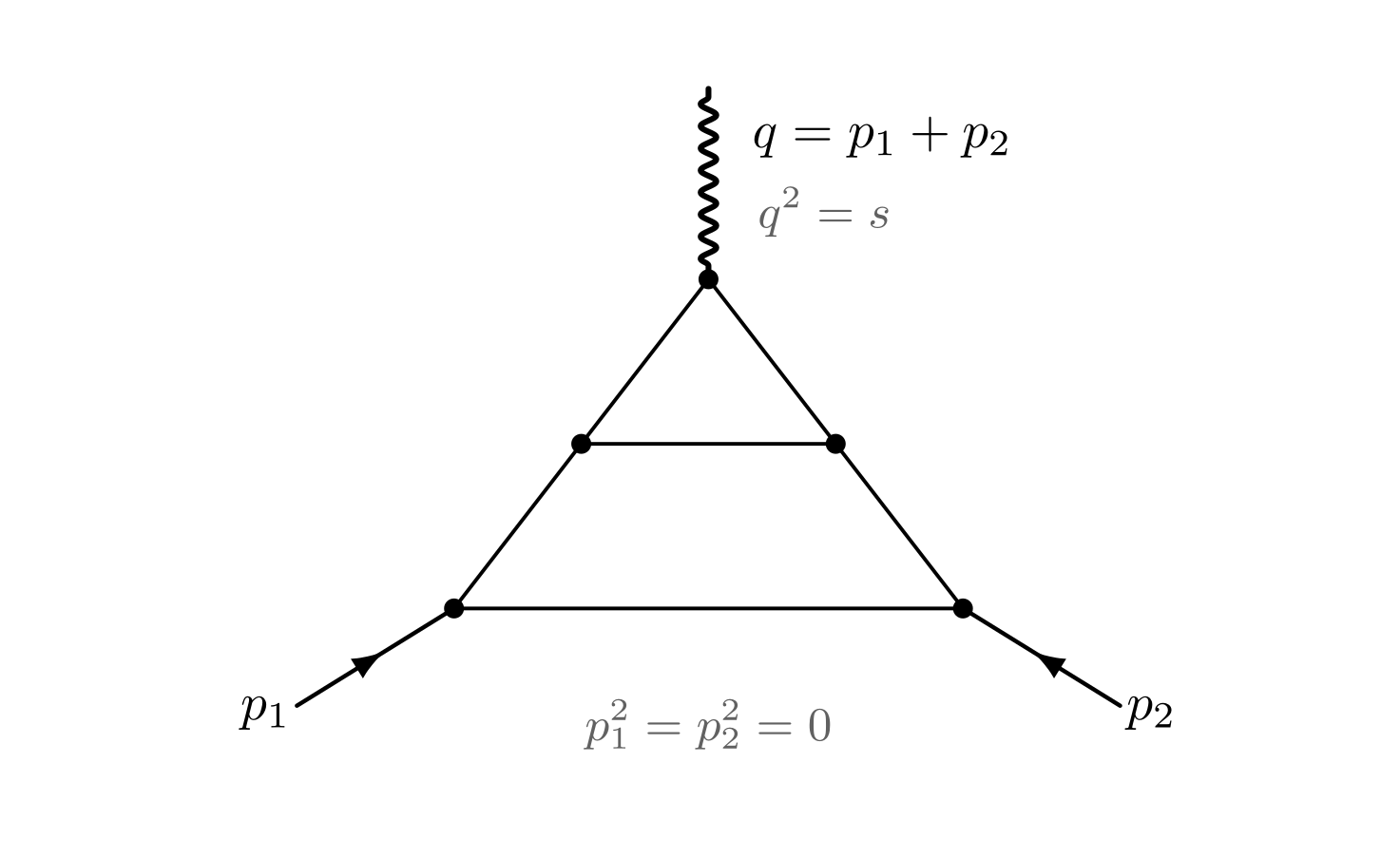
The object is the six-line planar ladder $I[1,0,1,1,1,1,1]$ of the seven-propagator family in $d=4-2\varepsilon$: seven scalar products, so the family's seven propagators are six lines plus one irreducible numerator, and its all-ones integral is not a graph at all (seven edges would force six vertices, and $2E+N=17<18$). The earlier account on this page and in the paper had attached a closed form to that seven-line object; an independent adjudication found the mismatch, the row was withdrawn, and it has now been re-derived from the family's own reduction.
The ladder has three genuine masters, every one a product of one-loop Gamma functions: the sunrise, the bubble-inserted triangle, and the product of two bubbles — the three of Gehrmann, Huber and Maître's four two-loop three-point masters given in closed $\Gamma$-function form (their fourth, the non-planar six-line triangle, is hypergeometric and lies outside this family). The family has no six-line master, so the reduction (Kira, at $s=-1$) writes the ladder as a rational combination of the three, and the result is an exact closed form in $d$ multiplying the single-scale power $(-s)^{-2-2\varepsilon}$. At $s=-1$, with the factor $e^{2\varepsilon\gamma_E}$, the ladder is a pure zeta-value tower with no $\varepsilon^{-3}$ term: the coefficient of $\varepsilon^j$ has uniform transcendental weight $j+4$, from $1/(4\varepsilon^4)$ at weight zero through $\varepsilon^8$ at weight 12, every coefficient a rational combination of $\zeta_3$, $\zeta_5$, $\zeta_7$ and even powers of $\pi$.
With the two one-loop building blocks
$$G(a,b)=\frac{\Gamma(a+b-\tfrac d2)\,\Gamma(\tfrac d2-a)\,\Gamma(\tfrac d2-b)}{\Gamma(a)\,\Gamma(b)\,\Gamma(d-a-b)},\qquad T(a,b,c)=\frac{\Gamma(a+b+c-\tfrac d2)\,\Gamma(\tfrac d2-a-b)\,\Gamma(\tfrac d2-b-c)}{\Gamma(a)\,\Gamma(c)\,\Gamma(d-a-b-c)},$$
the ladder is, exactly in $d$,
$$I[1,0,1,1,1,1,1](s)=(-s)^{-2-2\varepsilon}\Big[-\frac{3}{\varepsilon}\,G(1,2)\,T(1,1+\varepsilon,1)+\frac{(1-2\varepsilon)^2}{\varepsilon^2}\,G(1,1)^2+\frac{3(1-3\varepsilon)}{\varepsilon^2}\,G(1,2)\,G(1+\varepsilon,1)\Big],$$
and at $s=-1$ its expansion begins
$$e^{2\varepsilon\gamma_E}\,I(-1)=\frac{1}{4\varepsilon^4}+\frac{5\pi^2}{24\varepsilon^2}+\frac{29\zeta_3}{6\varepsilon}+\frac{3\pi^4}{32}+\varepsilon\Big(\frac{329\zeta_5}{10}-\frac{107\pi^2\zeta_3}{36}\Big)+\varepsilon^2\Big(\frac{1723\pi^6}{60480}-\frac{833\zeta_3^2}{18}\Big)+\varepsilon^3\Big(\frac{3149\zeta_7}{14}-\frac{211\pi^2\zeta_5}{12}-\frac{73\pi^4\zeta_3}{48}\Big)+O(\varepsilon^4).$$
Checks
An auxiliary-mass-flow evaluation of the ladder and of every master at $s=-1$ agrees with the closed form order by order: exactly at $\varepsilon^{-4}$, then from about 110 digits at $\varepsilon^{-3}$ down to 78 digits at $\varepsilon^{6}$, the decline being the numerical side's per-order accuracy. A run at a second point, $s=-2$, with its own reductions, agrees with the $s=-1$ values scaled by the exact power, to 78 digits at the deepest order. A replica on a second machine, with its own reductions, reproduces every printed digit. Independently of the reduction, an integer-relation search over weight-graded zeta monomials recovers the printed relations through $\varepsilon^5$; at $\varepsilon^6$ the exact coefficient's denominators exceed the search's reach, and that order rests on the exact route alone.
Downloads: sudakov-evaluate.py · sudakov-data.json
---
Everything on this page was validated against independent evaluations at points never used in the construction: the outer-mass double box against auxiliary-mass-flow runs at four never-fit points to at least 86 digits; two of the four fully massless integrals, the three-loop ladder and the pentagon, were checked against their published closed forms to at least 60 digits and against auxiliary-mass-flow numerics, the ladder to 72 digits at one never-used point of its nine-line family and the pentagon to 68 digits at one point (58 at thirteen points for its $O(\epsilon)$ part); the massless double box reproduces auxiliary-mass-flow values at two points held out of its fit to at least 89 digits beside its closed-form comparison; the fourth, the Sudakov ladder, was recomputed exactly from its own reduction and agrees with an independent numerical evaluation to at least 78 digits at every order (see its section). Each of the five comparisons can be rerun from the evaluator linked in its section.
Tools
| Tool | Role |
|---|---|
| Landau Alphabet | fixes each graph's letter alphabet from its singularity structure before any fitting |
| Ansatzer | the structural filters — symbol integrability, physical branch cuts, parity under square roots — that shrink the candidate word space to a fittable basis |
| PSLQ | integer-relation and lattice fits that pin the exact rational coefficients |
| AMFlow | independent numerical evaluations for all five: the outer-mass double box (four never-fit points), the massless double box (two points held out of its fit), the three-loop ladder (a fresh run of its nine-line family at one never-used point), the pentagon (directly) and the Sudakov vertex |
| Arb + GPLEval | two independent polylogarithm evaluators behind every comparison against the published forms |
References
| Iterated integrals and the two-loop massive double box | S. Caron-Huot, J. M. Henn | arXiv:1404.2922 |
| The Landau bootstrap (12-letter alphabet, published symbol) | H. S. Hannesdottir, A. J. McLeod, M. D. Schwartz, C. Vergu | arXiv:2410.02424, Phys. Rev. D 111 (2025) 085003 |
| Analytic regression of Feynman integrals from high-precision numerical sampling | O. Barrera, A. Dersy, R. Husain, M. D. Schwartz, X. Zhang | arXiv:2507.17815, JHEP 01 (2026) 014 |
| Analytical result for the two-loop massless planar double box | V. A. Smirnov | arXiv:hep-ph/9905323 |
| Three- and four-point ladder diagrams (the $\Phi^{(L)}$ family) | N. I. Usyukina, A. I. Davydychev | Phys. Lett. B 298 (1993) 363; 305 (1993) 136 |
| Ladder and zig-zag Feynman diagrams, operator formalism and conformal triangles | S. E. Derkachov, A. P. Isaev, L. A. Shumilov | arXiv:2302.11238, JHEP 06 (2023) 059 |
| Davydychev's integral representation of $\Phi^{(L)}$ | A. I. Davydychev | arXiv:1007.0237 |
| Dimensionally regulated pentagon integrals | Z. Bern, L. J. Dixon, D. A. Kosower | arXiv:hep-ph/9306240, Nucl. Phys. B 412 (1994) 751 |
| Two-loop planar five-gluon all-plus amplitude (26-letter pentagon alphabet) | T. Gehrmann, J. M. Henn, N. A. Lo Presti | arXiv:1511.05409 |