Modular graph functions (string theory)
The content on this page was written by AI under human supervision.
String theory's definite predictions about gravity are small corrections to Einstein's equations whose sizes the theory fixes completely. At one loop each size comes from integrating special functions, called modular graph functions, over the shape of a torus. For a long, thin torus these functions collapse to short Laurent polynomials whose coefficients are built from values of the Riemann zeta function and its multi-index relatives. Two conjectures say which such numbers may appear and how a hidden symmetry group acts on them. A paper by Matthew D. Schwartz computes a complete family of forty-nine of these functions in closed form. The deeper, multi-index constants do appear: the paper proves they can sit in only one coefficient per function, they fill exactly the conjectured number of independent directions, the symmetry maps them back into the family, and every coefficient checked, through the highest weight the family reaches, is of the conjectured single-valued kind.
Gravity's corrections at one loop
String theory is a proposal for quantum gravity. Its concrete output on that front is an infinite series of corrections to Einstein's equations: extra terms with more and more derivatives of the curvature, each multiplied by a definite number that the theory leaves no freedom to adjust. The numbers are organized by powers of $\alpha'$, the square of the string length, and by the number of loops. At one loop the surface the string sweeps out, its worldsheet, is a torus, and each coefficient is an integral over all possible shapes of that torus.
The shape of a torus is one complex number $\tau$: glue together opposite sides of the parallelogram spanned by $1$ and $\tau$ in the complex plane. In 2015 D'Hoker, Green, Gürdoğan and Vanhove organized the one-loop four-graviton integrands into what they named modular graph functions, one for each Feynman graph of a scalar field living on the torus. The simplest class has two vertices joined by $\ell$ edges, with a positive integer exponent $a_r$ on each edge, and is a sum over the momenta that can run around the torus:
$$C_{a_1,\dots,a_\ell}(\tau) \;=\!\!\sum_{\substack{p_1,\dots,p_\ell\in\Lambda\setminus\{0\}\\ p_1+\cdots+p_\ell=0}} \;\prod_{r=1}^{\ell} \frac{(\operatorname{Im}\tau/\pi)^{a_r}}{|p_r|^{2a_r}}\,, \qquad \Lambda=\mathbb Z\tau+\mathbb Z\,.$$Here $\Lambda$ is the lattice of points $m\tau+n$ with integer $m$ and $n$, the allowed momenta on a torus. Each edge $r$ carries a nonzero lattice momentum $p_r$, the momenta meeting at a vertex sum to zero, and $1/|p_r|^2$ is the scalar propagator, raised to the power $a_r$. The sum of the exponents, $w=a_1+\cdots+a_\ell$, is the weight. The function takes the same value for every $\tau$ describing the same torus, which is what “modular” means. Integrated over torus shapes, a weight-$w$ function contributes to the one-loop term with $2w$ derivatives acting on four powers of the curvature.
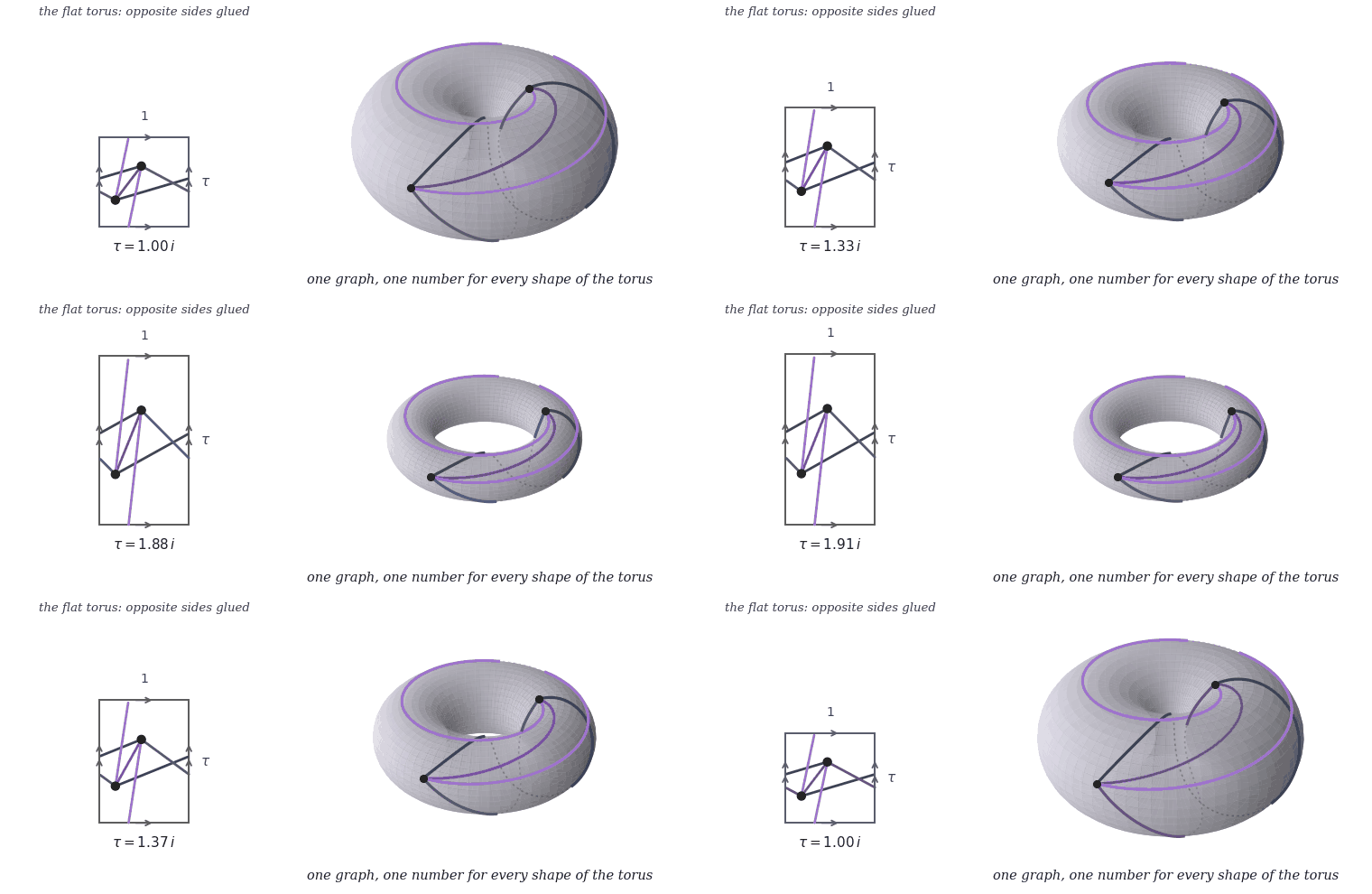
The torus two ways. Gluing opposite sides of the cell spanned by $1$ and $\tau$ (left, arrows mark the glued pairs) gives the closed surface on the right, so one complex number $\tau$ fixes the shape. The graph drawn on it has two vertices and four edges, each edge a propagator, and the four edges shown wind around the torus in four different ways, which is what the sum over lattice momenta in the formula above keeps track of. A modular graph function is one number for each shape $\tau$; as $\operatorname{Im}\tau$ grows the torus becomes long and thin, the regime of the next section, where every such function reduces to a Laurent polynomial up to exponentially small terms. (Animation drawn for this site; the ring in space is schematic, and the functions are defined by Eq. (1) of the paper.)
The thin torus and its numbers
When the imaginary part of $\tau$ is large the torus is long and thin, and a modular graph function simplifies drastically. Up to exponentially small terms, a weight-$w$ function becomes a Laurent polynomial in the single variable $y=\pi\operatorname{Im}\tau$: a finite sum of powers $y^k$, with $k$ running from $1-w$ to $w$, each multiplied by a constant $c_k$. These constants, the subject of the paper, involve rational numbers, values $\zeta_3,\zeta_5,\zeta_7,\dots$ of the Riemann zeta function at odd integers, and, for sufficiently complicated graphs, multiple zeta valuesNested generalizations of $\zeta_n=\sum_k k^{-n}$: $\zeta(n_1,\dots,n_r)$ sums $1/(k_1^{n_1}\cdots k_r^{n_r})$ over increasing chains of positive integers $k_1\lt k_2\lt\cdots\lt k_r$. The weight is $n_1+\cdots+n_r$ and the depth is the number of indices $r$. Many are polynomials in ordinary zeta values; some are not. that are not polynomials in those. Here is the shortest member of the family the paper computes, the weight-seven function with exponents $(2,2,2,1)$, as printed:
$$C_{2,2,2,1}(\tau) \;=\; \tfrac{2}{2764125}\,y^{7} + \tfrac{1}{900}\,\zeta_5\,y^{2} + \tfrac{7}{80}\,\zeta_9\,y^{-2} - \tfrac{11}{32}\,\zeta_{11}\,y^{-4} + \tfrac{63}{32}\,\zeta_5\zeta_7\,y^{-5} - \tfrac{825}{512}\,\zeta_{13}\,y^{-6} + O(e^{-2y})\,.$$Every power of $y$ not shown has coefficient zero. The pattern is typical: a pure fraction in front of the top power, and elsewhere fractions times zeta values whose indices, added to the power of $y$, always give the weight seven. A multiple zeta value $\zeta(n_1,\dots,n_r)$ likewise has a weight, the sum of its indices, and a depth, the number of indices. A depth-three value that cannot be reduced to products and values of lower depth is called irreducible; such values are the “deeper constants” of this page.
Some Laurent polynomials of modular graph functions were already known in closed form. D'Hoker and Green proved that for the “melon” graphs, any number of edges all with exponent one, every coefficient is a polynomial in odd zeta values. D'Hoker and Duke gave the Laurent polynomial of every three-edge function. Gerken tabulated the two- and three-vertex functions up to weight six; beyond that only special families and isolated coefficients were in print. Zerbini had given the Laurent polynomials of the two-vertex functions with one exponent equal to two and the others one, up to seven edges (the last up to one coefficient), and of several three-vertex functions. Irreducible depth-three values already appear in two of them, the six-edge and seven-edge two-vertex functions.
Two conjectures about which numbers may appear
Zerbini proved in 2015 that the Laurent coefficients of modular graph functions belong to a certain large class of numbers and conjectured something sharper: that they are single-valued multiple zeta valuesBrown (2013) defined a projection on multiple zeta values that sends $\zeta_2=\pi^2/6$, and with it every even zeta value, to zero and doubles the odd zeta values. Its image is a subalgebra, the single-valued multiple zeta values. At depth two they are all polynomials in odd zeta values; the first one that is not is $\zeta_{\mathrm{sv}}(3,5,3)$, at weight 11. in Brown's sense. Brown's construction projects even zeta values such as $\zeta_2=\pi^2/6$ to zero and doubles the odd ones; the first single-valued number that is not a polynomial in odd zeta values has weight eleven and depth three. The same class of numbers appears in closed-string amplitudes at tree level, and Zerbini's conjecture, the natural one-loop extension, is open.
The second conjecture concerns symmetry. Multiple zeta values, suitably formalized, carry an action of what Cartier called the cosmic Galois group. Its infinitesimal generators are operations $D_3, D_5, D_7,\dots$ that lower the weight by $3,5,7,\dots$: $D_m$ sends $\zeta_m$ to $1$, every other single zeta value and every power of $\zeta_2$ to $0$, and obeys the product rule. Brown proposed, and Panzer and Schnetz observed in $\phi^4$ quantum field theory, that the constants a physical theory produces should form a space closed under these operations.
A third conjecture, about counting, bears on the other two. In 1996 Broadhurst and Kreimer proposed a generating function for the number of genuinely new multiple zeta values of each weight and depth. At depth three a free count gives $1,2,3,5,7,9$ new values at the odd weights $11$ through $21$. Their formula gives $1,2,2,4,5,6$, because each cusp formA modular form that vanishes in the thin-torus limit. For the full modular group the first one, the discriminant $\Delta_{12}$, has weight 12. of the modular group, paired with an odd zeta value of complementary weight, removes one direction, starting with the pair $(\zeta_3,\Delta_{12})$ at weight fifteen. The formula remains a conjecture.
None of these conjectures could be tested on the complete families computed before. A polynomial in odd zeta values is single-valued automatically and is sent to another such polynomial by every $D_m$. In the melon and three-edge families both properties therefore hold with nothing to check, and no depth-three value occurs for the Broadhurst–Kreimer count to constrain. A 2024 construction by Dorigoni, Doroudiani, Drewitt, Hidding, Kleinschmidt, Schlotterer, Schneps and Verbeek does account for single-valued coefficients by another route, but for this family only through weight $w=10$, and granted that its integrals enter each function with single-valued coefficients, which its authors note is not yet established in general.
Forty-nine functions in closed form
The paper computes the two-vertex family with four edges at every weight from seven through twelve, the range above Gerken's tables. The distinct functions of weight $w$ correspond to the ways of writing $w$ as a sum of four positive integers: $3,5,6,9,11,15$ of them at those weights, forty-nine functions with $740$ Laurent coefficients in all. Every coefficient is obtained as an explicit rational combination of multiple zeta values, in exact arithmetic throughout.
The method is to split the lattice sum into sectors. Write each momentum as $p_r=m_r\tau+n_r$, with $m_r$ the winding number of edge $r$; after trading each sum over $n_r$ for a rapidly converging dual sum (Poisson resummation), the terms are grouped by which edges carry nonzero winding. Two wound edges give a single Riemann zeta value. Three give Mordell–Tornheim double sums, over positive integers $m,n$ with powers of $m$, $n$ and $m+n$ in the denominator, which reduce to multiple zeta values of depth at most two. The sector in which all four edges wind gives triple sums, which the paper reduces to depth at most three for arbitrary exponents. Independent numerical evaluations to hundreds of digits agree with the exact answers.
The running example is the weight-eight function $C_{2,2,2,2}$. Its Laurent polynomial has nine nonzero terms: a rational leading coefficient and seven more that are fractions times odd zeta values or products of two of them. The ninth, the coefficient of $y^{-5}$, equals $15.818917\ldots$, and the paper finds no expression for it as a rational combination of the three odd-zeta products of its weight, $\zeta_{13}$, $\zeta_3^2\zeta_7$ and $\zeta_3\zeta_5^2$. In single-valued multiple zeta values it has the closed form
$$c_{-5} \;=\; \frac{13803}{800}\,\zeta_{13} \;+\; \frac{153}{10}\,\zeta_3\zeta_5^{2} \;+\; \frac{51}{400}\,\zeta_{\mathrm{sv}}(5,3,5)\,,$$where $\zeta_{\mathrm{sv}}(5,3,5)$ is one of Brown's irreducible depth-three single-valued values at weight thirteen, given by an explicit four-term formula in ordinary multiple zeta values. The only appearance of $\pi$ in $c_{-5}$ is inside $\zeta_{\mathrm{sv}}(5,3,5)$ itself. So Zerbini's conjecture holds for $C_{2,2,2,2}$, while the D'Hoker–Green theorem that odd zeta values suffice does not extend past the melons. Besides Zerbini's examples, the family's own weight-seven members $C_{3,2,1,1}$ and $C_{4,1,1,1}$ contain the weight-eleven irreducible. To the author's knowledge, none of the family's full Laurent polynomials had appeared in print before, although $C_{2,2,2,1}$ is reducible, up to an additive constant, to three-edge functions and Eisenstein series by a weight-seven identity of D'Hoker and Kaidi. The author inserts the weight-seven polynomials into that identity and a companion one involving $C_{3,2,1,1}$ and $C_{4,1,1,1}$ and finds that every nonconstant power of $y$ cancels, as the identities require.
One slot per function
Across the forty-nine functions three regularities appear, which the paper calls laws. The first is confinement: in every function, every Laurent coefficient except one is a polynomial in odd zeta values, and depth-three values occur only in the single coefficient $c_{3-w}$, that of $y^{3-w}$, whose zeta indices total $2w-3$ (its transcendental weight). That makes $691$ odd-zeta polynomials and $49$ “deep” coefficients, of which $48$ contain an irreducible depth-three part; the exception is $C_{2,2,2,1}$ above, whose deep coefficient is just $-\tfrac{11}{32}\zeta_{11}$. The location is proved from the sector count for any four positive exponents, not only the forty-nine computed: only the all-wound sector makes triple sums, and power counting sends it to the single power $y^{3-w}$. That the other $691$ coefficients contain no even zeta values and no depth-two irreducibles is established function by function by the exact derivation.
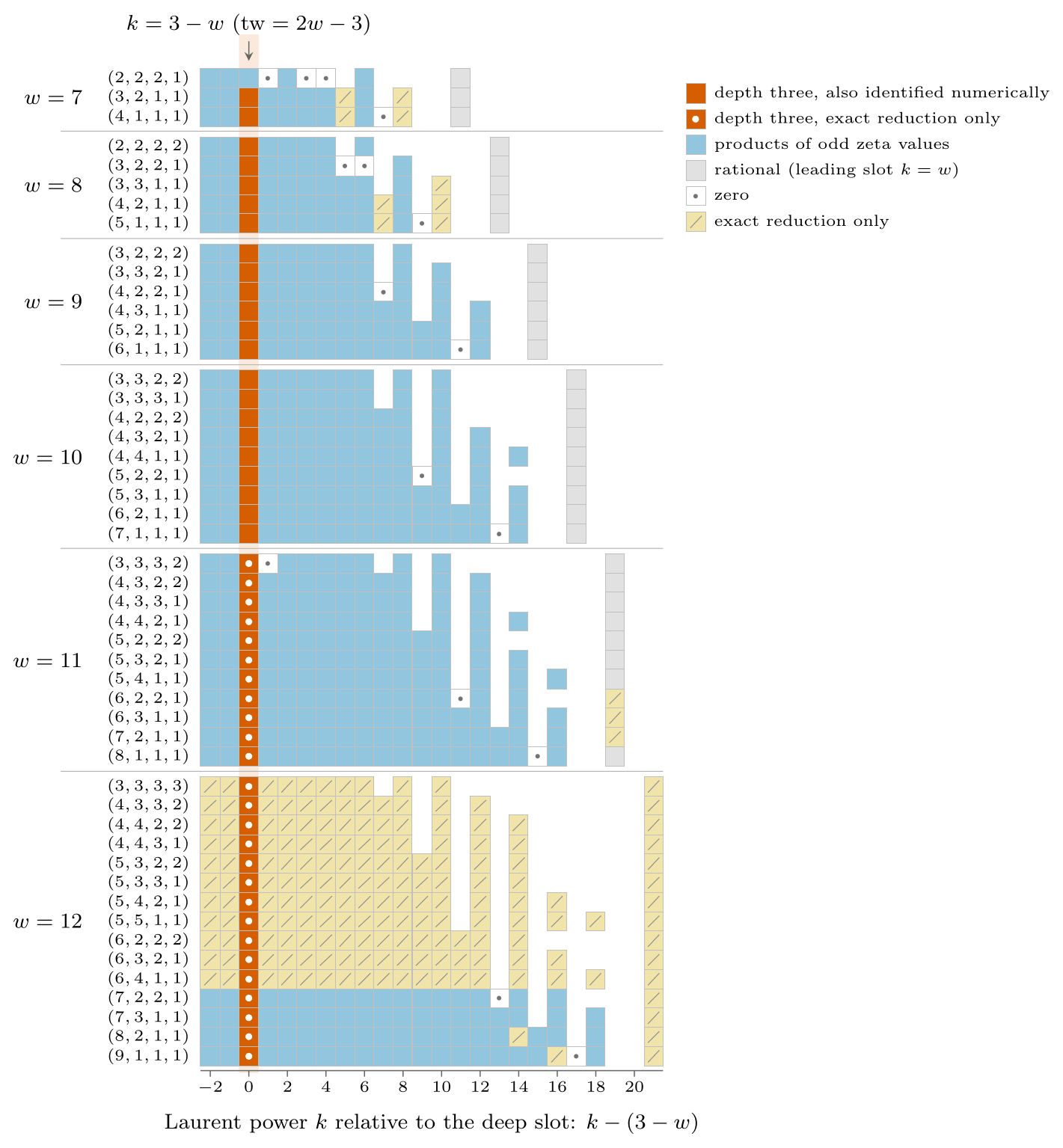
All $740$ Laurent coefficients of the forty-nine four-edge functions, one row per function and one cell per power of $y$, with the rows slid sideways so that each function's deep coefficient $c_{3-w}$ falls in the marked column. Orange cells contain depth-three constants, blue cells are polynomials in odd zeta values, gray cells are the rational leading terms and dotted cells are zero; a white dot on orange, and yellow in place of blue or gray, mark coefficients obtained by the exact reduction alone and not also identified numerically. Every depth-three constant in the family sits in the single marked column, and only $C_{2,2,2,1}$ has none. (Figure 1 of the paper.)
Confinement also propagates through the Laplace equations that modular graph functions satisfy on the space of torus shapes, with lower-weight functions as sources. The paper proves a transport theorem: unless the equation's eigenvalue equals $k(k-1)$ for some integer $k$ (the eigenvalue of a pure power $y^k$, the resonant case), the Laurent coefficients of the solution are fixed by those of the source. If the source's coefficients are built from a given stock of constants, so are the solution's. Resonance does occur: by the eigenvalue formula of Basu's Laplace system for the family, twelve of the forty-six exponent tuples at weights eight through twelve are resonant, among them the whole line $C_{k,1,1,1}$, whose eigenvalue is $k(k-1)$ identically and whose two resonant coefficients no Laplace system of its weight can fix. All forty-six functions are computed directly in any case; the classification only marks the coefficients a Laplace system might leave undetermined.
Testing the conjectures
The second law is saturation. At each weight, take the depth-three parts of all the deep coefficients and count how many are linearly independent over the rationals. The answer is $1,2,2,4,5,6$ at transcendental weights $11$ through $21$: the Broadhurst–Kreimer dimensions, six weights in a row.
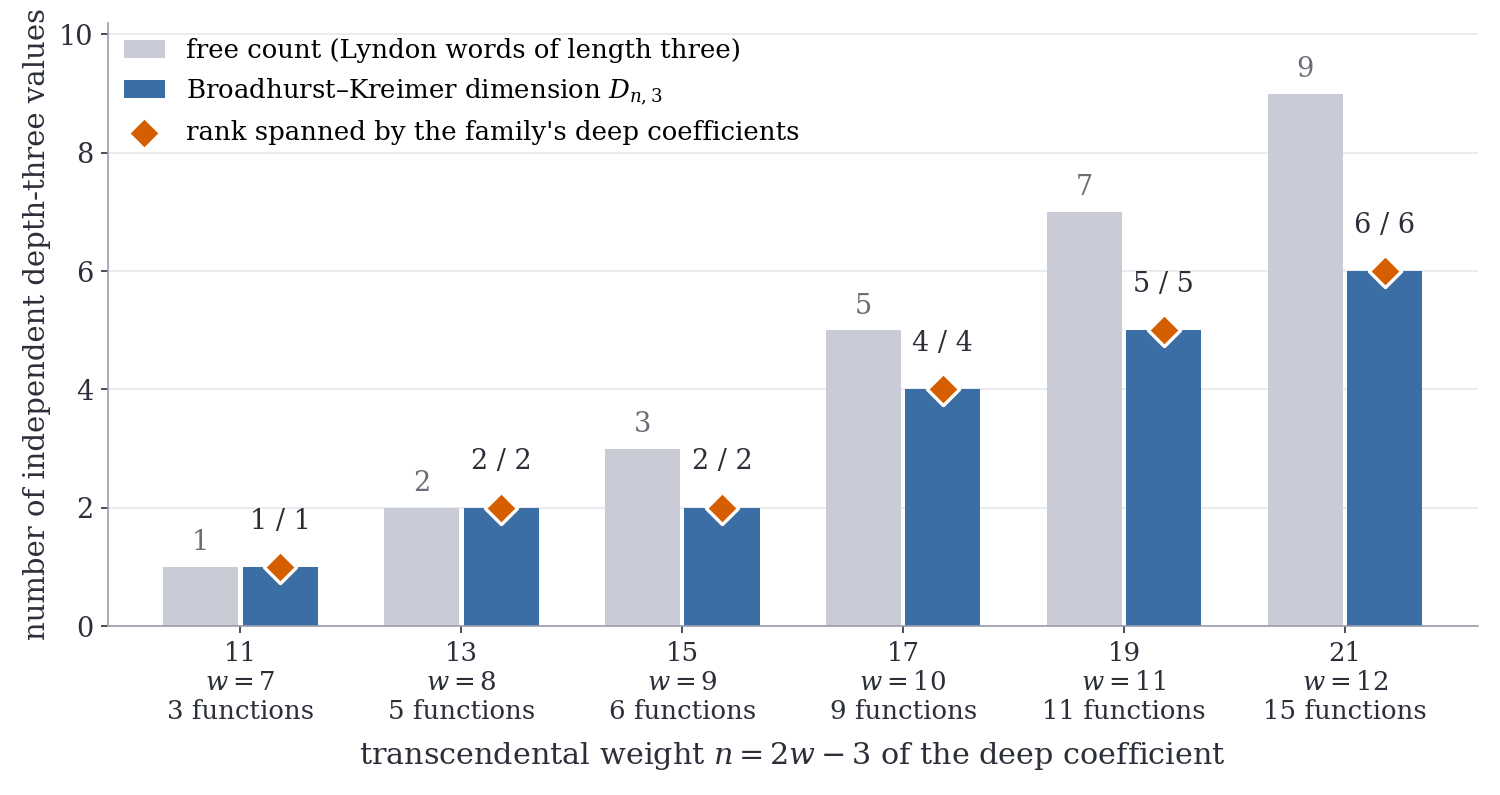
Independent depth-three constants at each odd weight from $11$ to $21$: the free count of possible new values (gray), the Broadhurst–Kreimer prediction after cusp forms remove directions (blue), and the number spanned by the four-edge family's deep coefficients (diamonds), with the number of functions of each weight under the axis. The family reaches the Broadhurst–Kreimer dimension at every weight. (Drawn for this page from Eqs. (14) and (46) of the paper.)
As the author stresses, the Broadhurst–Kreimer dimensions are conjectural and bound the ranks from above in advance, so equality tests the family against the conjecture without proving it. The equality is not independent evidence for the conjecture either: the known relations among depth-three multiple zeta values already leave only $1,2,2,4,5,6$ candidates at these weights, so full rank is the most the family could show. The computation shows that the string's coefficients reach that bound at all six weights, with no unexpected rational relation among them.
The third law is closure under the cosmic Galois group. Applying the $D_m$ requires every depth-three single-valued value $\zeta_{\mathrm{sv}}(a,b,c)$ with odd indices at weights $11$ through $21$ written out in ordinary multiple zeta values, $83$ in all. Brown had given three and Dorigoni et al. reductions through weight seventeen; the paper tabulates all $83$, sixty-one extracted from $700$-digit numerical values and twenty-two derived algebraically from Brown's single-valued map. For weights nineteen and twenty-one it reports finding no explicit expressions in the literature. The twenty-seven formulas extracted numerically there lack the inversion test available at lower weight, but the algebraic construction from Brown's single-valued map, which takes no numerical input, reproduces all sixty-one extracted formulas rational by rational, those twenty-seven included.
The $83$ values have $627$ images under the various $D_m$. Since $D_m$ removes one index, each image has depth at most two and must be a rational combination of products of two odd zeta values: for example $D_3\,\zeta_{\mathrm{sv}}(3,3,5)=-10\,\zeta_3\zeta_5$ and $D_5\,\zeta_{\mathrm{sv}}(3,3,5)=-10\,\zeta_3^2$. Computed exactly (relative to a fixed choice of basis for the irreducible generators, as noted in the paper), all $627$ have this form and are free of $\pi^2$; the author uses this as a check of the formulas. The family-specific statement is stronger: the family's own even-weight coefficients span every product of two odd zeta values that can occur, so each of the $382$ nonzero images is a rational combination of the family's lower-weight coefficients alone. A system closed under the derivations would behave this way; the author adds the caveat that a span computation on a finite family establishes membership, not structure.
The single-valued formulas also give a direct test of Zerbini's conjecture where, for this family, it is a live question. The twenty-six deep coefficients at $w=11$ and $12$, of transcendental weights nineteen and twenty-one, lie past the range $w\le 10$ in which the constructions of Dorigoni et al. account for single-valuedness (under the assumption noted above); the same authors' zeta-generator framework predicts single-valued coefficients there too, but conditionally. The paper checks the twenty-six directly, using its own weight-nineteen and weight-twenty-one formulas, extracted numerically and each recovered algebraically as well, and finds every one single-valued, eleven at weight nineteen and fifteen at weight twenty-one, each by an exact rational decomposition obtained by Gaussian elimination. In this family Zerbini's conjecture holds at every coefficient examined, including the first ones whose single-valuedness no computation in print establishes.
The couplings and the open questions
The physical couplings come from integrating over all torus shapes, and at order $\alpha'^8$, where the weight-eight functions such as $C_{2,2,2,2}$ enter, bookkeeping alone determines which Laurent coefficients reach the cutoff-dependent part of that integral. With the domain of torus shapes cut off at height $L$, the integration formula keeps the coefficient of $y^1$ as the coefficient of $\ln L$; the growing powers of $L$ cancel against the region beyond the cutoff and the negative powers vanish, leaving a finite constant $I_C$ that depends on the whole function. The weight-thirteen depth-three constants occur only in the coefficient of $y^{-5}$, so $\zeta_{\mathrm{sv}}(5,3,5)$ drops out of the divergent and logarithmic parts of the coupling. This counting of powers does not decide whether $\zeta_{\mathrm{sv}}(5,3,5)$ survives in the finite constant: on a strip of the domain the $y^{-5}$ term alone integrates to a finite piece, one sixth of its coefficient, which could cancel only against the rest of the integral. Two constants in Claasen and Doroudiani's representation of these couplings, fixed there under a transcendentality assumption, are reproduced in exact arithmetic from published inputs, hence consistent modulo that assumption. Uniform transcendentality at this order, the expectation that every term of a coupling carries the same total weight in $\pi$ and zeta values, then requires one stated cancellation: the thirty-nine strata whose integrals are not yet known in closed form must together cancel two $\ln(2\pi)$ coefficients, each a rational multiple of $\pi\zeta_7$. The condition is necessary but not shown to be sufficient, so the author does not decide whether the couplings are uniformly transcendental and states the condition as a falsifiable target rather than a verdict. Three published formulas are corrected along the way, all transcription-level defects: the overall sign of one integration formula at even weight, a term one Green function short in a published integrand, which the paper excludes from its strata count, and a swapped label in a worked example.
Several questions remain open. The depth-three directions that appear in an individual function follow patterns that are only partly explained. That $C_{2,2,2,1}$ contains no irreducible while its two weight-seven siblings do follows from the D'Hoker–Kaidi identity mentioned above, whose companion identity also forces the depth-three parts of $C_{4,1,1,1}$ and $C_{3,2,1,1}$ into the ratio $3:-1$. At transcendental weight fifteen, however, three of the six weight-nine functions lie on one rational line, and neither the coaction structures in the literature nor any principle tested in the paper explains it. The author asks whether these selection rules have a worldsheet origin. In twenty-nine five-edge functions through weight eleven, depth three is no longer confined to one coefficient, while the single coefficient that could hold depth four never does. And Zerbini's conjecture, the Broadhurst–Kreimer count and the cosmic Galois principle remain conjectures, with the family consistent with all three at every point checked. Two sibling pages on this site cover more string theory: the Grassmannian string integral, whose low-energy constants are again multiple zeta values, and the question of whether the theory's flux vacua exist.
The paper
- Irreducible multiple zeta values of depth three in four-edge modular graph functions (PDF) — Matthew D. Schwartz; the version on this site is marked preliminary. The main text derives the forty-nine Laurent polynomials, states the three laws and treats the couplings at order $\alpha'^8$; the appendices contain the proofs, the numerical checks against published values, the five-edge scan and the derivation of the $83$ single-valued formulas, which are printed in part there and in full in the ancillary files.
Supplementary material
Files hosted on this site. The first eleven are the paper’s ancillary files, whose README states the conventions (the ascending convention for multiple zeta values, $y=\pi\operatorname{Im}\tau$, even zeta values as powers of $\zeta_2$); the last two hold the runnable core of the weight-eight example $C_{2,2,2,2}$.
- README.md — the README of the ancillary files: what each file contains, the conventions, the checksums, and how the files were generated and checked against the paper’s exact data.
- laurent_C4_w7-12.txt — all forty-nine Laurent polynomials $C_{a,b,c,d}$ of the four-edge family at weights seven through twelve: $740$ coefficients, each an exact rational combination of multiple zeta values, one line per nonzero coefficient ($724$; the $16$ that cancel exactly are omitted), in a plain-text syntax readable by any computer-algebra system.
- laurent_C4_w7-12.json — the same $740$ coefficients as JSON, one entry per nonzero coefficient.
- laurent_C4_w7-12.tex — the same data typeset as LaTeX: forty-five numbered displays, one for each function not printed in the main text (Appendix E of the paper prints five of them).
- zsv_depth3_w11-21.txt — the $83$ formulas for the single-valued depth-three values $\zeta_{\mathrm{sv}}(a,b,c)$, with $a,b,c$ odd, at weights eleven through twenty-one, each written in ordinary multiple zeta values and labeled extracted ($61$) or derived ($22$) as in the paper.
- zsv_depth3_w11-21.json — the same $83$ formulas as JSON.
- zsv_depth3_w11-21.tex — the same formulas typeset in LaTeX, grouped by weight.
- supplement.tex — wraps the two LaTeX files into one stand-alone document (
pdflatex supplement.tex). - sv_certificates_w19-21.txt — the twenty-six single-valuedness certificates at transcendental weights nineteen and twenty-one: for each deep coefficient of the weight-eleven and weight-twelve functions, its exact decomposition into rational multiples of $\zeta_{\mathrm{sv}}$ values plus odd-zeta monomials, together with the basis data needed to check it by substitution (the $49$ weight-nineteen and weight-twenty-one $\zeta_{\mathrm{sv}}$ values in the reduced basis, $42$ double-shuffle reductions, and the $f$-alphabet images of the $32$ basis generators).
- sv_certificates_w19-21.json — the same certificates and basis data as JSON, the form the check script reads.
- check_svcert_anc.py — Python script that verifies all twenty-six certificates and all $49$ values by substitution, in exact rational arithmetic, from the three JSON files alone (
python3 check_svcert_anc.py). - mgf-expression.md — the machine-readable closed form of the weight-eight example $C_{2,2,2,2}$, all nine coefficients with Brown’s formula for $\zeta_{\mathrm{sv}}(5,3,5)$.
- mgf-evaluate.py — a standalone Python script (mpmath only) that recomputes every coefficient of $C_{2,2,2,2}$ from its closed form at any requested precision, computing $\zeta_{\mathrm{sv}}(5,3,5)$ at run time, and compares the results with stored 280-digit reference values on every run.
References
| E. D’Hoker, M.B. Green, Ö. Gürdoğan and P. Vanhove, Modular Graph Functions, Commun. Num. Theor. Phys. 11 (2017) 165 | defined and named modular graph functions in the one-loop four-graviton amplitude |
| F. Zerbini, Single-valued multiple zeta values in genus 1 superstring amplitudes, Commun. Num. Theor. Phys. 10 (2016) 703 | Laurent polynomials of the $C_{2,1,\dots,1}$ functions; the conjecture that every coefficient is single-valued |
| E. D’Hoker and M.B. Green, Absence of irreducible multiple zeta-values in melon modular graph functions, Commun. Num. Theor. Phys. 14 (2020) 315 | proof that the melon functions contain only odd zeta values |
| E. D’Hoker and W. Duke, Fourier series of modular graph functions, J. Number Theory 192 (2018) 1 | the Laurent polynomial of every three-edge function in closed form |
| J.E. Gerken, Basis Decompositions and a Mathematica Package for Modular Graph Forms, J. Phys. A 54 (2021) 195401 | tables of the two- and three-vertex functions through weight six |
| E. D’Hoker and J. Kaidi, Hierarchy of Modular Graph Identities, JHEP 11 (2016) 051 | the weight-seven identities against which $C_{2,2,2,1}$, $C_{3,2,1,1}$ and $C_{4,1,1,1}$ are checked |
| A. Basu, Eigenvalue equation for the modular graph $C_{a,b,c,d}$, JHEP 07 (2019) 126 | the Laplace system for the four-edge family, whose eigenvalues decide resonance |
| F. Brown, Single-valued motivic periods and multiple zeta values, Forum Math. Sigma 2 (2014) e25 | defined single-valued multiple zeta values; the explicit formula for $\zeta_{\mathrm{sv}}(5,3,5)$ |
| P. Cartier, Fonctions polylogarithmes, nombres polyzêtas et groupes pro-unipotents, Astérisque 282 (2002) 137 | introduced the cosmic Galois group acting on multiple zeta values |
| F. Brown, Feynman amplitudes, coaction principle, and cosmic Galois group, Commun. Num. Theor. Phys. 11 (2017) 453 | the proposal that a theory’s constants are closed under the derivations $D_m$ |
| E. Panzer and O. Schnetz, The Galois coaction on $\phi^4$ periods, Commun. Num. Theor. Phys. 11 (2017) 657 | the same closure observed in $\phi^4$ quantum field theory |
| D.J. Broadhurst and D. Kreimer, Association of multiple zeta values with positive knots via Feynman diagrams up to 9 loops, Phys. Lett. B 393 (1997) 403 | the conjectured count of new multiple zeta values by weight and depth |
| D. Dorigoni, M. Doroudiani, J. Drewitt, M. Hidding, A. Kleinschmidt, O. Schlotterer, L. Schneps and B. Verbeek, Non-holomorphic modular forms from zeta generators, JHEP 10 (2024) 053 | single-valued coefficients by another route through $w=10$; depth-three reductions through weight seventeen |
| E. Claasen and M. Doroudiani, From modular graph forms to iterated integrals, JHEP 06 (2025) 204 | the order-$\alpha'^8$ couplings with two constants fixed under a transcendentality assumption |